Tag Archives: phd

#RavynnReads: “Eloquent Rage” by Brittney Cooper

This week and I got off on the wrong foot. Weird things were happening with my mood, I couldn’t sit still and I was feeling generally out of sorts. So, I decided do what I always do when I’m feeling in a funk: I get books.

I drove up to the north part of my city to the public library that I prefer– brand new, new books, and a general sparkle that always inflates my mood. I didn’t have any books in mind– I thought I’d just go have a look around and see if anything caught my eye. When nothing did, I took to the computers to see if they had any of the books that I needed for comps. After spending about five minutes in the search engine, I began to notice a trend. Every time I would search a book that I wanted (The New Jim Crow, Audre Lorde’s Collected Poems, Nnedi Okorafor’s Binti, Eloquent Rage, etc.), my heart would leap with excitement upon noting that the library had the book, and do a mild decrescendo upon realizing the availability was at the library downtown.

As I left the library fuming about the inconvenience of having to drive all the way across town to the other library, it struck me that all the books that I wanted were Black books and they were all housed in the library smack in the middle of the Black neighborhood. Quelle surprise. As if Black books were not able to take up space in a predominantly white space. As if all a Black populace would be interested in is Black books. As if white populations would not be interested in Black books. (Granted there were thousands of books in both libraries, but I’m still frustrated that the majority of the Black books were in the “Black” library.)

Shocked at my own naiveté, I decided half way home that driving the 25 minutes across town was worth it if it meant getting Brittney Cooper’s Eloquent Rage. This library was dimly lit and generally of a poorer disposition than the library in the white part of town, but within minutes, my arms were full of my beloved Black books, including a Okorafor book, The Book of Phoenix, Ibram Kendi’s Stamped from the Beginning, Zadie Smith’s Feel Free and of course, as the title of this piece implies, Eloquent Rage: A Black Feminist Discovers Her Superpower by Brittney Cooper.

After simmering down from the injustice of realizing my books had been segregated, I settled into the couch to read the opening chapter of Eloquent Rage. Within moments, I found myself chuckling at Cooper’s candor, snapping my fingers in agreement with many of her sentiments, and riveted by her analysis which seamlessly wove together theory and personal anecdotes which produced scholarship which would be palatable to a broad range of audiences.

Damn, I thought, drowning in my own admiration, I want to write like her when I grow up.

In Eloquent Rage, Audre Lorde shares the stage with Beyoncé, who shares with Patricia Hill Collins, who shares with Michelle Obama. Black women have been theorizing about anger forever, both in academic and non-academic spaces. Cooper breaks down and analyzes Beyoncé’s “Formation” video with the same care that she defines ‘feminism’ and ‘intersectionality.’ For that, I am eternally grateful because I have seen what the type of public facing scholarship I want to write looks like in Cooper’s work.

In addition to discussing Black women’s rage, which as Audre Lorde notes is both full of information and energy, and an appropriate response to racism (Sister Outsider), Cooper discusses understanding her own feminist identity in conjunction with other identities that don’t always inherently mesh well together. I am thinking specifically of when she discusses being a Christian feminist and also being a heterosexual Black feminist. Cooper’s right that feminism has yet to really take into that God plays a big part in a lot of Black feminists’ lives, but I think she’s also right to point to the fact that Black churches still tend to be sites of Black patriarchy run amok. How do we reconcile those two spaces? How do we become good God-fearing Christians while also wanting to smash the patriarchy?

Another topic which I think Cooper nails in “Love in a Hopeless Place,” is difficulty heterosexual Black feminists face while in pursuit of relationships, a place I only know too well. I am either too intimidating, too angry, too sassy, too opinionated, too bossy, or too independent– words that essentially equate to “You cannot be forced into submission by me. I find that threatening.” Cooper’s analysis is rife with statistics and a much more eloquent analysis than what you will find here. She turns a conversation about a difficulty find mates into a debriefing on the Moynihan Report, which essentially calls the Black family a “tangle of pathology” and that our maternal led households are a part of the problem. Much of the Moynihan Report is based on the assumption that “legitimate” families are constituted of (1) father, (1) mother and (2.5) children. (Maybe not the 2.5 kids part but the “nuclear family unit” piece is there.)

Using Beyoncé as a jumping off point for discussing feminism, Cooper states that feminism’s tagline should be, as her idol says, “I love being a woman and being a friend to other women.” (28) If that’s not your MO, then you’re not a feminist, Cooper decides. That goes for nonsense about not having Black female friends because “they’re too much drama” or you “get along better with men.” Cooper explicitly says:

Friendships with Black girls have always saved my life. I give the side eye to any Black woman who doesn’t have other Black women friends, to any woman who is prone to talk about how she relates better to men than to women, to anyone who goes on and on about how she “doesn’t trust females.” If you say fuck the patriarchy but you don’t ride for other women, then it might be more true that the patriarchy has fucked you, seducing you with the belief that men care more about your well-being than women do.

It isn’t true.

(p. 13-14)

I can say with absolute certainty that Black women friendships have given me the most out of life, from my intellectual soul sisterhood with Micah, to my coffeeshop buddy Kels, to my homie Alexis and my cousin Leah, I would not be the woman I am today without each one of them. They lift as they climb, they’re there for me, they understand me and most of all they listen with care when I come home from class after three hours of having to listen to racist, homophobic vitriol.

Brittney Cooper’s book, which touches on everything which matters to Black women, from dating to hair, as touched my life in important ways, namely by making me feel seen. Thanks to Cooper, I, as a big black girl nerd from the South, that had trouble making Black girl friends growing up and trouble dating, who grew up in a devout faith, but is, without a shadow of a doubt, a feminist, feel like part of my story has been told. A story that has only partially been exposed. From her complicated relationships with white women, to her mixed feeling about Hillary Clinton and Tevin Campbell obsession, Cooper and I might be of different generations, but her story is mine and I loved reading every second of it.

11/10 would recommend and am currently trying to figure out if I can add this to my Comps list.

But, seriously, don’t take my word for it, check it out for yourself.


Comps Reading: Sister Outsider by Audre Lorde

Sister Outsider has been on my reading list for years. Ever since I read “The Master’s Tools Will Never Dismantle the Master’s House” for the first time years ago, Audre Lorde has been high on my list of favorite theorists– though it is mentioned in the book that she did not view herself as a theorist, but rather a poet. (Introduction, p. 8) I even have a pair of Audre Lorde tattoos on my wrist which read, “I am deliberate and afraid of nothing.” (“New Year’s Day”)

Poetry reveals itself through out this text as Audre Lorde uses prose to do what she claimed poetry did for her: help put words to an unnamed feeling, unmask that which has been hidden away, and build community between those who have difficulty hearing each other. She sprinkles actual lines of poetry amid her prose, because as she tells Adrienne Rich in an interview, “somewhere in that poem would be the feeling, the vital piece of information….The poem was my response.” (p. 82) The lines slip in when she gets close to a feeling that it seems she might not otherwise be able to identify. It’s moving.

Reading Sister Outsider had me feeling like Lorde, in that her sentences provided vital pieces of information, providing a response for feelings that were previously unnamed. I think this is interesting, this need to name feeling that she has. This is one part of the difference between pain and suffering that she notes in “Eye to Eye: Black Women, Hatred, and Anger”: pain becomes suffering when the feeling is “incomplete” and unnamed. (p. 172) I find her discussion of the difference between pain and suffering intriguing, but I do not know if I am convinced. She writes that pain is an event and it must be named, but suffering is something that one can “condemn” oneself to, a relieving of unnamed pain over and over again. I suppose the part which I take issue is the condemnation because it implies that suffering is a choice. What I think Lorde may mean there however, is where pain can be named and acknowledged, it should be, because it is one way to avoid suffering.

In a similar vein, Lorde describes the difference between hatred and anger in “Eye to Eye,” stating that anger is a “passion of displeasure” and hatred is an “emotional habit or attitude…which is coupled with ill will.” (p. 152) Lorde writes that anger does not destroy; hatred does. She writes that anger can be a powerful fuel and in “The Uses of Anger,” a piece which compliments “Eye to Eye” nicely, in my humble opinion, she writes that “anger is loaded with information and energy.” (p. 127) Again, I believe her discussion of both anger and hatred are novel and convincing, but not perfect. I am not sure that I believe that anger cannot destroy, but I suppose when it has morphed into hatred, the point is mute. But that raises a question: she argues that hatred becomes the source of anger, but is it not the other way around? Wouldn’t anger about a situation lead to hatred?

But her main point of these particular essays, or at least what I am taking away from them, is that Black women have internalized self-hatred and thus are angry at each other in a self-destructive way. While Lorde struggles to unpack the inexplicable animosity between Black women, I struggle to unpack that she believes that animosity is there at all. She struggles with this animosity because she cites women as the main source of her restorative energy and thus finds it concerning; as someone whose main support system is a pack of Black women, I really want to know what kind of relationships has she had which have exposed such powerful hatred that she felt compelled to write two separate essays about it. It makes me want to write about Black female friendship and relationships because there is no power greater than the feeling of being supported by Black women.

On an unrelated note, I found it interesting that Lorde bookended her text with essays about other countries. The first are notes from her trip to Russia, in which she basked in the glory of the country like an other tourist, while also being sensitive to racial difference in order to provide a comparison between Russia and the United States. It seems every Black intellectual that I admire has some notes on “Another Country” (for a little Baldwin joke), in which being abroad makes even more stark the state of American racism. The last is “Grenada Revisited: An Interim Report,” which was mostly interesting to see Grenada through the eyes of an outsider-insider: Lorde herself is Grenadian but she views the country with the sensibilities of an American, having lived there all of her life. (Brief and related side note: no where in her text is “American/America” capitalized. Because it is consistent, I am sure there is a reason for such a choice, but I do not know what it is. If someone knows, please leave me a note in the comments.)

Lorde has so many different identities, which she weaves seamlessly into the text to create a complex interwoven web, and I’ve chosen to simply follow a few of the strands. Among those that I have missed in my brief discussion of her work are her identities as a feminist, as a lesbian, as a Cancer survivor, as a Grenadian-American, and particularly as a poet. What she says about these things which make her different is that we must not merely tolerate difference. It must go deeper than that. We must not merely say “Black is beautiful.” It must go deeper. The question which springs immediately to my mind is: How? Lorde is invested in the means of offering solutions: a solution is what she is offering when she says “the Master’s Tools Will Never Dismantle the Master’s House.” A solution is what she is offering when she says that we need to practice being as kind to ourselves as we are to our neighbors, for only that will off-set the hatred which we have internalized. We must raise our children to feel for themselves and not do the feeling for them. I think her essay “Man Child: A Black Lesbian Feminist’s Response” which discusses raising a boy as a lesbian feminist, tackles that issue justly.

The last thing I want to think about is the relationships between Black women, white women, and Women of Color, which can sometimes include Black women, but the way that Lorde uses it, (when quoting white women) is a way of including the issues of Black women, but softened by the perspectives of other non-white women. I do not believe this is a view that Lorde holds herself, but rather the way that white women use the term “Women of Color.” (See her discussion of This Bridge Called My Back in “Eye to Eye.”) Some of these tensions become most prevalent in Lorde’s interview with Adrienne Rich, who sometimes seems impatient with Lorde’s view of intuiting and feeling as a way of understanding and knowledge making. When she says the white man says, “I think therefore I am” and the Black woman says, “I feel, therefore I can be free,” Rich points out that people have found this sentiment anti-feminist, drawing on preconceived notions of femininity. I don’t agree: I think there is something very feminist in reclaiming emotion for women, which is so much of what Lorde’s work is. She is reclaiming anger, helping to reshape hatred, teaching us that guilt is ineffective. But I guess my question is, if rationality is to the white man as emotion is to the black woman (which is a problematic dichotomy in of itself) where does that leave Black men and white women? It seems as though white women get clumped into the rationality of white men. But what of Black men? Just something else to think about while I’m driving through town tomorrow.

There are so many things to think about when discussing Audre Lorde’s Sister Outsider, and I do not believe I can do it justice in a short blog post, but I did want to take the time to write down a few of my many thoughts because for one, I had a lot of them while I was reading, and two, it is probably a good practice to review my books as such as I read them. I probably won’t have time to do such an in depth review of every one of my books, but I probably will do this for the important ones, my favorite ones, and the ones which have given me the most to think about.

So to leave you today, I want to offer you some of my favorite quotes from Sister Outsider, on the off chance you don’t plan on reading it yourself. (Which you most definitely should.)

Favorite Quotes and Ideas:

“Poetry is the way we help give name to the nameless so it can be thought.” (p. 37)

“The Black mother within each of us– the poet– whispers in our dreams: I feel, therefore I can be free.” (p. 38)

“I am not only a casualty, I am also a warrior.” (p. 41)

“Black feminism is not white feminism in blackface.” (p. 60)

“One oppression does not justify another.” (p. 63)

“Every line I write shrieks there are no easy solutions.” (p. 78)

“Documentation does not help one perceive.” (p. 104)

“The mythical norm.” (p. 116)

“Change means growth, and growth can be painful.” (p. 123)

“There is no such thing as a single-issue struggle because we do not live single-issue lives.” (p. 138)

The Finale of Part 1: Graduation

For those of you who have been following along, you know that I am a PhD student at William & Mary. You might also know that I have recently graduated from William & Mary. For clarification, I was accepted into a MA/PhD program in American Studies, and last September I successfully defended my Masters thesis, thus officially moving me into the PhD portion of my program. Because it’s a rolling program, I defended and kept moving forward in my PhD work, moving through coursework and preparing my comprehensive exams lists– I was so busy that I barely got a chance to truly celebrate getting my Masters.

Until this past weekend.

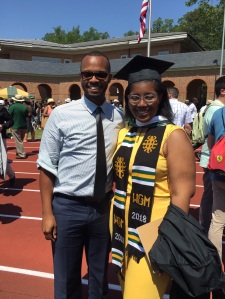
IMG_0052
My Uncle Edwin and I

I participated in Commencement here at William & Mary and it was a truly magnificent occasion. My uncles drove up from Jacksonville for the graduation and spent the entire weekend with me and my family. My uncles, my parents, my grandma, my great-aunt and my aunt all celebrated me by coming to my ceremonies and going out to celebratory dinners and lunches with me for three days straight.

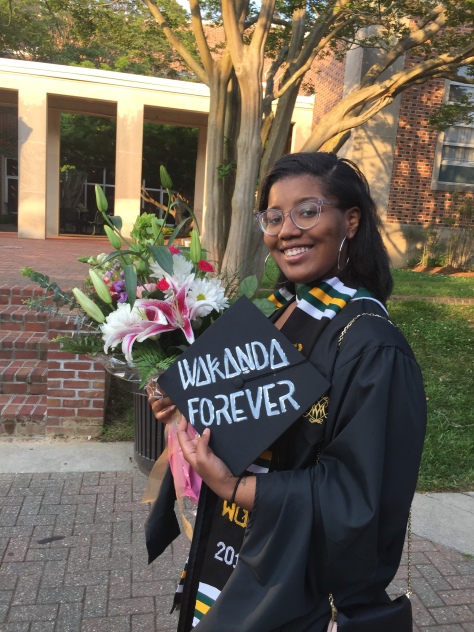
The festivity of the three day Commencement weekend was Donning of the Kente. This tradition was primarily meant for African American graduating students and a chance for the Black community to celebrate its graduates together, though our ceremony is open to anyone who wants to participate. Because it was a Lemon Project event, I spent most of my time before hand checking people in and handing out stoles. However, when it was time for the ceremony to begin, I was able to participate with everyone else. It was fantastic. When it was my turn, I went on stage to applause and my parents donned me with a kente stole. We took a picture and then we returned to our seats and watched as the rest of the students were donned. Though you are only allowed up to two people to don you, some students appeared on stage with their entire families. Grandmothers cried, children of the graduates cheered, many thanked God as they left the stage and others took selfies as they marched across.

IMG_4969
Me after Donning of the Kente

Afterwards, we had a big family dinner at Ruby Tuesdays and then everyone their separate ways for the big ceremony the next day.

Everyone congregated at my apartment around 7 AM Saturday morning in preparation for the outdoors ceremony to be held in Zable Stadium. Thanks to the ceremony being held on the football field, I was able to invite 7 guests instead of 4. However, let me stress that the ceremony was outdoors– in 90 degree weather. While it was a beautiful day (comparatively, my UVA ceremony was held outdoors in light rain) it was still sweltering underneath the mandatory ceremonial garb we had all donned for the occasion.

I marched in with the other Masters and JD students to the William & Mary hymn. Two surprises awaited me as I went to take my seat– first, I was able to spot my family amid the massive crowd. They had managed to find incredible seats near the front. Their seats were perpendicular to my own, which was incredibly, in the front, near the middle and directly in front of the stage, next to two other American Studies masters students. As the rest of the graduating class filed in, I waved at my family wildly, amazed that we could see each other and spent the rest of my time taking in the massive book-like program that had been made in honor of the occasion.

The ceremony was about two hours long and very traditional– the President of the University gave remarks, awards were given out, and senator Mark Warner gave the keynote address, advising students to stay involved in our democracy, not be afraid of failure and to, most of all, call your mother. There were however a few highlights: the President gave honorary doctorates of letters to the first three residential African American students at William & Mary, Lynn Briley, Janet Brown Strafer, and Karen Ely. An honorary doctorate was also given to Katherine Johnson, one of the first computers for NASA (you know, the one Taraji played in Hidden Figures? Yup, her.)

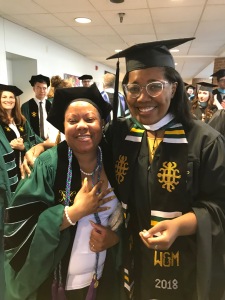
IMG_0318
Me with my 9th grade IB Coordinator Micah Smith

And after all of that was over, degrees were conferred. The most amazing part was watching people that I knew walk across the stage and receive their doctorates. I actually knew a lot of people graduating: James, who has been like an older brother to me in this program, walked across the stage; my dear friend, Sarah, who worked with my on the Lemon Project; Renee, Nabeel, and Janine, all American Studies graduate students; my friend Patrick from Anthropology; Beth from History; and incredibly, the woman who worked with my 9th grade class of International Baccalaureate students as our Coordinator. She was so beloved that we fought to keep her, only to eventually lose her to a more stable position in Newport News. Though she left, she kept up with my class, meeting up with us for dinner upon occasion and sending love and well wishes whenever she could. Running into her on her graduation day nearly sent me into a bout of tears.

Finally, we were dismissed from the heat and I was able to reunite with my family for pictures. We eventually made it back to my apartment for quick naps before heading out for a late lunch at Red Lobster.

My parents came up one last time on Sunday, which also happened to be Mother’s Day, for my American Studies Departmental ceremony. It was short, sweet and to the point, the highlight of which was receiving flowers from my friend, Kelsey. We ended the day by heading to Wakefield, where my parents grew up, for a barbecue at my grandmother’s and to spend some time with my great Aunt.

I woke up this morning, groggy and still a little tired from all the excitement, only to find one last surprise. I checked my grades and saw that all of them were in, and I had managed a 4.0 this semester. Yup, I got an A in my Comics class, my Histories of Race class and my Black Arts Movement Directed Research. I’m actually really proud of the work I did for all of these classes. For Comics, I wrote a tribute to Lois Lane adaptations in the last 10 years that I’m considering getting published. For my Black Arts Movement class, I wrote “Beneatha Younger’s Afro,” which attempted to modernize a classic character and discuss how she is politically relevant today. And for my Histories of Race class? I still can’t say what I did for that class because this might actually turn into a huge project for me– things are still unfolding, but just know this paper might be the first time you see Ravynn K. Stringfield’s name in print.

Now everything is over. My family has gone back to the regularly scheduled lives, I can stop holding my breath while I wait for grades to come in, and I can lay in bed watching Netflix all day for days at a time if I want to. Knowing myself, however, I know that will only last a few days before I’m back at the grind, working on comps lists and planning my research trip to the Schomburg Center. Side note, I applied for research money for the first time and received about a third of what I applied for, but if I stay with a friend, I should still be able to make the trip. (I will, of course, post about the trip when I make it, not to worry.) I also have a stack of books that I’ve been dying to dig into and art that I need to make, so I have some good, relaxing plans for the summer. I just hope that I can get it together and make it through one last semester of coursework. Then, onto my next adventure: Comps.

Stay tuned, guys, you won’t want to miss what’s next.