Category Archives: Uncategorized

Week 9, or the Lemon Symposium, March 16-17, 2018

I love conferences. In fact, conferences are probably my favorite part of being an academic. However, it’s not just going to conferences that I like– it’s being a part of the university hosting them. I love welcoming people to my university who are here for intellectual conversations. It’s about the ideas that fly in a space other than a classroom setting and new people that give life to them. You have to admit, it can be tiring to throw around the same ideas with the same set of people. Conferences breathe new life into age old dilemmas, and you never know what the outcome of new conversations will be.

The most special thing about the Lemon Project, for me, is it’s commitment to the community. Community partners have always been welcomed to participate in the conversations we’re having at the College. So not only do I get a fresh set of intellectuals to meet and bond with but elders from my community to learn from as well.
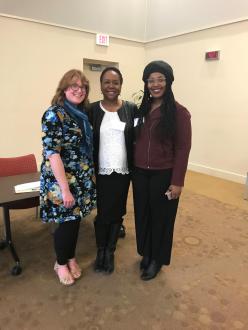
Lemon Project Team: Sarah Thomas (Lemon Fellow), Jody Allen (Director), Ravynn Stringfield (Graduate Assistant)

Between the live tweeting, taking pictures, running the mic, directing people, and checking people in, it’s a miracle that I managed to find time to be in the moment and listen. There were two roundtables in particular that really stuck with me from the event. The first was “Desegregating Higher Education: Placing William & Mary in Historical Context,” which featured an array of people with whom I was honored to share a room: Lynn Briley and Janet Brown Strafer (two of the Legacy 3, the first residential African American students at William and Mary); Lillian Ashcroft-Easton (the first African American to receive a PhD in the History department); Michael Engs (an African American graduate of the class of ‘69); Sam Sadler (for whom the Sadler Center is named); and Ron Sims (an early African American professor and administrator in the 1980s). It struck me as they talked so eloquently about their experiences at the College that these were the people who had made it possible for me exist in this space. Thankfully, as Valarie Gray-Holmes would say, they left gate open for students like me. (Gray-Holmes is writer and performer of the one woman show, “The New Gatekeepers,” which was performed during the Lemon Symposium.)

The second roundtable that I have been mulling over was “Building the Legacy: Where Do We Go From Here?” It featured Jessica O’Brien (graduate of the College); Karen Ely (the last of the Legacy 3); Chon Glover (our Chief Diversity Officer); Sharron Gatling (a staff member in the Diversity office); and senior undergraduate student Taylor Jasper. The questions asked were difficult to answer and sometimes, for Glover especially, difficult to answer without personal investment and emotion getting in the way. They were asked questions like “What has W&M done to heal the racial divide?” and “What specifically should our next steps be when we look at issues of race and reconciliation?” The answers were varied. In terms of what William & Mary has done, chief among the responses was the implementation of the Task Force of Race and Race Relations and the hiring of a Chief Diversity Officer. When thinking about what the next steps would be it seemed that everyone agreed that we have to move beyond the ceremonial and the low-hanging fruit, which is to say, we need to do the heavy lifting now. What exactly “the heavy lifting” will look like is unclear, but I think it’s safe to say it’s going to require more than renaming buildings and a year long celebration of the 50th anniversary of residential African Americans.

Artist Steve Prince discussing his work “A Bessie Stitch: 1948”

In addition to the fruitful conversations, I was particularly moved by all of the art that we had infused in this little symposium. We kicked off the weekend with an artist talk by Steve Prince, who spoke of African diasporic funeral traditions through art. The dirge, he argued, is the slow, sad, emotionally evocative first line, and what we need to get to is what’s called the “Second Line,” the music which celebrates life and helps us heal and move forward. He peppered his talk with images from his own beautiful work and helped the audience see his message within them. Then he held an artist workshop to create a collaborative work celebrating Mr. Lemon, for whom our project is named. (I unfortunately did not attend.) Finally, we ended the day with Gray-Holmes play, “The New Gatekeepers,” which I found as moving as the piece she performed in August 2017 at the mural unveiling in Swem Library which kicked off the 50th celebration. Gray-Holmes told the story of a woman from the Tidewater area in 1959 who witnessed the integration of William & Mary, whose grandson who had dreams of going to college, and how integration looked across the changing landscape of our country.
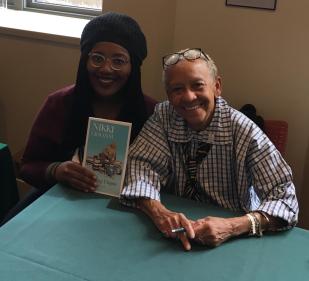
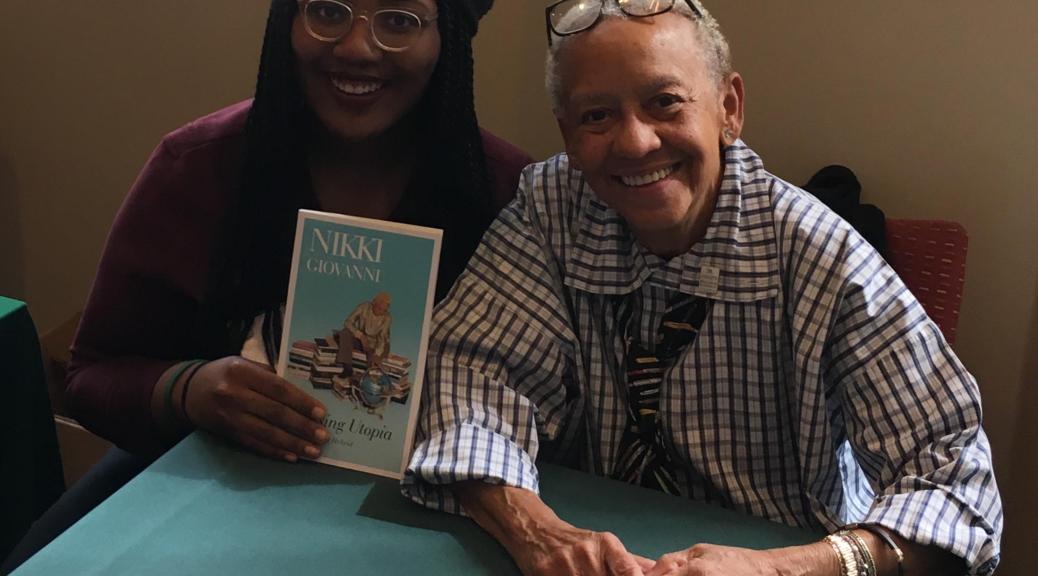
Ravynn Stringfield with Professor Nikki Giovanni

Of course, no discussion of this year’s Lemon Symposium would be complete without discussing the incredible keynote by Professor Nikki Giovanni. Nikki Giovanni came to prominence during the 1960s and 1970s as a Black Arts Movement poet, thrilling readers with earthy but vibrant, compassionate yet revolutionary poetry. Yesterday, Giovanni celebrated the Lemon Project with us, spoke of the process by which Africans came to be enslaved and were carried to America, describing it as a process which involved no longer recognizing clouds and thus knowing this land would be different. This was the first time I had ever heard enslavement described in this way– only Nikki Giovanni could get me to consider clouds as a system of meaning. She performed her legendary poem “Ego Tripping” at the request of Professor Jacquelyn McLendon, explained her theories about outer space and finding new life out there, and also thrilled us all by explaining that she believed “everything used to be somebody someone loved.” She is a tiny human full of these incredible ideas that she believes in so fully that I find myself convinced that there is life on other planets and that my precious laurel wreath ring used to be someone’s beloved aunt.

This year’s Symposium was amazing. The conversations were impactful, there was amazing audience participation, the art was inspired, and I got to meet some truly incredible people. To think, this isn’t even a complete summary of every single thing that happened, because I’d have to write a short book to do that. But I wanted to take some time to reflect on the dialogue that I had the fortune to be a part of these last two days because the questions we asked were important and the answers to those questions? Critical. I’m not sure what my role is going to be moving forward, but at least I’m beginning to think about my own answers to the questions that were raised.

Week 8, Ravynn’s Spring Break Reads

I needed Spring Break more than I even realized. What I thought would be an uneventful week turned into a deep dive into texts I’ve been dying to read for the last few months. Before I knew it, I had devoured four books, plus a graphic novel, the 6 episode Black Panther television show, and all of my usual CW shows.

I realized I needed to give my mind a break and consume things I wanted to read for me when I was developing my blog post for Week 7 (which you’ll notice does not exist). It was supposed to be a “mixtape” of all the best things I’d read for classes since the last time I did a mixtape, which was during Fall Break. I quickly realized that I was having trouble gathering up a list of the things I’d loved, but the list of things I wanted to read but hadn’t was nice and long. I scoured my apartment for unread books and made a quick trip to Barnes and Noble to amass a nice stack of things to read on my week off.

So, here’s a mixtape of what I read (and loved) this Spring Break:

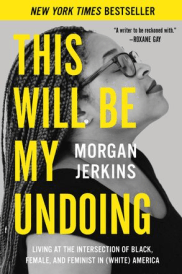
This Will Be My Undoing by Morgan Jerkins

How I found it: I follow Morgan Jerkins on Twitter because she’s an editor at a literary journal I’ve yet to work up the nerve to submit to. But I’ve been following her work and was excited to find out that she had a book coming out. I bought it impulsively at Barnes and Noble a few weeks ago but hadn’t had an opportunity to read until now as I’m on Spring Break.

2 second summary: Essays on being a Black girl/woman in white America.

What I loved about it: Jerkins’s essays really resonated with me, from topics as sacred as Black hair, Michelle Obama and why finding a man is so difficult. She’s raw and honest, brutal and yet touching. I cried twice from the sheer pain of seeing on the page what I’ve felt a million times but never dared to say. She’s a literary role model for me– I can only hope that one day I can decide to be equally as fearless and write my truth, too.

Rating: 12/10 would absolutely recommend


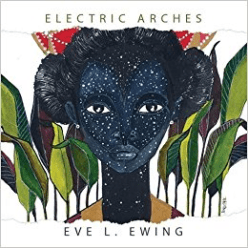
Electric Arches by Eve L. Ewing

How I found it: I actually rediscovered this after I bought it during a Haymarket Books sale last semester. I bought it because I also follow Eve L. Ewing on Twitter. In addition to being a dope poet, she’s also a scholar and I try to follow as many Black women doing the things I aspire to do as possible.

2 second summary: Poems (and accompanying visuals) set in 1990s Chicago that explore Black womanhood with an afrofuturist twist.

What I loved about it: In lieu of an exhaustive list of all the poems that I loved from this work, let me simply quote my favorite lines for you:

Love is like a comic book. It’s fragile

And the best we can do is protect it

In whatever clumsy ways we can…

“Origin Story”

Rating: 10/10 would absolutely recommend


Sing, Unburied, Sing by Jesmyn Ward

How I found it: I was perusing a call for book reviews when I noticed that this novel was tacked to the end of the list of books up for potential review. Always eager to pursue my literary side, I made a note to read it but never got around to it. Until now…

2 second summary: A young boy, Jojo, coming of age in Mississippi deals with manhood, his relationship with both the Black and white sides of his family, and a relationship with the spirit of a story unfinished.

What I loved about it: I have a grotesque fascination with death and I wonder about the departed, in particular my Grandma, whose presence I often feel. Death and spirits are complicated but fixtures of our lives which demand attention. I loved getting to spend some time thinking about the living’s relationship to the dead and why the unburied sometimes sing.

Rating: 9/10 would recommend


Homegoing by Yaa Gyasi

How I found it: My friend, Micah, put me on to it. Only the best of the best can impress her and so when she raved about just the first fifty pages, I knew I had to pick it up and see for myself.

2 second summary: An 8 generation story which follows the lives of two Ghanian women and their descendants, which lead to a beautiful story about the impact of both slavery and the diaspora.

What I loved about it: Yaa Gyasi is an extremely talented writer. She’s got some beautifully clean sentences in her novel, sentences that make me want to pick up a pen and try to see if I can replicate words with even half the impact. The story that stood out to me the most (SPOILERS) was Willie’s story about her husband who passed for white and then simply slipped out of the Black world. (Not without traumatizing her first, of course, though.) I’ve read a lot of passing stories that take place during the Nadir and then into the Harlem Renaissance, but this particular story hit me where it hurt.

Rating: 11/10 would absolutely recommend.


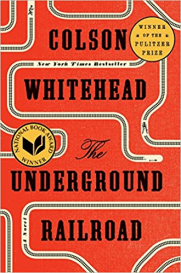
The Underground Railroad by Colson Whitehead

How I found it: I don’t remember the exact first time I heard about this book but I do remember all the hype surrounding it. It was so impactful that I suggested it for review for a potential publication I was working on at the time I found it.

2 second summary: Cora is a enslaved person who decides to escape via the Underground Railroad, which Whitehead has reimagined as a literal railway.

What I loved about it: As I was reading this, I thought back on many of the enslaved histories I’ve read over the last two years in grad school and picked up on many of the details from those histories in Whitehead’s story. Never before had those histories come to life for me more than when I read Whitehead’s novel. Maybe it’s a personal failing, but I simply don’t process informational nearly as well if it isn’t presented in a literary way– if it isn’t a good narrative. It was an extremely informative read, with a strong Black female protagonist (indomitable, is the word used in the novel to describe her.)

Rating: 10/10 would absolutely recommend


There you have it: everything I’ve read– and loved– over Spring Break 2018.

I still have some books on my list that I want to read (including Citizen, An American Marriage, and Invisible Man Got The Whole World Watching) but I’m so grateful for the break and the chance to read some of the novels that have been on my mind for the last few months. I hope this post inspires you to take a look at least one (or 5) new read(s)!

Week 6, or The Psychic Violence of Graduate School

I had one really rough class this week. At the break in my three hour seminar, one of my classmates approached me and asked me why I had been quieter than usual so far. I told her that I didn’t have much to say considering that one of the pieces we had read for the week involved a grotesque amount of explicitly described violence against enslaved people, particularly assault against enslaved women. Another African American student from the class described the experience of reading such things traumatic. I was angry because it taught me less about a history of racial formation than it did about a history of the horrific things white slaveholders could do to enslaved people.

I am an incredibly sensitive person, despite whatever impression one may have of me. I found myself unable to watch movies about slavery until I was in college because I would have a panic attack. Even then, I still haven’t seen 12 Years a Slave because I know how much violence is in it. It is a psychic assault in some ways to be forced to read about the traumas suffered by your ancestors as written by a man whose ancestors would have been enslavers.

So I did the one thing that I have a hard time doing: I spoke up.

I expressed my concerns about the gratuitous violence and fought back against the students that tried to assert that violence is an effective learning tool. I countered by saying, “The first time you think to yourself, ‘oh, Black lives do matter’ should not be when you see a dead body on the 5 o’clock news.” We shouldn’t need violence to prove that the institution of slavery was horrifying and we shouldn’t use violence as a tool because it becomes a spectacle. This is one of the main arguments of another text that we read for this week: Saidiya Hartman’s Scenes of Subjection. I appreciated the ways in which she acknowledged violence without letting it become the focal point of her work and therefore a spectacle.

Black pain has been a spectacle in this country for as long as Black and white people have coexisted in America. (To put ‘being forcibly removed from one’s own continent and forced to do hard labor’ gently.)

Because Black pain has moved into different arenas, including the classroom, we need new tactics to deal with it. For the purpose of thinking productively, I want to include a list of things that you can do, and that I have done, to protect yourself in moments of psychic violence in the classroom:

  • Take a break. When I find myself overwhelmed by a classroom discussion that just isn’t going my way, I excuse myself and take a walk around the hallways.
  • Write down your ‘would be’ responses. One thing I started doing last semester in a similar class was to write down my responses to the problematic statements happening in the event that I didn’t get a chance to get a word in edgewise.
  • Speak up. This is hard to do and requires a lot of bravery that I do not have, often preferring to internalize the hardness of the conversation and reflect on it in writing later on.
  • Speak to your professor privately. I have always found talking to my professors about concerns I have in their classes to be productive. This is something that I haven’t done yet, but I think I might do in the future.
  • Tag team. My friend pointed out that when there are moments of violence that you are trying to address but that might be difficult or traumatizing for you to do, tag in a friend to help you fight.
  • Self-care. Sometimes the best option is to opt out and preserve yourself to fight another fight, which is usually my option. It’s a cop out option to be sure, but I admit that I simply am not a fighter in the conventional sense.

These moments happen. They happen more often than one would care to admit. They’re troubling, difficult, disappointing and sometimes can drive you to want to leave this whole world of the Academy behind. This moment happened on the tail end of a week where I have very seriously considered taking my Master’s degree and calling it quits. One of the things that gets me through is the hope of creating my own classroom where I can minimize the degree of pain. I don’t want to be the type of professor that turns away from conversations regarding my students’ pain because it is uncomfortable. I want my students to be able to come to me with that and I want us to be able to work through it together. I’m in this race because I simply don’t want other students of color to have these isolating and traumatic experiences. I’m in this for them.