All posts by Ravynn K. Stringfield

Ravynn K. Stringfield is a Ph.D. candidate in American Studies at William & Mary. Her research focuses on Black women and girls in new media narratives that are fantastic, futuristic and/or digital in nature. She is also a dog mom, new yogi and hazelnut latte enthusiast.

Week 1, or Goal Setting for a New Semester

Well, it’s that time: the syllabi are posted and students have returned to campus. Soon, long summer days will turn into crisp mornings and brisk nights. That’s right– it’s the start of the semester. The start of a new semester for me is a moment of reflection– a moment to meditate on how I’ve done things in the past, which in turn informs how I set goals for myself in the future.

This semester in particular is very special to me. It’s my last semester of coursework as a Ph.D student, so things are set up a little differently than they have been for the last two years. In the past, I have taken three classes per semester, but in this last go around, I’ll only take two. The two classes I’m taking are a perfect fit for me: Introduction to the Digital Humanities and Critical Race Theory and Education. With the extra time, I will start to prepare for my Comprehensive Exams (Comps), which will tentatively take place in May 2019. And, if you’ve been following along, I will be completing my assistantship this year with the Lemon Project .

Given how much I have to accomplish this semester, I thought it would be a productive exercise to make my goals public, which might encourage me to hold myself more accountable as I go through this semester. So, here are my goals:

  1. Get through this last semester of coursework in one piece. I’ve done such a great job making my way through my classes for the last four semesters, and it’s amazing that I can celebrate yet another milestone along this process: my last first day of classes. The goal is not to be perfect, but to successfully complete these last two courses. To me, this means that I will do the readings, complete all the assignments, do the final papers/projects and most importantly I will do the best that I can in that moment, no matter what the final grade is.
  2. Finalize my Comps Committee. I had a snafu with someone who I assumed would be willing to be on my committee and therefore had to quickly scramble to find someone to replace him. Fortunately, I have found someone to replace him with, but I need to confirm that the replacement will be willing to work with and examine me.
  3. Set a date for my Comps Colloquium. Colloqs in my program are simply a formality; one must set a meeting with all the members of the committee and agree that the set of lists I come into the meeting with will be the final lists which I will be examined on. It is also the moment to set the date for my examination, which I hope will happen in mid to late May 2019.
  4. Start reading for Comps. This one will be hard, especially when I have readings for coursework to do, and an assistantship to prepare for each week. However, the more that I read now, the less stressed I will be come December when it’s really time to buckle down and start reading about a book or two a day.
  5. Prioritize my health. I mean all manners of my health. If I’m physically ill, I’m going to rest until I feel better and I won’t put off doctor appointments. I’m going to prioritize my mental health by making sure I’m eating properly, staying hydrated, taking breaks, and remembering to treat myself generally like a human and not a lean mean grad school machine. I’m also going to prioritize my fitness, and instead of laying in bed watching all of my favorite CW shows, I think I’ll take my iPad to the gym and walk on the treadmill while I watch instead.
  6. I am going to prioritize my joy. I think my own happiness comes second to literally anything grad school related. This year, I’m shifting my mindset. I’m going to do more of what makes me happy, whether it’s making art, knitting or crocheting, baking, writing, or spending time with friends and family, I plan on incorporating that into my daily life.
  7. I am going to write again. In full transparency, I started the semester off with a series of rejections. I finally worked up the courage to write stories that I was ready to share with the world, so I submitted them to literary magazines, and was rejected from both publications. Again, in full transparency, I’m going to be sad, I’m going to wallow, and I’m going to sulk for a while, but ultimately, I am going to write again. I am going to try to get published again. All I’ve ever wanted was to see my name in print and I deserve to have that feeling. Someone, somewhere, is waiting to read my words.
  8. I am going to spend more time with people. After the initial shock of how lonely grad school was, I got used to spending almost all of my time by myself. Aside from classes, I rarely see anyone. It’s partially grad school, partially my super introverted nature, and partially my social anxiety. Case in point– I went out with friends a few evenings ago and stayed out for a long time, much longer than usual for me, and my friends definitely mentioned it. The only reason it came up is because I usually isolate myself, but I was having such a good time that I wondered why I didn’t want that sort of interaction more often. Especially with Comps coming up, I think it’s more important than ever to make sure I’m seeking out healthy, mutually supportive friendships.

I think the most productive thing to do at the start of every semester is to sit down and make goals for yourself. Whether or not you follow through is up to you; at least you did make a concerted effort to better yourself, and were at one point committed to those goals. Now that I’ve shared my goals with you, I encourage you to write down your own list of goals and keep them somewhere visible so you can check in and note your progress every now and then.

Happy Grad Schooling!


P.S. Leave a comment down below with your top three goals for the semester!

#KeioChronicles: What I Learned From Teaching Japanese Students

If you follow me on Twitter, you might have noticed that I had been tweeting using the hashtag #KeioChronicles. This summer (as I did last summer), I was one of three Course Instructors for the Keio/William & Mary Cross Cultural Collaboration. Japanese students from Keio University come to William & Mary for a two week program, which involved lectures on American culture from W&M faculty, dialogue classes, or discussion sections, led by Course Instructors, and group research projects that focus on some aspect of cross-cultural analysis. In addition to all of this, we also took the students on cultural “experiences,” some of which included going to the beach, experiencing American consumption at the Williamsburg Outlets, and attending a baseball game.

My primary role was to lead my class in discussion of the lectures that we had. I helped them formulate questions and did my best to answer them, or at least help them direct their questions to the lecturer of the day, who visited each dialogue class for about fifteen minutes. I was also responsible for grading my students on their participation in class, on the journal entries that they write throughout the program, and on their final research project presentations. And, as if that were not enough, I also drove the vans for the program to get the students from place to place. (We’re talking huge 12 passenger vans.)

I always learn a lot from participating in Keio, whether it be from watching their final presentations, which included topics ranging from the types of ties worn by politicians in American and Japan to differences in elementary education in the two countries, or in my everyday interactions with the students, like taking them to Chick-fil-A for the first time. Last year was particularly heavy because I had to learn how to teach through a tragedy as it was happening. I had to keep it together while white supremacists marched on my former home of Charlottesville. I had to try not to cry when I heard the news that one of them had driven a car into a crowd of people, killing a young woman. But most importantly, I had to learn how to turn tragedy into a teachable moment when it felt like my world was falling apart.

So upon finishing this round of the program, it felt appropriate to come up with a list of things I’ve learned from Keio, my students, and teaching this year.

  1. I learned how to take a bad review. Bad reviews are a part of life, much like rejection, and at first, I’ll admit, reading it stung. In a way, a bad review is a type of rejection– something about your teaching style did not vibe with the writer of the review. I learned, however, not to take a bad review personally.
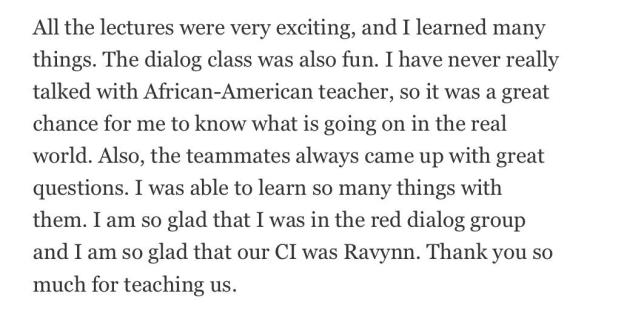
  2. I learned to not doubt myself. This is related to #1. After taking some time to assess my own work in the classroom, I wondered if someone had finally seen through me and called a spade, a spade. I wondered if I wasn’t knowledgeable. It took me sometime to realize that this wasn’t the case. One negative comment shouldn’t knock me off course. Especially when I had had such a positive impact on all the rest of my students. In fact, I’ll always cherish the kind words one of my students wrote in her journal entry about me and my teaching:
  3. I learned to take advantage of the fact that this is one of the rare moments I’ll be asked to teach something that is not my expertise. While we did have a class on race relations and digital humanities, which is totally my wheelhouse, we also had lectures on business and religion. I had to do a lot of reaching while leading class on these topics, but I chose to look at it as a learning opportunity for myself as well as for my students. I am on a career path that values life long learning, and teaching Keio is one of the few opportunities I have to take advantage of learning completely new things.
  4. I learned that explaining America is one of the toughest feats there is. The nature of this program calls on the Course Instructors to do a lot of explaining– why things are a certain way in American culture. A lot of the time I had to accept that I wouldn’t immediately know the answer; more often than not, they had to accept that the answer was not black and white. My Japanese students had to learn to accept ambiguity, theories, and speculation. I think they are used to being presented with knowledge as cold hard facts, things that cannot be disputed in anyway; I’ve come to discover that knowledge is nebulous and often what I know, even if it is a lot, is usually not the whole story.
  5. I learned as much from my students as they did from me. The questions they asked always kept me on my toes. If I didn’t know, I always challenged myself to find out the answer. They often helped me think about topics in a different way.

Teaching Keio was an adventure: every day was different, with a new topic and new questions. Even when I thought my students would struggle, they surprised me by being engaged, asking amazing questions, and sharing insightful thoughts. They brought a good energy to my class and we learned together in an environment that held as many laughs as thought provoking conversation. Teaching foreign students is truthfully not that different from teaching students from your own country. The main difference is that while teaching students from a different country, you will be forced to reckon with much more of what you take for granted. The very things you accept as true are the things they will want to know more about. The very fabric of your existence, they may know nothing about: I got blank stares when I asked them about whether they had heard of #BlackLivesMatter but they all nodded when I mentioned #MeToo. Suddenly, I was forced to explain a movement in detail that has become the backdrop of my life since 2014 so they could understand the necessity of such a force. I taught them about my America, and in return they attempted to explain Japan to me: why they had heard of #MeToo and not #BlackLivesMatter, whether or not gentrification or some equivalent existed in Japan, and generally why more people don’t protest in Japan. One of my students brought a wonderful Japanese expression to my attention: The nail that sticks out gets hammered down.

But it was more than just being in the classroom together that brought me joy: it was the moments of watching my students master ordering food at restaurants and trying the spiciest wings at Buffalo Wild Wings. It was our spur of the moment Target trip after lunch, all of our van rides together, and hearing Japanese mixed with English. It was the big things like watching my students dance and sing with unbridled enthusiasm at the Talent Show; it was the little moments like their smiles as they read the notes I wrote them when it was time to say goodbye and all of the pictures we took together that night.


To the Red Dialogue Class–

Thank you for your time and attention. I wish you the best in all your future endeavours.

Love from your teacher,

Ravynn

5 Steps to Prep and Study for Comps

In a recent post, I detailed the next part of my PhD journey after finishing coursework: Comprehensive Exams, better known as Comps. The post described what Comps are, what their purpose is, and how to create lists for them. Now that I have my lists, a few people have asked me to describe how I am preparing and studying for the exams, so here’s a step-by-step guide to my process.

Step 1: Get organized.

I’m pretty sure this is the number one step for most of my how-to guides when it comes to graduate school. For some people, just having the lists is enough. I need more.

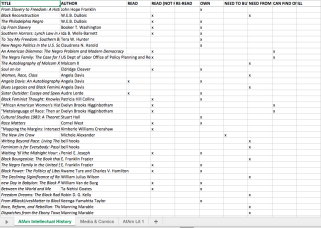
One of the first things I did was create an Excel spreadsheet that has the title and author of the text, along with some other pertinent information. What else you choose to include is up to you, but I included: whether or not I had read the material; read it but not recently; whether I had reread it; whether I owned it, needed to get it from the library, or could get it online; if I needed to Interlibrary Loan (ILL) it, or whether I wanted to buy it for my personal collection; and a separate section for notes.

Having the Excel sheet setup like this helps me see at a glance what I need to read, how I need to obtain the text and gives me an opportunity to write down any additional notes.

Step 2: Plan it!

I admittedly do not have an intricate plan for the order in which I’m reading things, at least not right now. Because I’m starting early, I’m mostly choosing things off of my lists that I wanted to read anyway for fun.

Once I’m in the thick of reading (i.e. when I’m doing nothing but comps), I will do another post about how I’ve planned out my readings. As of right now, my goal has been to read 1-3 books per week.

Step 3: Read!

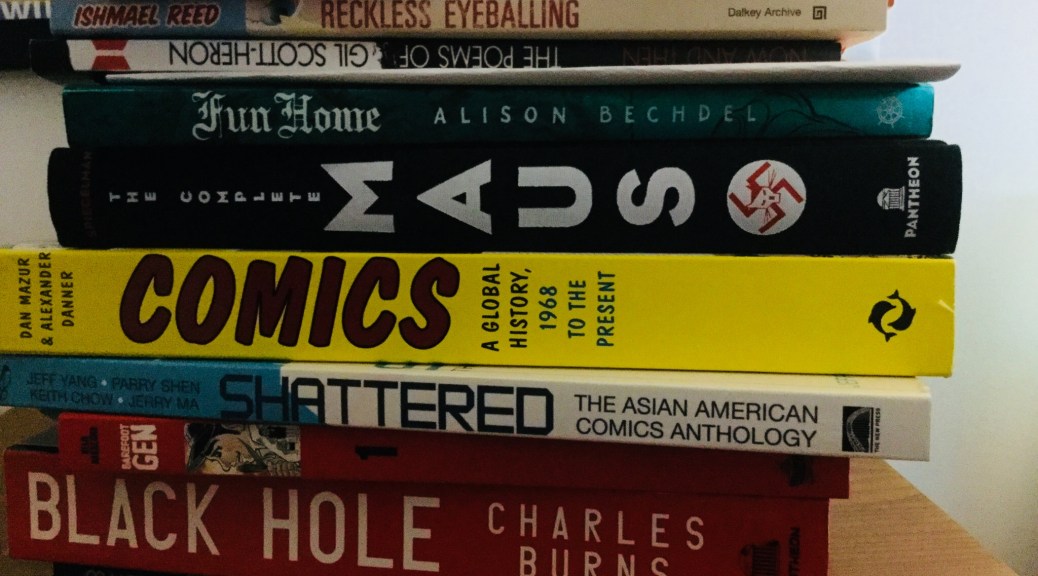
IMG_3781

I try my very best not to overwhelm myself with reading, especially during the summer when I’m supposed to be relaxing. As always, I read in small chunks, either one chapter at a time for academic texts, or in intervals of 25 pages for novels and comics/graphic novels, making sure to take breaks in between each section. I spend the most time on the introduction and conclusion, making sure to highlight or underline the author’s thesis, the goals of the text, the evidence they will use and their methodology. I try to spend no more than 30 minutes per chapter, unless the chapter is particularly pertinent to my own research interests.

For novels and graphic novels, I try to simply enjoy reading them, because it was, after all, my love of them that got me into graduate school in the first place.

Step 4: Take notes

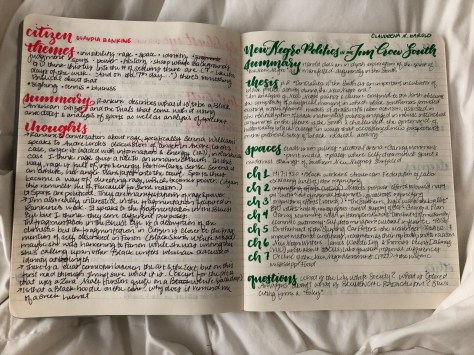
IMG_5317.jpg

In addition to the Excel sheet, I also keep a physical journal where I take notes on the texts that I am reading. My process for note taking varies by the type of text I am engaging with but here are the key subjects I hit during my note taking:

  • For novels and short stories, I read the entire text, highlight and underline key passages to my heart’s content. Once I’m done, I provide a brief summary, pull out themes and motifs from the text, note fast facts like the date published and etc, write down main characters and then my thoughts and questions. I like to use the “thoughts” section to synthesize and make connections between the current text and any others that I have read. For example, when reading The Bluest Eye, I used this section to make connections between Maureen, Pecola and tragic mulatto narratives that I read in my Interracialism class.
  • For comics and graphic novels, I like to note keywords, themes, and visual and/or verbal motifs. I have a “thoughts and questions” section for things that troubled me during my reading, as well as things to bring up during Comps meetings with my faculty members.
  • For academic texts/non-fiction, I cite the main argument, the goals of the text, evidence used, and methodology with a brief descriptive summary of the text. If I can discern it, I like to note the scholarly lineage of the text, which is to say which other scholars is the text in conversation with, and from where does it draw its secondary sources. I also have a section to discuss ways in which the text may be of service to my own scholarly work. (Where does my scholarship fit?)

Step 5: Decompress!

Be sure to give yourself time in between texts to take care of yourself. Reach out to your friends, go to the gym, eat a good meal. You will spend a lot of time with just you and your thoughts, but don’t let it consume you.


So there you have it: a step-by-step guide to preparing and studying for Comps. As the year progresses, I’ll have even more detailed guides to prepping for the big exams, but this is how I’ve been doing it thus far. I hope at least some of this was helpful to you. Happy reading!