
Guest Post: A Series of Unexpected Events

When I finished undergrad three years ago, I told myself a thousand times that I was never going to graduate school. Finishing a Bachelor’s degree was hard enough, why would I willingly put myself through more academic torture at an even higher cost (both mental and financial)? It seemed unnecessary at the time and even if I were to go, I had not a clue what I would study. My career path upon graduation was uncertain to say the least – the last thing on my mind was another degree. Now fast-forward to today… *cue maniacal laughter at my previous naiveté* …and I am headed back to grad school this coming fall. Yes, I said back, as in for my second attempt. It has been quite an interesting chain of events and along this journey, I’ve learned that sometimes where you need to be is right where you started from the beginning. *clears throat* Let me explain.

As a Virginian who grew up near Charlottesville, UVA was an obvious choice for college. I knew a lot about the University and had been there for football games and that sort of thing. From what I had experienced prior to enrolling, UVA offered the quintessential college experience, the kind you see depicted in the movies. When I got in, I was thrilled, proud, over-the-moon– but I was also nervous. My mom didn’t go back to finish her Bachelor’s degree until she was pregnant with me, so her college experience as a married woman with a family looked very different than mine would and my dad did not attend college at all. Not being able to rely on my parents to give me advice on what to expect as I ventured into unknown territory was scary, but I knew that I would figure it out. What I didn’t know was that most of the lessons I would learn throughout my undergraduate career would not take place in the classroom but in my day-to-day interactions with other students and other members of the University community. The biggest lesson that I learned about myself during those ever-important four years? I have anxiety. At times, borderline crippling anxiety, and the worst part was not that it took me until college to figure it out. The worst part was that I was unaware that it wasn’t normal.

Growing up in a small, rural town in Central Virginia, mental health was a rare topic of discussion and during instances where it was actually acknowledged it was always with regard to extreme cases of mental health disorders. In high school my classmates would make ignorant jokes toward others about having multiple personalities or being “special.” So that was really my only exposure to what constituted mental health issues. At home, there was even less talk of it. My parents maintained a very traditional black household where things like “what do you have to worry about?” and “mind over matter” were phrases that framed anything stress related. They always made it seem like my sister and I were too young to know what anxiety was so I didn’t know any different. Maintaining the idea that nothing was wrong kept me from seeking help, kept me from understanding that it’s okay to talk about my anxiety and depression, especially when it came to being a young black woman studying at a very prestigious predominantly white institution.

The source of my anxiety and depression while in undergrad was this: I never thought I was good enough. I compared myself to everyone at every turn. I had no concept of my worth. Then my self-esteem hit the lowest of lows following a bad break-up that took place during my first year of college. I didn’t know it then, but I was seriously depressed for over a year after that split. College is hard, breakups are hard, finding confidence in yourself as a single black woman when it feels like the world is on your shoulders at all times is hard. Finally getting my diploma at graduation and reflecting on all of those tough experiences had me thinking, “there’s no way I could ever go back and do this again,” but then I landed an unexpected job offer. Four months after graduation I was hired as an Admission Counselor for UVA and I found my passion– working with students who don’t see their potential, students who struggle to see their worth. Students like me. That’s when everything changed.

After finishing two admission cycles at my alma mater and loving the work that I was doing, I decided that I did want to go to grad school. So I applied and was accepted into UVA’s Master of Higher Education Administration program and I began taking classes part-time while I continued to work full-time. However, juggling both work and school simultaneously proved to be a challenge that triggered my anxiety in a slightly different kind of way than before. This time, my anxiety came from feeling stagnant. I got antsy with the idea that I was “stuck” at UVA, being that I had studied there, worked there, and was still studying and working there while many of my friends had moved on and found higher-paying jobs in cooler cities. I started to compare myself to others again, I felt like this whole “adulting” thing was a competition and it seemed like I was losing by a mile. So in an overwhelming state of frustration I made a rash decision. I chose not to enroll in grad classes for the coming semester and I applied for jobs at other universities until I got an offer to work for a school in DC. This was like a dream come true! I could finally move out of my parents’ house and have my first real apartment on my own, I would be in a city that was full of young black professionals, and I would be making more money (or so I initially thought). Well, life has a really funny way of humbling you when you least expect it and that’s exactly what happened.

I took the new job and hated every second of it. The leadership was awful, the electronic processes were archaic, the office culture was unhealthy, and given the higher cost of living in DC I really wasn’t making more money. This is when my anxiety and depression caused me to hit rock bottom. I started taking the prescription anxiety medicine that my doctor had given me several months prior hoping that it would make a difference in my day-to-day functioning, but I still had days where I could barely find the motivation to get out of bed. I was broke, unhappy, and I had never felt so alone. Emphasis on alone, living by yourself in the city sounds cool in theory until you realize that you come home to an empty apartment everyday. That’s not something that makes you feel any better when your work life is hell on Earth. I lasted six months in that position before I quit and decided to come back to UVA for grad school full-time. I’m even taking a class this summer to catch up so that I’ll still be on track to finish the program next spring (yay!) and it finally feels like I have my life back on track.

This time last year I never thought that I would be so excited to be moving back home and starting grad school again, that just goes to show that sometimes we have to go through difficult situations before we can see things clearly. It’s so true what they say about how the grass isn’t always greener on the other side. I definitely learned that the hard way but that’s okay. Not every lesson we learn in life will come easy. Moving forward I know that my anxiety hasn’t gone anywhere, it’s something that I will have to deal with through grad school and beyond. The difference is that now I’ve been through things that have taught me that I am stronger and wiser than I used to think I was. I have found ways to better manage the moments where I feel like I’m on the verge of a panic attack. Those are life skills that I may not have learned as quickly if I didn’t take that leap of faith and accept that other job. It may not have been where I needed to be but we gain insight from every experience we have as human beings, good or bad, and that’s the silver lining.

Do I still have moments where I question my worth? Absolutely. Are there times when I doubt myself? 100%. But at the end of the day, I don’t beat myself up about those things nearly as much anymore. What brings me peace of mind through those inevitable ups and downs is the reassurance that, despite the detours I may have taken along the way, I know I am exactly where I’m supposed to be.
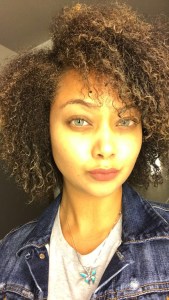

IMG_1593Alexis Richardson, 25, completed her undergraduate degree at the University of Virginia in 2015. After three years of working in college admissions she has returned to UVA as a full-time grad student to finish her Master of Higher Education Administration.

#RavynnReads: “Eloquent Rage” by Brittney Cooper

This week and I got off on the wrong foot. Weird things were happening with my mood, I couldn’t sit still and I was feeling generally out of sorts. So, I decided do what I always do when I’m feeling in a funk: I get books.

I drove up to the north part of my city to the public library that I prefer– brand new, new books, and a general sparkle that always inflates my mood. I didn’t have any books in mind– I thought I’d just go have a look around and see if anything caught my eye. When nothing did, I took to the computers to see if they had any of the books that I needed for comps. After spending about five minutes in the search engine, I began to notice a trend. Every time I would search a book that I wanted (The New Jim Crow, Audre Lorde’s Collected Poems, Nnedi Okorafor’s Binti, Eloquent Rage, etc.), my heart would leap with excitement upon noting that the library had the book, and do a mild decrescendo upon realizing the availability was at the library downtown.

As I left the library fuming about the inconvenience of having to drive all the way across town to the other library, it struck me that all the books that I wanted were Black books and they were all housed in the library smack in the middle of the Black neighborhood. Quelle surprise. As if Black books were not able to take up space in a predominantly white space. As if all a Black populace would be interested in is Black books. As if white populations would not be interested in Black books. (Granted there were thousands of books in both libraries, but I’m still frustrated that the majority of the Black books were in the “Black” library.)

Shocked at my own naiveté, I decided half way home that driving the 25 minutes across town was worth it if it meant getting Brittney Cooper’s Eloquent Rage. This library was dimly lit and generally of a poorer disposition than the library in the white part of town, but within minutes, my arms were full of my beloved Black books, including a Okorafor book, The Book of Phoenix, Ibram Kendi’s Stamped from the Beginning, Zadie Smith’s Feel Free and of course, as the title of this piece implies, Eloquent Rage: A Black Feminist Discovers Her Superpower by Brittney Cooper.

After simmering down from the injustice of realizing my books had been segregated, I settled into the couch to read the opening chapter of Eloquent Rage. Within moments, I found myself chuckling at Cooper’s candor, snapping my fingers in agreement with many of her sentiments, and riveted by her analysis which seamlessly wove together theory and personal anecdotes which produced scholarship which would be palatable to a broad range of audiences.

Damn, I thought, drowning in my own admiration, I want to write like her when I grow up.

In Eloquent Rage, Audre Lorde shares the stage with Beyoncé, who shares with Patricia Hill Collins, who shares with Michelle Obama. Black women have been theorizing about anger forever, both in academic and non-academic spaces. Cooper breaks down and analyzes Beyoncé’s “Formation” video with the same care that she defines ‘feminism’ and ‘intersectionality.’ For that, I am eternally grateful because I have seen what the type of public facing scholarship I want to write looks like in Cooper’s work.

In addition to discussing Black women’s rage, which as Audre Lorde notes is both full of information and energy, and an appropriate response to racism (Sister Outsider), Cooper discusses understanding her own feminist identity in conjunction with other identities that don’t always inherently mesh well together. I am thinking specifically of when she discusses being a Christian feminist and also being a heterosexual Black feminist. Cooper’s right that feminism has yet to really take into that God plays a big part in a lot of Black feminists’ lives, but I think she’s also right to point to the fact that Black churches still tend to be sites of Black patriarchy run amok. How do we reconcile those two spaces? How do we become good God-fearing Christians while also wanting to smash the patriarchy?

Another topic which I think Cooper nails in “Love in a Hopeless Place,” is difficulty heterosexual Black feminists face while in pursuit of relationships, a place I only know too well. I am either too intimidating, too angry, too sassy, too opinionated, too bossy, or too independent– words that essentially equate to “You cannot be forced into submission by me. I find that threatening.” Cooper’s analysis is rife with statistics and a much more eloquent analysis than what you will find here. She turns a conversation about a difficulty find mates into a debriefing on the Moynihan Report, which essentially calls the Black family a “tangle of pathology” and that our maternal led households are a part of the problem. Much of the Moynihan Report is based on the assumption that “legitimate” families are constituted of (1) father, (1) mother and (2.5) children. (Maybe not the 2.5 kids part but the “nuclear family unit” piece is there.)

Using Beyoncé as a jumping off point for discussing feminism, Cooper states that feminism’s tagline should be, as her idol says, “I love being a woman and being a friend to other women.” (28) If that’s not your MO, then you’re not a feminist, Cooper decides. That goes for nonsense about not having Black female friends because “they’re too much drama” or you “get along better with men.” Cooper explicitly says:

Friendships with Black girls have always saved my life. I give the side eye to any Black woman who doesn’t have other Black women friends, to any woman who is prone to talk about how she relates better to men than to women, to anyone who goes on and on about how she “doesn’t trust females.” If you say fuck the patriarchy but you don’t ride for other women, then it might be more true that the patriarchy has fucked you, seducing you with the belief that men care more about your well-being than women do.

It isn’t true.

(p. 13-14)

I can say with absolute certainty that Black women friendships have given me the most out of life, from my intellectual soul sisterhood with Micah, to my coffeeshop buddy Kels, to my homie Alexis and my cousin Leah, I would not be the woman I am today without each one of them. They lift as they climb, they’re there for me, they understand me and most of all they listen with care when I come home from class after three hours of having to listen to racist, homophobic vitriol.

Brittney Cooper’s book, which touches on everything which matters to Black women, from dating to hair, as touched my life in important ways, namely by making me feel seen. Thanks to Cooper, I, as a big black girl nerd from the South, that had trouble making Black girl friends growing up and trouble dating, who grew up in a devout faith, but is, without a shadow of a doubt, a feminist, feel like part of my story has been told. A story that has only partially been exposed. From her complicated relationships with white women, to her mixed feeling about Hillary Clinton and Tevin Campbell obsession, Cooper and I might be of different generations, but her story is mine and I loved reading every second of it.

11/10 would recommend and am currently trying to figure out if I can add this to my Comps list.

But, seriously, don’t take my word for it, check it out for yourself.


Black Girl Doesn’t Do Grad School

Hi. I’m Taylor Lamb. I’m a (very) recent graduate of the University of Virginia with a B.A. in English and a minor in Drama. And I am not going to grad school.

[Pauses for you to take a moment to scroll and check if you’re on the right blog] Yes, I know. This isn’t exactly the content you signed up for.

But I think I have a cool perspective to share anyway.

I love school. A lot. I always have. School is what I’m good at. It’s what I’m best at, in all honesty. As much as I may have complained about my assignments, the late nights, and the early mornings… I actually thrived most when I was a student. A lot of my self esteem was linked to me making good grades (which is probably unhealthy) and doing well in school was how I felt like I was doing well in life. With all of this in mind, pursuing a masters’ degree seemed like the most natural next step as I was finishing my Bachelor’s Degree.

But the problem was- I had no need for it.

Realistically, I didn’t even need a Bachelor’s degree. I want to act. I also want to write too, hence the english degree, but acting is really my main goal. I hope to break into the entertainment industry, and having a Bachelor’s is absolutely not necessary. Some could even consider it as a detriment. The past 4 years I spent in undergrad, I could’ve been auditioning, or taking acting classes, or saving money so that I could afford to move to a city that gives me a better chance at achieving my goals. But I love school. And I wasn’t ready to be done with it. And I had always dreamed of going to college. So, I matriculated for 4 years. And now I’m done. And scared.

I was thisclose to going to grad school just to go. My University just recently launched an accelerated master’s program for English. Just one extra year (of incredibly hard work, mind you) and I’d have a master’s in English. And, I deeply considered it. I could continue to thrive in school for a year, and I could also delay having to make Big Decisions for a year. It seemed pretty great.

But, the kicker- they didn’t offer financial aid. I’m fortunate enough to have graduated with a very small amount of debt due to a full tuition scholarship. That is why I attended UVA in the first place. It was pretty integral to my college experience.

So, would I put myself in debt just to delay my life for a year, for a degree that I ultimately didn’t need? Would I take out loans just so I could revel in the joy of being a student for one more year? I definitely considered it. Everyone else is in debt, why can’t I be? Was I really ready to leave the comfort of academia? Wasn’t it worth it?

Ultimately, I had to decide… no. It wasn’t worth it. Not for me, anyway.

I’m terrified. It’s been less than two weeks as I type this, so it hasn’t kicked in that I’m done with school, quite yet. But, I know that it’s coming. The realization that I won’t be getting graded anymore. That any “assignments” I receive will be for work and not just for learning. That I don’t have some big defined goal of attaining a degree that everything I do is ultimately working towards.

And I’m gonna miss it. I know I will. I love learning and now I have to be self-motivated in a pursuit of knowledge, which isn’t one of my strong suits. But, I ultimately had to make the decision that was best for me, my future, and my bank account.

I’ll continue to live vicariously by voraciously reading every post on Black Girl Does Grad School. I’ll be jealous that I’m not writing any more papers, and won’t eventually get to use #blackandhooded on my instagram pics.

Thanks to y’all who are fighting the good fight of post-graduate education, for giving me something to look in on and be in awe of.

Signed,

A Black Girl Who Isn’t Going to Grad School

.

.

.

.

(…for now)


Taylor Lamb is an alumna of the University of Virginia where she studied English with a minor in Drama. She is a writer, actress, and passionate about art for social change. If you want to get her revved up, ask her about Beyoncé or Buffy the Vampire Slayer.

Read her writings here https://www.clippings.me/taylorlamb or check her out on Youtube https://www.youtube.com/user/TaylorLeighLamb

My attempt at joining the Academy