Tag Archives: writing

Week 9: #RMDHatWM, or Hacking the System

Let’s be brutally honest for a second: I was exhausted leading up to the Race, Memory and the Digital Humanities Conference (#RMDHatWM). Just last week, I spent three days conferencing at my alma mater, UVA; I went to Hampton Comicon; and I had two papers and presentations due (one of which I only found out about one week in advance, but I digress). All I wanted Thursday after class was my dog, a cup of tea and The Miseducation of Lauryn Hill on repeat. But after hearing about the conference through the Equality Lab last fall, after my teacher moved our class time to accommodate the opening roundtable, and after remembering that I had volunteered to help–I went anyway.

I’m so glad I did.

Liz Losh, my professor, the director of the Equality Lab, and William & Mary’s first official digital humanist, put together an amazing series of roundtables, talks and events featuring some of the coolest scholars I’ve ever met. I was first struck by the fact that the opening and closing keynote speakers were both Black women and they were the epitome of #BlackGirlMagic. Thanks to Liz’s prodding, I ended up with a semi-working relationship with the closing keynote, P. Gabrielle Foreman, whom I came to deeply admire. Situated at the intersections of Literature, History and Black Studies, I was in awe of the way she seamlessly utilized Langston Hughes poetry and historical archive as a lens through which we might understanding her work digital archiving, organizing and activist work through the Colored Conventions Project. As a baby grad student working at the intersections of similar scholarship, it was amazing to have a Black woman model a methodology based not on limitations of the Academy but on the truth she was seeking to tell.

The same can be said for Jessica Marie Johnson. Her work transcended space and time as if those principles never existed anyway. In her talk, she moved us from Puerto Rico to New Orleans, cited Black Code Studies and New Orleans folklore, utilized audio to contextualize the sound of Black screams and pain as well as animated videos featuring everyone’s favorite song, “Formation.” I’ve never seen how someone’s mind can move so fast, folding together layers into a cohesive and extensively cited project.

Overall, this conference was valuable because I got to see diverse scholars address issues I’ve been grappling with the whole semester. They asked: How does this lead to transformative action? Where is our scholarship situated? What tools can DH offer us in our goals to dismantle systems of oppression?

The answers I got, for the first time, were satisfying. There is no one way to do DH, therefore there is no one solution. The goal should not necessarily be to find a solution, but to engage in a process with your work that is ethical, intentional, and empathetic. This will lead to transformative work because if you are engaging in such a way and constantly returning to questions of power, privilege and access, you will cite ethically (CITE BLACK WOMEN. GIVE US CREDIT FOR OUR WORK!), you will have reciprocally beneficial relationships with community partners, and you will build infrastructures to encourage this kind of work.

The time that I was able to spend with incredibly brilliant scholars was equally valuable. From advancing Professor Foreman’s slides for her keynote to getting hugs from Jessica Marie Johnson and Marcia Chatelain–I even got to spend a few priceless moments with Jessica, Marcia and Tacuma Peters at the end of the conference. I was so excited to meet them: Black scholars thriving in their fields, and they were also happy to meet me–another face in the crowd, a baby scholar on the come up. They fueled me with stories about how grad school was great (or not), how being a professor was great (or… not), and how to value each phase in my journey through the Academy. They told me not to downplay my work: finishing my Masters is a big deal. They told me to take advantage of my freedom as a graduate student. And they also gave me cards and contact information, which was stunning and so appreciated. I left the conference feeling loved, supported and newly secure in my roles as scholar, activist and creator.

We hack the system by writing ourselves in, creating archives for ourselves and citing POC, WOC, queer authors, indigenous scholars. We do it by working together, valuing the work of everybody–and I mean everybody–involved, and creating communities and infrastructure both digitally and physically. We hack the system by caring for each other and lifting as we climb.

This is how we hack the system. This is how we hack ourselves into the system.

This conference was just what I needed. I needed a model for how to be a caring participant of society as I move through the Academy and thankfully I got an entire room full.

This is how we hack the system.


In honor of modeling the amazing citation practices I saw at #RMDHatWM, I want to take a moment to shout out people that I learned from this conference, and whose ideas greatly inspired this synthesization of three days worth of rigorous intellectual work:

Gabrielle Foreman

Jessica Marie Johnson

Liz Losh

Angel Davis Nieves

Marisa Parham

Amanda Phillips

Kelli Moore

Fiona Barnett

Jacqueline Wernimont

Roopika Risam

Samantha Callaghan

Alexis Lothian

Catherine Steele

Week 5, or How to Successfully Defend A Master’s Thesis

Yes, it’s true, I did defend my thesis on Wednesday and I’m still riding on the high of being free from that enormous weight.

As I’ve got this step behind me, I want to reflect a little bit on the process. My program required me to write a portfolio, with the understanding that the essays will build off of those written for seminars over the course of the year. I used an essay that I wrote for my Popular Culture and Power class during my first semester, and the essay I wrote for my Harlem Renaissance class for the other. At the end of the year, my first step was to get organized…

STEP 1: Get organized! Make yourself a schedule!
img_1465

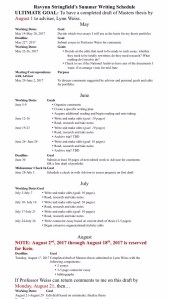
At the start of the summer, I was required to create and submit a writing plan to my advisor and the Dean. While this was primarily a formality so that I would be allowed to hold a part time job at Michaels, having this as a set of guidelines was really helpful.

I admittedly did not follow this schedule exactly, but I followed it well enough to get a first draft in on August 1 as planned and a defense by the end of September. Some of the best advice I’ve ever gotten was to be firm with your goals, but flexible about how and when you get there.


STEP 2: Make sure to do your research!

I already wrote about the joys of archival research, so be sure to check that out, as well as the lovely piece that was written about me from the VCU end.

STEP 3: Just write! 

Write, unfiltered, as much as you can, every day if possible. I also wrote about that struggle over the summer as well in another blog post.

STEP 4: Editing, editing…and more editing.

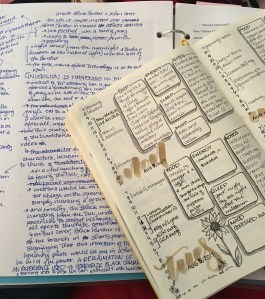
IMG_4348After I wrote my first draft and submitted it to my advisor the first time, she gave me a nice little letter with general comments, as well as a physical copy of my paper with marginalia. It took me a little while to wade through all of her comments, but after I did, I compiled a list of all the edits as a check list with notes on how to address each point. (For example, she might suggest that I need to add historical evidence, and I would write in which books or articles had the evidence she was looking for. Occasionally, I’d write a sentence or two addressing the issue on the page. Or rewrite an entire section on the back of a page…)
This process was particularly stressful because I waited until school started to really get into this. So I did an insane amount of content edits in about two weeks. For two weeks, I carried my binder of notes and drafts and edits around with me until I felt like crazy Joe Gould, writing and rewriting his oral history. I was agitated and stressed out for two solid weeks, and in the days leading up to my second submission, I had every last one of my family and friends praying for me.

But fortunately, my second submission was defensible! I got my advisor my second draft Monday morning of the 11th and by the 12th, she’d e-mailed me saying my draft was good, that she’d go ahead and e-mail my committee to set up a date at the end of September, that I would have yet another annotated draft in my mailbox and that after finishing those edits, I should e-mail out my portfolio (my third draft) to my committee by the 15th. (Can I just take a second to emphasize what a SUPERHERO my advisor is???)

STEP 5: Schedule and prepare for your defense.

My advisor handled this part, primarily because I think she thought we’d be able to get the ball moving faster if she plead on my behalf. I had to get my defense done by the end of September and while I wanted to be done, the fast turn around had less to do with me and more to do with satisfying administration.

Because of this, I didn’t have any control over when I actually defended. They gave me a date and a time, and that was it. I gave myself a week break from looking at my thesis because honestly, I was burnt out from thinking about it. Then, I started trying to prepare.

My defense, as I understood it, was not a formal thing. It would mostly be a conversation. My advisor suggested however, that I write a short statement to introduce my work. I tried very hard to write it, but it only happened the night before the big day, and in the end of it was just a series of bullet points– cute anecdotes about being a precocious child in love with comics and a hotheaded teenager using comics to prove a point in English class. I talked about how I came to Black Panther comics and Incognegro, what I was trying to accomplish and where I wanted to go with my work.  I practiced it in my car driving from Suffolk to Williamsburg and to my dog, who had no idea what was happening but looked at me encouragingly.

STEP 6: DEFEND!

Even knowing that the defense was informal, that my committee members were awesome, that my advisor would not set me up for failure, I was still nervous going in. I put on my James Baldwin sweatshirt and prayed for the confidence of Angela Davis, the candor of Ta-Nehisi Coates and the presence of mind of Ida B. Wells, Frederick Douglass, DuBois and literally every Black figure I’ve ever been inspired by as I walked up to the building.

We had it in the library in the American Studies building. I chatted with my advisor until everyone appeared, and soon after that, my advisor welcomed everyone and gave me the floor for my introduction. I did it and then the questions started. One of my committee members set me at ease by saying that all of his questions should be framed by the fact that he thought my portfolio was great and it was a really fun read. He got the ball rolling by asking me to talk about the parts that I enjoyed writing and did well in my portfolio and which could have used more work– and as I described how fun it was to go do archival research and learning about the historical presence of Black Panther, I finally understood what everyone was trying to tell me. I was the expert on this. I knew this stuff. This was my wheelhouse and I loved it. It showed in my work. It showed in my face as I lit up talking about my paper. So it went on like that for an hour and a half, fielding questions about intellectual property, time-traveling frogs, and Christopher Priest. They complimented sections of my close readings and pointed out one important section of an image that I completely missed (thankfully it didn’t destroy my argument and I can go back and add it as a footnote.) They gave me suggestions and helped me think through where I could go with my ideas. I took lots of notes, and then at last, it was over.

They asked me to step out of the room for a few minutes and when the door opened again, my advisor came to get me, smiling widely and giving me thumbs up. “They loved it!” she told me, and I walked back into the room to congratulations and hugs. I chatted with them for a little while longer, got myself a celebratory hazelnut latte, and called my parents with the news as I walked to class.

STEP 7: CELEBRATE AND GIVE THANKS!

IMG_4389 I spent the hours after my successful defense buying myself ingredients to make stew, having Red Lobster with my parents and writing a blog post about my gratitude for everyone who helped me get to this point.
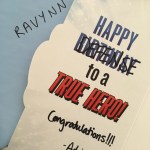
The celebration lasted a couple of days. I was taken out for dinner, ice cream and coffee by friends and family. My friend got me a hilariously appropriate congratulatory Superman card, on which she had crossed out the “birthday” with Sharpie and added “defense” instead. I got calls from friends and texts from advisors and mentors and I could not have been happier.

STEP 8: Attend to the final administrative touches.

Now, even though the hard part is over, I still have administrative touches to go through. My committee each gave me drafts with comments and line edits, though one member assured me it would be a day or two of edits at the most. I still have to submit it to an online system for the College, which could result in formatting edits, plus forms of all kinds which will allow it to go on JSTOR and I have to get it bound for the American Studies department once those edits happen.

My advisor suggested I get these done sooner than later, so I’ll probably take this up again over Fall Break. I applied to get my diploma in January, so I do need to make sure all of these logistic matters are in order so nothing stands between me and degree number 2.

It’s been a wild ride but the worst is over thankfully. Now, I can move on to the next step– I’ll admit, I’m already thinking about comps lists.

As my mom would say, “Keep it movin’.”

Week 4.5, or Gratitude

I’m coming to you with a midweek update to let y’all know your favorite Black Girl Doing Graduate School has successfully passed her Master’s Thesis Defense, which means that I’ve leveled up from Ravynn, MA/PhD student to Ravynn, PhD student.

Ravynn Stringfield, M.A….That’s a nice feeling.

I’ll be back to my regular schedule on Sunday with a comprehensive guide to successfully completing a Master’s Portfolio, but until then, I wanted to briefly give some shout outs to some people who have helped pull me through to this point.

Thank you to…

  • God. First and foremost. My relationship with God has gotten so much more intimate since I started grad school, real talk.
  • My amazing parents who love me, support me, encourage me, and push me. I would be nothing without my parents.
  • My fantastic advisor, Lynn, who really stuck it out with me when it got tough and who gives some of the best pep talks and critical feedback in the world.
  • My thesis committee for a fun and productive defense that I will take with me as I go forward in my journey in PhDLand. (Thanks also for just taking time out of your schedule for me, I know how busy y’all are.)
  • Cindy Jackson at VCU Libraries for helping me with my research!
  • MY CREWWWW, Kelsey, Micah and Leah, y’all are the realest, I love y’all. I don’t know how I would’ve gotten by without being to talk to y’all on the regular. Micah, you helped inspire my project and helped me think through it in its early stages. Kelsey, you push me and I push you because no one else is looking out for Black women but Black women! I would have never gotten here without your support. Leah, thank you for listening to me whine about how hard school is pretty much every day and for ALWAYS, and I mean, ALWAYS rooting for me. Protip to everyone: Get you a Leah.
  • Professor Harold, for always believing in me and having high standards for me. They’re not impossible, you know I can reach them and I know I can always ask for your help getting there.
  • Dana, you don’t know how valuable it has been to have a Black woman ahead of me in grad school to turn to when the going gets rough. Seeing that you have gotten where I want to be, encourages me to keeping moving forward. Thank you for lifting as you climb.
  • My William & Mary grad school peers: Ari, Chris, Hyunyoung, Felicia, Zarah, Adrienne, Shana, James, Travis, and Jaymi for encouraging me, whether it be bringing me books, talking comics, having Black (woman) moments with me, or simply hanging out and making me smile, y’all have all helped me get here, and I am so grateful.
  • My Outreach moms, Dean Gregory and Ms. Cathy, and my big sister, Alexis, for always reminding me that I always have a home with them, for believing in me and for just being family to me.
  • My family and friends, more generally, who have checked up on me as I’ve ventured along my grad school journey.
  • You, dear reader, whoever you may be. It’s been wonderful having this outlet to come home to every week. So thanks for reading, it encourages me to keep going.

I will more than likely forget someone immediately after I post this, but for now, consider this a working list.

Thanks everyone for helping me (and boy, did I need help) to get through this.