Category Archives: Ravynn

Week 11, or Finding the Right Mentor for You

This past week, I had the opportunity to spend time with one of my faculty mentors from the University of Virginia, Professor Claudrena Harold. As always, I learned a lot from listening to her speak, the passion she has for working with undergraduate students, and making sure that she’s being true to her intellectual and artistic vision when pursuing a history. I am always in awe of the way that she pursues certain forms to tell certain stories and I hope that when the time comes, I can be as inventive in my own scholarship.

My time with Professor Harold got me thinking about mentorship and advising relationships, as well as how to find the right people for you. So I thought I’d offer a short post on questions to consider when finding an advisor.

  • First, ask yourself what you need from an advisor or a mentor. This might be difficult. You might not know immediately what you need, in particular if you’re negotiating a new space. I know for me, I came in with one advisor who was particularly tough and in all honesty, I wasn’t ready for her. As a student freshly graduated from undergrad, I needed someone to be a little milder with me. I needed pep talks. I needed guidance, assurance and affirmation, so I picked a different advisor. Now that I’m almost two years deep in my program, I feel I can handle the toughness that will make my work the best and sharpest that it can be, so I’m considering switching back to my first advisor.
  • Second, see who you gravitate towards organically. The person you are assigned or who you pick when you first arrive in graduate school simply may not be the best person to advise you. You pick these people often based on similar research interests, but they may not cater to you in other ways. Take your first semester, or even your first year, to see if there are any professors you find yourself drawn to, even if your research interests don’t align perfectly. See who takes a genuine interest in you. Those professors are often going to be the ones to guide you with the most compassion.
  • Third, don’t be afraid to switch it up. As I’ve mentioned previously, you may need different people in different stages of your journey. Who was great for you during coursework, may not be the person to get you through comprehensive exams, and they may not be the person to get you through your dissertation. Different stages may necessitate different types of assistance.
  • Fourth, don’t be afraid to look outside of your immediate program for mentorship. Some of the best mentors I’ve had have come from outside my actual program of study. (Professor Harold being one of them; I was a French major in undergrad and she was a professor of history and African-American studies.)
  • Bonus: If you can find someone who caters to you emotionally, but also provides you with excellent feedback in a timely fashion, signs all your forms for you, and helps you make connections HOLD ON TO THEM TIGHT. More often than not, you may not have an advisor who can do all of that; you might have different professors that provide you with different things and together create the perfect mentor.

I believe the key to all of this is knowing what you’d like in a mentor or an advisor, but this takes some time to discover. For me, I like someone that is firm on deadlines, but lenient when necessary; that gets me good feedback in a timely fashion; that, in essence is dependable, but also can be gentle with me when I’m feeling the sting of imposter syndrome and the urge to drop out of grad school. I also like to have someone who can empathize with my experiences as a Black woman in the Academy, but I don’t often have those people to choose from in my current environment.

Keep in mind that everything that I offer up as advice has been my personal experience, so take it with a grain of salt. All of these suggestions may work for you when deciding on a mentor or advisor, or they may be entirely useless. Whatever the case may be, I do hope that on your journey, you find people, in your field or elsewhere, that can provide the necessary support that you personally need in order to be successful in your journey.

Week 10, or “Fake News” and Real Mentorship

My professor, Liz Losh, gave the William & Mary Tack Lecture this past Thursday night.

The Tack Lecture series is a pretty big deal. It’s a part of a new W&M tradition in which each semester, a professor is asked to give a public lecture on something that both academics and community members will find engaging, allowing everyone to be a part of the University’s intellectual discourses. This semester, Professor Losh gave a talk entitled “Fake News for Real People.” As the rhetorician that she is, Losh began by discussing what creates a persuasive news story: ethos (an appeal to ethics), pathos (an appeal to emotion) and logos (an appeal to logic). Fake news stories, she argued, include too much pathos and not enough ethos or logos– we need all three in credible news. Losh argued that fake news is not a purely partisan issue, that fake news may have purposes other than deception and the problem isn’t just fake news– it’s a crisis about truth telling in an era of simulation.

Fake news is not a new concern, it dates back to Orson Welles creating mass panic with his radio broadcasts, however our fake news tends to be a simulation, copies for which there is no original– or in this case, news stories for which there is no source. She argues that there are three genres of fake news: Fake News 1.0 (satires of political theatre), Fake News 2.0 (asymmetrical disinformation warfare) and Fake News 3.0 (disparagement that undermines traditional news organizations.) Fake News 1.0 was actually helpful in some sense– it improved media literacy. Viewers of the Daily Show and the Colbert Report tended to do well on news quizzes and were more equipped to identify satire. The problem is that people care less about the source and focus more and more on the content, which is to say that they care less about the context and more about the content.

In our current moment of Fake News 3.0, Losh argues that there is confusion about what fake news is. There is cause to doubt traditional news sources and, therefore, people become confused about basic facts. She proposes three trends which may explain our issue with fake news: authority is replaced by authorization, authenticity is replaced by authentication and veracity is replaced by verification. Finally, she offered a few solutions to fake news: technology companies created the problem, therefore they should be in charge of creating solutions; teach media literacy and news literacy early and often; and fund the humanities, because knowing history, rhetoric, philosophy and foreign languages helps in identifying fake news stories.

Professor Losh ended her lecture by shouting out the Equality Lab fellows (I am one) and the Race, Memory and the Digital Humanities Symposium, which I wrote about last semester. Hilariously, the picture that she chose to represent RMDH with was one of me flashing my conference badge and smiling like a goofball. The picture (which several of my colleagues made sure to take snapshots of) stayed on the screen throughout the entire Q&A section. It was mildly mortifying but also hilarious and had been done with good will.

Professor Losh ending with a picture of me made me start think about her commitment to mentorship. Yes, she is a prolific scholar; yes, she is basically an academic rockstar; but she doesn’t get nearly enough credit for the work she does with her students. When Adrienne, Ashley and I came to her with a partially formed syllabus for an independent study on comics, Professor Losh did us one better and turned our independent study into a real class that would show up on our transcripts. She makes sure her students and Equality Lab fellows have access to scholars in our fields so we can ask them questions and share our own work with them. (She’s also willing to give you a little nudge when you might otherwise be too shy to share on your own. [Me. All the time.]) She makes sure that we have a physical space to work and create together. She gives you lengthy, but kind, feedback on your writing with the sole purpose helping you get better. Stick around long enough, she’ll present you with all kinds of opportunities you would have never thought imaginable and, best of all, she gives really great pep talks.

For the last few weeks (or much of the semester, take your pick), I had been feeling completely burnt out and utterly uninspired. I talked incessantly of quitting grad school– taking my MA degree and hightailing it out of her to pursue a glamorous (though admittedly not lucrative) career in publishing or editing in a city like D.C. or Richmond. I hated going to class, I hated reading for class, I hated talking to people, I hated being here. I had talked to everyone I knew about quitting, including my advisor– everyone, that is, except Liz. I had avoided talking to her because I knew if I did, she’d make me stay. Professor Losh was the one person I knew who would be able to talk some sense into me and I wanted to leave so badly I didn’t want to hear sense.

Sure enough, it took a quick chat with her and a week off to help me clear my head.

Ever since, I’ve been trudging along with a little more determination in my heart. I still don’t know if I can finish this whole PhD game, but I do at least know I can finish this semester. This graduate school game is wild, but good mentorship, like what I get from Professor Losh, and a strong support system can pull you through.

Week 9, or the Lemon Symposium, March 16-17, 2018

I love conferences. In fact, conferences are probably my favorite part of being an academic. However, it’s not just going to conferences that I like– it’s being a part of the university hosting them. I love welcoming people to my university who are here for intellectual conversations. It’s about the ideas that fly in a space other than a classroom setting and new people that give life to them. You have to admit, it can be tiring to throw around the same ideas with the same set of people. Conferences breathe new life into age old dilemmas, and you never know what the outcome of new conversations will be.

The most special thing about the Lemon Project, for me, is it’s commitment to the community. Community partners have always been welcomed to participate in the conversations we’re having at the College. So not only do I get a fresh set of intellectuals to meet and bond with but elders from my community to learn from as well.

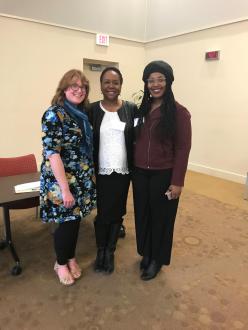
Lemon Project Team: Sarah Thomas (Lemon Fellow), Jody Allen (Director), Ravynn Stringfield (Graduate Assistant)

Between the live tweeting, taking pictures, running the mic, directing people, and checking people in, it’s a miracle that I managed to find time to be in the moment and listen. There were two roundtables in particular that really stuck with me from the event. The first was “Desegregating Higher Education: Placing William & Mary in Historical Context,” which featured an array of people with whom I was honored to share a room: Lynn Briley and Janet Brown Strafer (two of the Legacy 3, the first residential African American students at William and Mary); Lillian Ashcroft-Easton (the first African American to receive a PhD in the History department); Michael Engs (an African American graduate of the class of ‘69); Sam Sadler (for whom the Sadler Center is named); and Ron Sims (an early African American professor and administrator in the 1980s). It struck me as they talked so eloquently about their experiences at the College that these were the people who had made it possible for me exist in this space. Thankfully, as Valarie Gray-Holmes would say, they left gate open for students like me. (Gray-Holmes is writer and performer of the one woman show, “The New Gatekeepers,” which was performed during the Lemon Symposium.)

The second roundtable that I have been mulling over was “Building the Legacy: Where Do We Go From Here?” It featured Jessica O’Brien (graduate of the College); Karen Ely (the last of the Legacy 3); Chon Glover (our Chief Diversity Officer); Sharron Gatling (a staff member in the Diversity office); and senior undergraduate student Taylor Jasper. The questions asked were difficult to answer and sometimes, for Glover especially, difficult to answer without personal investment and emotion getting in the way. They were asked questions like “What has W&M done to heal the racial divide?” and “What specifically should our next steps be when we look at issues of race and reconciliation?” The answers were varied. In terms of what William & Mary has done, chief among the responses was the implementation of the Task Force of Race and Race Relations and the hiring of a Chief Diversity Officer. When thinking about what the next steps would be it seemed that everyone agreed that we have to move beyond the ceremonial and the low-hanging fruit, which is to say, we need to do the heavy lifting now. What exactly “the heavy lifting” will look like is unclear, but I think it’s safe to say it’s going to require more than renaming buildings and a year long celebration of the 50th anniversary of residential African Americans.

Artist Steve Prince discussing his work “A Bessie Stitch: 1948”

In addition to the fruitful conversations, I was particularly moved by all of the art that we had infused in this little symposium. We kicked off the weekend with an artist talk by Steve Prince, who spoke of African diasporic funeral traditions through art. The dirge, he argued, is the slow, sad, emotionally evocative first line, and what we need to get to is what’s called the “Second Line,” the music which celebrates life and helps us heal and move forward. He peppered his talk with images from his own beautiful work and helped the audience see his message within them. Then he held an artist workshop to create a collaborative work celebrating Mr. Lemon, for whom our project is named. (I unfortunately did not attend.) Finally, we ended the day with Gray-Holmes play, “The New Gatekeepers,” which I found as moving as the piece she performed in August 2017 at the mural unveiling in Swem Library which kicked off the 50th celebration. Gray-Holmes told the story of a woman from the Tidewater area in 1959 who witnessed the integration of William & Mary, whose grandson who had dreams of going to college, and how integration looked across the changing landscape of our country.

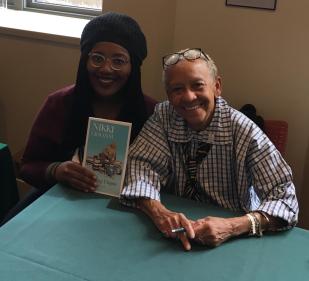
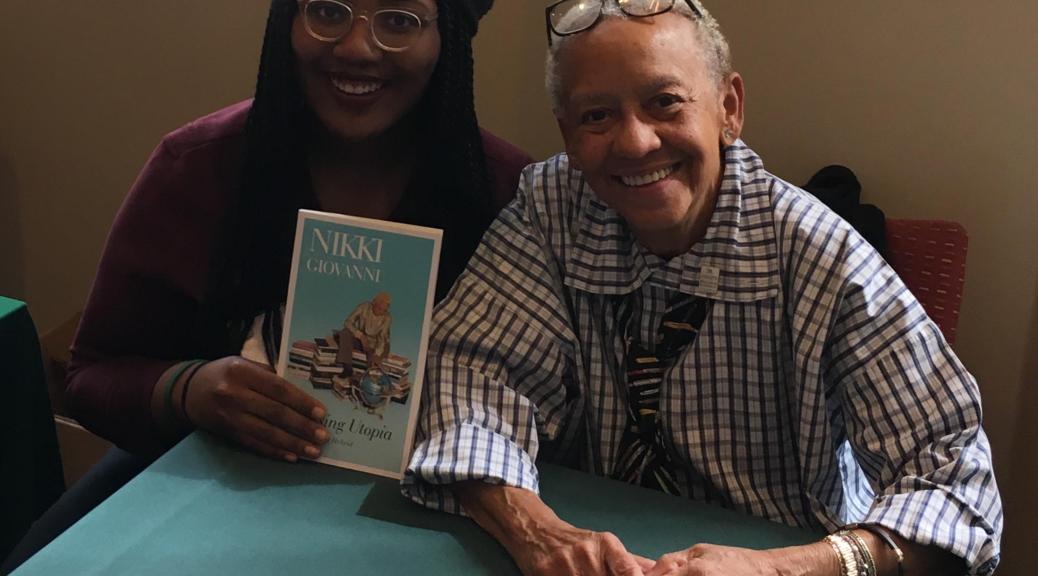
Ravynn Stringfield with Professor Nikki Giovanni

Of course, no discussion of this year’s Lemon Symposium would be complete without discussing the incredible keynote by Professor Nikki Giovanni. Nikki Giovanni came to prominence during the 1960s and 1970s as a Black Arts Movement poet, thrilling readers with earthy but vibrant, compassionate yet revolutionary poetry. Yesterday, Giovanni celebrated the Lemon Project with us, spoke of the process by which Africans came to be enslaved and were carried to America, describing it as a process which involved no longer recognizing clouds and thus knowing this land would be different. This was the first time I had ever heard enslavement described in this way– only Nikki Giovanni could get me to consider clouds as a system of meaning. She performed her legendary poem “Ego Tripping” at the request of Professor Jacquelyn McLendon, explained her theories about outer space and finding new life out there, and also thrilled us all by explaining that she believed “everything used to be somebody someone loved.” She is a tiny human full of these incredible ideas that she believes in so fully that I find myself convinced that there is life on other planets and that my precious laurel wreath ring used to be someone’s beloved aunt.

This year’s Symposium was amazing. The conversations were impactful, there was amazing audience participation, the art was inspired, and I got to meet some truly incredible people. To think, this isn’t even a complete summary of every single thing that happened, because I’d have to write a short book to do that. But I wanted to take some time to reflect on the dialogue that I had the fortune to be a part of these last two days because the questions we asked were important and the answers to those questions? Critical. I’m not sure what my role is going to be moving forward, but at least I’m beginning to think about my own answers to the questions that were raised.