
All posts by Ravynn K. Stringfield

Ravynn K. Stringfield is a Ph.D. candidate in American Studies at William & Mary. Her research focuses on Black women and girls in new media narratives that are fantastic, futuristic and/or digital in nature. She is also a dog mom, new yogi and hazelnut latte enthusiast.

Scholarly Insurgency at “Fugitive Futures: Grad Students of Color Un-Settling the University”

Scholarly insurgency is a way of life.

I don’t often think of what I do with this blog as “insurgency.” I do, however, think my work on Black Girl Does Grad School is urgent and necessary, which is how I came to “Fugitive Futures: Grad Students of Color Un-Settling the University.”

I saw the CFP circulating around Twitter and enough people forwarded it to me via e-mail, urging me to submit, that I decided to do it. The title alone was enough to draw me in. Fugitive Futures. Here was a group of young, up and coming scholars committed to reimagining the Academy as we know it. After attending “Intentionally Digital, Intentionally Black” at the University of Maryland last semester, I knew that I needed to be a part of more—for lack of a better word—intentional spaces.

A note about conferences: I honestly don’t think I do conferencing “right.” I’ve yet to present at or even go to a national conference like the American Studies Association or the Modern Language Association conference. I haven’t even presented at many conferences at all—“Fugitive Futures” is only my second. Let’s remember this is my third year in grad school and only my second conference presentation. In the interest of transparency, I was feeling overworked and not very confident about my “research.” I didn’t believe I had anything to contribute, and the only thing I managed to do consistently throughout my three years in grad school was write my BGDGS posts. But then, as I’ve written about, “Intentionally Digital, Intentionally Black” shifted my mindset. I started expanding my own conception of myself as a scholar and started to consider my digital work a scholarly intervention. The moment I stopped pigeon-holing myself as strictly a comics scholar, I started to blossom. After that, I realized I was ready to get back into the conference circuit, but I did wait until I was ready. It may not be the most solid advice, but it’s real.

“Fugitive Futures” marked a huge turn in my life. It marked the beginning of my second decade of life (I celebrated my 25th birthday the day before I boarded my plane to Austin). It marked my first real taste of total independence as it was my first solo journey to a place I’ve never been before. It marked the end of an academic dry spell. There was a lot riding on this trip, this conference, this presentation to be good—and I fortunately was not disappointed.

We kicked off the two day conference with a keynote by Saidiya Hartman. It was her book, Scenes of Subjection, that kept me from walking out of my Histories of Race class last year. Given her work is the epitome of scholarly insurgency, Hartman’s keynote was a perfect fit for the event. And while I could spend this entire post discussing her keynote alone, it is the graduate students and their fugitivity in their respective communities that I want to discuss. Presentations were wide ranging and conversations surrounding them were generative. I admired Carlisia McCord’s brutal honesty and her bravery in naming individual oppressors in her talk, “Can This Be Un-Settled: Why Not Just Flip the Table, and Burn it Down.” I heard from a group of doctoral students from UCLA speak about their collective efforts to organize for themselves in “’The Only Hope’: Black Doctoral Students Reclaiming Their Time.” Creative writers and Ph.D. students Maurine Ogbaa, Onyinye Ihezukwu, and Novuyo Rosa Tshuma gave illuminating talks on what it means to be African writers in “(Re)membering Africa: sneak[ing] into the university and steal[ing] what one can.” I was particularly taken with this talk because I had no idea one could get a Ph.D. Literature and Creative Writing and I will admit my mind was spinning wildly, wondering if I could do something like that. I have since come to my senses and am recommitted to my American Studies program. There were collaborative presentations and presentations from across the nation (and even a really cool student from Canada); presentations that made me laugh and made me cry, and both that made me consider what it means to have work that elicits such reactions and what a revolutionary act that is in and of itself.

When I’m in these sorts of spaces, I start to imagine what it would be like if we could coalition build with these people. As a digital humanities scholar, I’m always up for connecting via Twitter and apps like Slack. I think the digital can be a wonderfully generative place to imagine new futures. It is my hope that I will remain in contact with the people that we met this weekend, and that we will be active colleagues in helping each other navigate these spaces that were not designed for people like us to succeed.

If any of the organizers of “Fugitive Futures” are reading this, or even any of the wonderful people I met this weekend: Thank you. I see you. You can do this. You are appreciated.

We are the future, and the future looks insurgent.
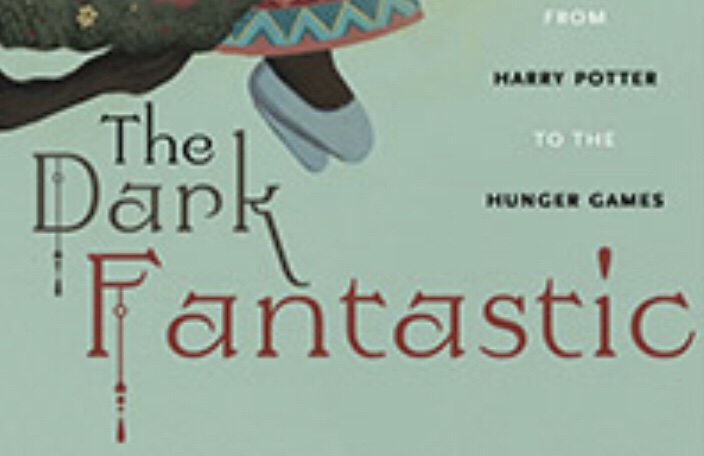
Book Review: THE DARK FANTASTIC by Ebony Thomas

“Are the cartographies of dreams truly universal?”

Ebony Thomas, The Dark Fantastic, 2

The Dark Fantastic: Race and the Imagination from Harry Potter to the Hunger Games drew me in from the very first time I saw its stunning cover. As a literature scholar, a Black studies enthusiast and Black fangirl supreme, I wanted– no, needed– this book. Someone had found a way to weave together several pieces of my own scholarly interests including race, literature, digitality and the fantastic. Despite being in the midst of reading for comprehensive exams, I couldn’t contain myself when I got an Advance Reader Copy of the book. One glance at the table of contents– which included chapters on my favorite witches, Hermione Granger and Bonnie Bennett– and I was hooked. I had found my scholarly Harry Potter.

The path through The Dark Fantastic is fairly straightforward, though Thomas takes the reader on an adventure to dystopian futures, far away realms and a magical present before leaving us at the gates of Hogwarts. In doing so, she encourages us to question our relationship to the fantastic, and more generally our relationship to reading and imagining. Is it as universal as we think? Why is there an imagination gap in literature for young people? Why is it that some young people of color “don’t like to read much?” (7)

In order to unravel some of these questions, Thomas first defines “the dark fantastic:” “the role that racial difference plays in our fantastically stored imagination.” (7) Thomas explains that she prefers the Fantastic to speculative fiction, noting that fantastic has a multiplicity of meanings. This distinction was important for me, as I am a scholar whose work will no doubt involve questions of the fantastic (or speculative) and I will have to decide which term more accurately describes my work. One thing that I particularly like about fantastic is that it’s not limited by “literature”– Thomas works on transmedia narratives that include books, television and film, not to mention fan culture, thus incorporating the digital.

Returning to the text, in the “Dark Other,” Thomas highlights a cycle that appears in a myriad of texts: “(1) spectacle, (2) hesitation, (3) violence, (4) haunting, and (5) emancipation.” Thomas revisits this pattern throughout each chapter, noting how each of these Dark girls (Rue from The Hunger Games, Gwen from Merlin, Bonnie Bennett from The Vampire Diaries, and Hermione Granger from Harry Potter) does or does not fall victim to it. Equally important to these discussions of the girls are the fans, often Dark themselves, that have critiques of the treatment of these characters.

Much of Thomas’ chapter on Rue from The Hunger Games is rooted in the cognitive dissonance the Dark Other can cause for (white) readers. A preconceived notion of what innocence looks like left some viewers of the film perturbed, to say the least, by the casting of a Black girl for the role. Thomas shows how Katniss becomes the moral center of the book only after Rue’s death, yet it is difficult for some to imagine that this young Dark girl can become impetus for a revolution. Like Rue’s, the chapter on Gwen traces her place in the dark fantastic cycle (or how she breaks it) before investigating fans’ relationships to the character. The main difference between these two is that Rue is written in her original text as Dark, while Gwen (Guinevere of Arthurian legend) is a fair maiden. For me, this brings up the question of race bending: is it or is it not an appropriate form of reimagining? To this point, there was a discussion on Twitter regarding a Black Batman. Fans circulated their actor choices for the role to which acclaimed author Nnedi Okorafor encouraged fans and writers to simply create more original Black characters. Shortly afterwards, writer Jamelle Bouie posted a thread in which he completely reimagined Batman’s origin story so that a Black Batman would contextually make sense. What Bouie did was imaginative and quite frankly, convincing– convincing enough to make me believe that we can have both new original characters and critical reimaginings, which is precisely what I believe has happened with Gwen in Merlin. As Thomas aptly states: “Gwen matters because she represents the dreams of brown girls who never saw themselves represented in fairy tales growing up.” (104)

Despite being an avid Potterhead and devoted lover of Hermione Granger, the chapter on Bonnie Bennett immediately caught my attention. The quickest way to infuriate me is to bring up the treatment of Bonnie in The Vampire Diaries; in fact,there is a video of me somewhere on the internet passionately discussing (hand gestures and all) this exact subject with my Branch Out students. Thomas knows that Bonnie “is not an easy character for mainstream audiences…to love” (109) and it’s hard to make a case for her. She’s sidelined, chastened, and used as a deus ex machina for many of the main gang’s numerous problems. But her character arc, in my opinion, best illustrates Thomas’ dark fantastic cycle: the viewer is introduced to Bonnie’s magic in the breath-taking “Feather Scene” (spectacle); negotiating Damon and Bonnie’s potential relationship by making her hate him (hesitation); Bonnie is repeatedly pushed to her physical limits with her magic, all in the name of helping her friends (violence); when she finally dies from exertion, Bonnie still haunts the show, serving as the anchor for the “Other Side” (haunting); and once she has saved everyone…again… Bonnie departs Mystic Falls for Africa (emancipation…?). It is unclear whether Bonnie was truly emancipated, and I would actually argue that she wasn’t. The writers’ decision to have Bonnie depart for Africa, which, as Thomas points out, was never something she r expressed any interest in, signals the Dark witch’s life to be an afterthought by them. But Thomas reminds us that “[d]ark girls like Bonnie are the problem and the solution, always.” (139) It’s time for more.

And honestly, I hope I’m part of the generation that participates in creating these worlds for Dark girls to revel in.

Thomas concludes with an ode to Black Hermione. Though she never imagined Hermione as anything but white, fans across the globe have taken J. K. Rowling’s description of brown eyes and frizzy hair to heart. The “Hermione Is Black” Tumblr tag shows us just how much audiences were imagining this possibility– “creative digital media communities” (165) have been doing this work for years.


Ebony Thomas took on the Herculean task of breaking apart and dissecting how and why we imagine, giving us convincing theorization and contextualization using her four case studies. She took us on a tour of her own imagination, which greatly resembles mine, weaving in narratives about her own journey grappling with the Dark Fantastic. She provided imaginative scholarship on subject matter near and dear to my heart. Most importantly, to me, Thomas provided an example of how I can combine all my passions into a coherent project, and for that, I am forever grateful. It is possible to engage both Morrison and Jenkins, Todorov and Whitted.

Thomas proves without a doubt that scholarship can be fun, creative, and if you’re lucky, fantastic.

How to Make Comps Reading Schedules

One question I’ve gotten since I published my last post was how I structure and organize all of my Comps readings. With my total number of “To Read” items coming in at 282, I knew I was going to have to get organized. So, this week, I’m going to share with you how I’ve been creating weekly reading lists for myself.

BIG PICTURE

  1. Find your preferred site for your organizing. For me, it’s an Excel spreadsheet that I haven’t closed since September 2018. I have a workbook page for each of my four lists, anda final page for my reading schedule.
  2. Divide each of your lists into smaller subsections. My lists are sometimes divided chronologically, and sometimes by theme. For example, my African American Literature list, from Slavery to the Civil Rights Movement is divided like this: Slave Narratives, Reconstruction and Nadir, Harlem Renaissance, Interwar Period, and Criticism. Each block of texts is color coded. I do this because tackling smaller subsections are easier than tackling a list of 50+ texts; and it makes preparing for meetings with your faculty easier. When I finish all of my Slave Narrative texts, I can schedule a meeting just to talk about that subsection. It helps if you don’t jump all over the place, but rather work with texts that can speak to each other at one time.
  3. PROTIP: I mark texts that I have read in a grad level setting, and have good notes on as “Read, to Return to,” so that I can review those more closely during my designated review period before exams.

WEEKLY PLANNING

Here’s the thing: every week is going to be different. Some weeks you can body several 600-page tomes, and some weeks you’ll barely be able to get through an article. The key here is to pay attention to your body and mind so that you don’t overwork yourself.

  1. Decide how you want to present your weekly lists. As I’ve said, my excel sheet is my life line.
  2. Know roughly how many texts you need to read per week to get through everything. For me, it was 10-12 texts per week.
  3. Assign yourself readings based on what you’ve got going on each week/how you’re feeling. Weeks where I don’t have any meetings, I usually assign myself 12 texts and they are typically on the longer side. Weeks where I have out of town conferences, meetings, etc. I assign myself closer to ten readings, and some of them might be on the shorter side, like poems, articles, and book chapters.
  4. Plan your readings for three or four weeks at a time, then give yourself a week to catch up on anything you missed. I know that reading 12 books a week is ambitious, particularly when I err on the side of reading every page. (PROTIP: have a better reading practice than I do.) So I if I don’t meet my goal in a given week, it’s fine– I’ll have an opportunity to catch up.
  5. Plan how you’re going to tackle your readings. Are you going list by list? Are you reading all monographs? Or a mix of articles and chapters? I’ve found that having variety in my weekly schedule keeps me focused and interested. I don’t know that I could have read all of one list and moved onto the next, but if that’s what will work for you try that. As I am typically trying to read 12 texts per week, I assign myself three texts from each of my four lists to read during the week. To keep myself from burning out, I try to mix and match monographs with poems, articles and book chapters. Some days, I simply can’t get through a monograph, but I can read and annotate three poems. And I work through my lists methodically, aiming to finish a subsection before moving onto the next and meeting with my professors.
  6. Then Read! (Blog post on how to read forthcoming)
  7. Take good notes! (Blog post on taking good notes forthcoming)

TIPS

  1. Mark off your readings as you finish them. It’s super satisfying and encourages you to work towards the next mark off on a finished text.
  2. Take advantage of the fact that you’re not confined to a classroom. Read in new places. Don’t stay cooped up in your apartment (unless that’s what you want to do.)
  3. When you can, talk to people about what you’re reading. My parents are the bomb.com when it comes to this. I’m an hour from home so I’ve spent a lot of comps in my childhood bedroom reading. When I’m done with a book, I revert to my childhood practice of telling my mother what I’ve just read, if I liked it, main arguments, things that made me uneasy. My mom’s a great listener and if I catch her while she’s doing the dishes, I’m free to chat about the text in great detail. My dad’s the questioner. He’ll ask me questions I never thought about and make me rethink my entire relationship with the text. I’ll read him quotes, and he’ll take the book, read it for himself, and come to his own conclusion. My family and I are definitely in this PhD game together.

There you have it, a short reflection on how I’ve been planning, organizing and tackling my readings! If you’re also reading for comps, best of luck to you! We got this!