
Category Archives: writing

Dissertating During Coronavirus

As you all are well aware, we are in the midst of a pandemic. In a matter of weeks, the coronavirus has redoubled public health and safety efforts, effectively resulting in the seeming indefinite closure of schools and universities, retailers and other places and events where folks congregate. This means conferences have been cancelled or postponed, travel is limited, and teleworking and online learning is the new standard.

There’s plenty to be concerned about: beyond the risk and concerns of contracting the virus, many are worried about spreading it, as we’re learning some folks are asymptomatic carriers; parents and other caretakers are now concerned about how to balance caring for their children and elderly; finding appropriate sustenance and necessities as panic-induced bulk buying cleans out shelves at grocery stores. There are worries about displaced college students having to shelter in abusive homes; acute financial concerns as some people are laid off entirely and losing work, and others having to continue working overtime to support a panicking population; and whether our president will wield this disaster as an opportunity to postpone the election.

And that’s just some of the discourse I’ve seen on the news and around the internet in the last week.

Then, of course, there’s the firm suggestion that we practice “social distancing,” a conscious effort to prevent the spread of the virus, which involves limiting the amount of contact we have with others. Many others are having a much harder time with this than I am, admittedly. Staying indoors, only venturing out for necessities, and entertaining myself with hobbies I can do in the house is pretty much what I do anyway. Plus, as I’ve written before, it’s just me and my dissertation this semester, which means I can write from anywhere as I have no obligations to be physically present at the university.

Rationally, I know not much changes for me, aside from the fact that my dog and I are weathering the pandemic from my parents’ house an hour away from campus. And yet, the low level of panic I typically feel in general on any given day has been turned up from about a 1.5 to a 4, with spikes of acute anxiety throughout the day.

I know I will be okay for a while. I’m safe. I have many of my comforts: my dog, my art, my books, my journals… but I can’t say I’m not unaffected by the many stories that cross my timeline in a day. Folks I interact with regularly online are having graduations cancelled and losing freelance gigs and are already in precarious financial and health situations. It could easily be months before things get back to normal.

It feels…disingenuous to be worried about my dissertation right now. On the one hand, there are so many other, more important things I could be occupying myself with at the moment. But on the other, work has always been my anchor, it has kept me grounded in the midst of personal upheavals. As long as my already busy mind is kept focused on a task, I can minimize the amount of time I spend spiraling into rabbit holes about the world ending.

I can’t say that there’s a “right” response to an international pandemic, but pressuring myself to work on a project that ultimately will end up on a shelf in College Apartments, untouched for decades once finished, just doesn’t seem useful.

What I think is a better idea is striving for some sense of normalcy in these uncertain times. Given that I am already prone to panic and anxiety without the added stress of a global crisis, for me, striving for normalcy will probably mean being more proactive than usual about my mental health and tending myself first, and working when and if I feel like it. I will need sleep, walks with Genghis, time to read, make art, write, to feel okay. I really need yoga, but it looks like my University is working to put some virtual fitness classes in place for us, so hopefully, I’ll be able to tune in with my favorite yoga teachers soon enough.

Most importantly, I think I’ll be reminding myself as often as I can to take some very deep breaths. More often than not, I realize I’ve been holding my breath. I sit up straight and and do some seated cat and cows to release my spine, roll my head on my shoulders, and breathe.

Sometimes that’s all you can do.

Breathe.

Dissertation Check-In #1

I opened a new scrivener file for my dissertation and started writing on December 28, 2019. In the two months that have elapsed since that day, I have done a lot of reading and a lot of drafting– 50 pages worth actually.

If it seems like I’m writing like a madwoman, here are some things to keep in mind:

  1. Writing is my primary vehicle for processing the world so I write a lot and often.
  2. I write fast. If I have an idea, I can lay down 1,000 words in under an hour.
  3. I don’t self-edit as I write. I word vomit and edit later.
  4. I am not working this semester. At my school, if you TA or are a teaching fellow, you’re off the semester you are not working.
  5. I have written something that can serve as a basis for each chapter, intro and conclusion, whether it be a conference or seminar paper, or an article draft. (Protip: before I started writing, I gathered all my relevant writing into a document so I would have my ideas all in one place. That document was 150 pages.)

To point number five, I’ve tested out a lot of these ideas, worked them out, but I’m excited to get to spend some time molding them on paper and synthesizing them even further.

Also, in terms of actual writing time, I don’t spend that much time writing. Every week, I give myself a writing goal word count. Typically, the minimum is 1,250 words (or 250 words on average every week day) and the maximum is 2,500 (or 500 words on average every week day). I try to be very flexible with myself, so it doesn’t matter how the words come out. If I write 1,250 words or more one day, I consider my work done for the week unless I have a stroke of inspiration, I rarely write more. Usually, though, I spend about an hour three days out of the week working on my word count goal.

That said, if I’m only writing a few hours a week, what am I doing the rest of the time? Reading. I spend a lot of time reading, rereading, reviewing, and researching. I’m taking notes and sketching and outlining. Admittedly, I do other things, too: I go to meetings for my various jobs around campus and with my advisor, I do conferences, go to lectures. And of course, I spend some time freelance writing, pitching and drafting and editing essays.

But I’ve got a rhythm for the time being: Monday through Friday, I am in Williamsburg, writing in my apartment or at the local coffeehouse. Every day that I write, I also move. So I try to make it to a yoga class (or Body Combat on Wednesdays), every day that I spend sedentary working. On Friday, I stop working, no matter where I am on the spectrum of my word count, and I drive home to Suffolk and spend the weekend with my folks. We do nothing happily and we go to church on Sundays. I sometimes make things, like mini canvases with custom quotes, for people. I take a break. And then on Monday, I drive back to Williamsburg and start my week over again.

All of my pages have gone off to my dissertation advisor and I’ve since gotten edits and comments back. However, sometime last week, I realized I was going really hard on the dissertation, even with all of my scheduling and breaks. So I took last week (which incidentally happened to be my birthday week) off. Tomorrow, Monday March 2, I am going to comb through my advisor’s comments a little more carefully and spend a week or two adjusting and reworking based on her thoughts. I will spend the last two weeks of March hopefully drafting about 20 new pages of work.

My goal, ultimately, is to have a sizeable chunk of this project drafted this year. I expect most of my work will come in the editing process. Writing, simply put, isn’t the hard part for me. Editing to get it where it needs to be is the beast I have to conquer.

In any case, I think I’ve made good progress over the last two months. I have a system that works for me and an advisor who is supportive, present and forthcoming with feedback. I do like being in this space: I love that it’s just me and my writing. It’s what I love, just getting carried away by ideas, and right now I can do that with minimal interruption.

It’s kind of nice.

Will it stay that way? Only time will tell.

The Hunger Games: Publishing in Academia

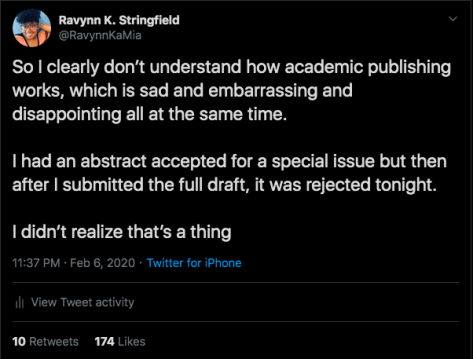
On Thursday night (2/6), I made a knee-jerk decision to tweet about the rejection I’d just gotten. I was feeling a lot of things, including, as the tweet left mentions, sadness, embarrassment and disappointment– yet, I forgot the most important reaction of all: confusion.

image

I’ve written more times than I can actively recall about rejection. It happens, with abounding frequency. When writing and publishing is involved, it is inevitable that you are denied, and it’s no surprise that rejections can be brutal.

And yet, when my latest rejection landed in my inbox, I was taken aback. I had submitted an abstract to a special issue, which was accepted. The wording in the initial abstract acceptance led me to believe that, yes, there were a lot of accepted papers, however, logistically, they, the editors, would find space for everyone.

So one could imagine my surprise when I received a brief rejection with no feedback, instead of revisions.

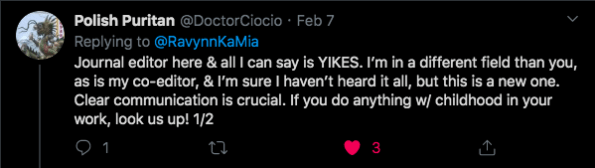
The initial tweet sparked conversation. Over 50 people replied with their own reactions to the situation. Some academics, including a journal editor, expressed shock that this was a possibility:

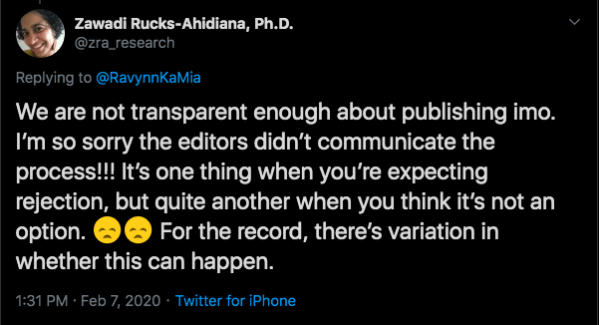
Others mentioned that this is an unusual, though not unheard of, possibility, that relies on very clear communication:

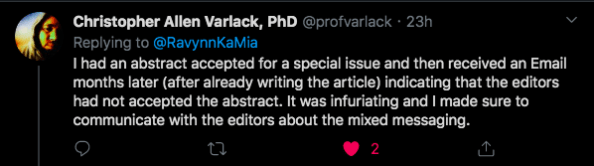
Still others offered suggestions, from reaching out to the editors and asking for feedback to shopping the piece around to other journals. Many offered words of encouragement, but several showed their solidarity by sharing equally jarring rejection stories:

The division amongst those commenting were striking. There were actually several divides and sides to what folks recognized as the issue. Many newer scholars, that tended to be from marginalized communities, had never heard of this practice. However, senior scholars tended to begrudgingly admit that rejecting a manuscript after the abstract has been accepted is not an unheard of practice. There were divisions between whether this was an issue of lack of clarity and transparency, that no feedback was offered, or that it had happened at all.

And while there was at least one comment that suggested that the fault of this was my own for not asking adequate questions and also a reflection of lack of mentorship, most people, regardless of what they saw to be the issue, were in solidarity.

Clearly, there are some things we need to discuss about academic publishing.

While I am a new scholar, I am not completely new to the academic publishing process. I spent my first year in grad school as an apprentice with a scholarly press that published had both a quarterly journal and a books division. I spent two solid weeks in apprentice training learning the ins and outs of academic publishing. Of course, much of what I absorbed during my training and the subsequent year of work did not sink in until I started to hear peers speak about the process and I began to undergo it myself. I began to have a clearer idea in my mind about what terms like peer review and revise and resubmit meant.

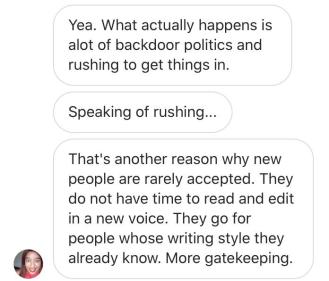
This experience has also clarified ideas about transparency in the processes we must undergo in the Academy. This is the number one reason why I started, and maintain, this blog. I recognize that much of this journey is opaque. Another twitter user, Jameelah Jones, reminded me on Instagram that the structure of many academic journals is not meant to ensure the success of new scholars. There are invisible, gatekeeping rules and constraints that, like spiderwebs, of which you are unaware until you run headlong into them. And unlike those who learn their lessons and fall into complacency, I will continue to fall and record my errors (and triumphs) so those who come after me won’t have to make my mistake. The success of future generations of scholars matter as much to me as my own success.

To ensure the success of future generations of scholars in publishing, it is advisable that we drop the unspoken rules of the Academy that uphold a status quo and begin to operate with transparency. This means: we must be clear about expectations and processes, rather than depend on assumed knowledge. We must actively encourage the growth of emerging scholars, which in this case can mean ensuring constructive critique on pieces of writing. We must lift as we climb.

Publishing does not have to be a gatekeeping practice. It should be an institution that stands for new ideas and the dissemination of new knowledge, rather than a shield that protects the old guard. Given that academic publishing can tend toward being more harmful than helpful, it’s no wonder why newer scholars have invested their time and energy in projects that seek to cultivate their voices, often of their own making.

In some ways, I should be grateful. If not for the state of academic publishing and the tendency of academic structures to both reject and overuse contingent faculty, I wouldn’t have Contingent Magazine. The feeling of shouting into a void with publishing that often reaches a very small audience propelled me to begin writing for online magazines. Lack of transparency has birthed a network of graduate students creating their own infrastructures for each other and those who will come after, just look at #CiteASista, #FirstGenDocs, Blk + In Grad School, and Blackademia. Just look at this site.

I now believe that a large part of my scholarly intervention has been through the creation and curation of this blog, the conversations I can start and cultivate, the people I connect with that have become integral parts of my journey.

And I firmly believe in the possibility and potential the conversations changemakers have, in person and in the digital, to foster new forms of knowledge production and dissemination.

So maybe, the question isn’t even: how do we fix what’s broken?

Perhaps it is: what’s next?