Category Archives: The Journey

Creative Note-taking

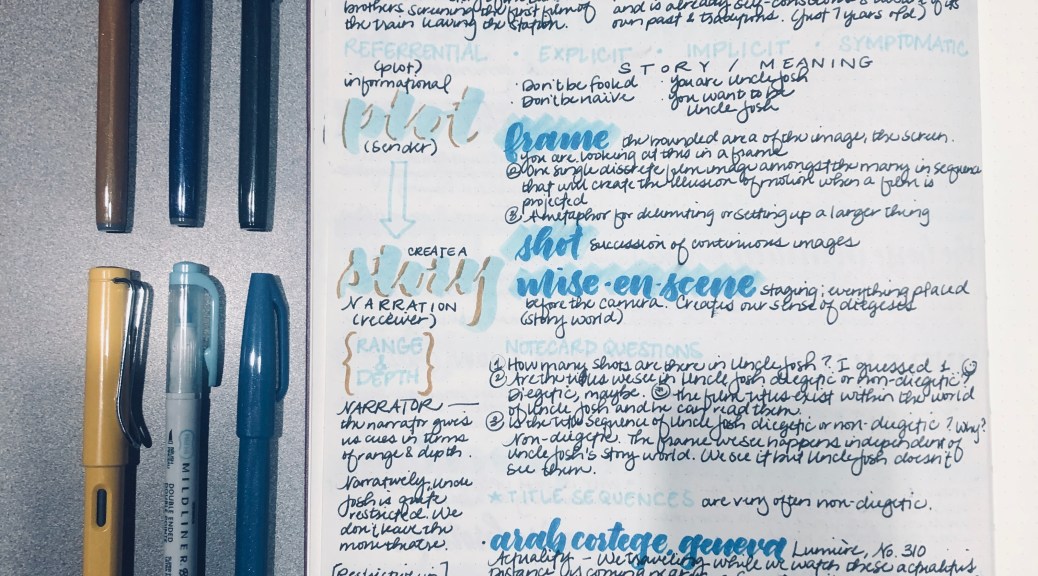
If you follow me on Twitter, or on my creative instagram account (@RavynnCreates), you know that I love creating aesthetically pleasing notes. People often have questions about them, so I thought I’d create a FAQ post about my notes.

  1. Why do you make your notes like that?

Well, first, it’s super fun! I love making things. It also helps me focus, and it makes my notes easier to read and study when I have to go back to them.

2. What do you mean it helps you focus?

Making creative notes is almost like making a mind map. I think about the relationship of sections and words. For example, if we’re talking about the features of the “Classical Hollywood Narration,” it helps to make that heading large, and make the features smaller underneath, or close to the heading. Sometimes it helps to box things in so I know everything in that section goes together. It can also help to color code. If my heading is gold, I might use a different gold pen to number or bullet point everything that falls under that category. Sometimes I use a combination of all of these methods.

3. Do you make them during class? Like while the professor is lecturing?

Yep. Again, it helps me focus.

4. So you don’t just take quick notes and then rewrite them?

No. I do not.

5. What do you use to take notes? Pens? Notebooks?

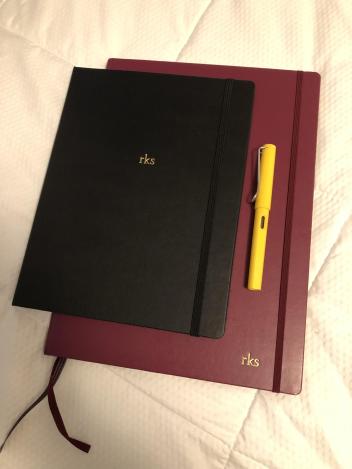
My semester notebook is a burgundy Leuchtturm A4+ Master Slim with 121 dotted pages that I got from Jenni Bick in Dupont Circle in DC. Yes, it is personalized.

I use a variety of different pens. For headings and small brush lettering, I use Pentel Sign pens. For shadows and highlights, I use Mildliner Brush Pens. For detailing, I use Metallic Gelly Roll pens. For regular writing, my main text, I most often use a Lamy Safari fountain pen. If I’m not feeling the Lamy (or if I have run out of ink), I use Zebra Sarasa 0.7 ballpoint pens.
6. Wow, that’s really specific. Why do you use those brands?

Leuchtturm journals have thick pages that don’t ghost (show ink on the other side) and they are pre-numbered. Pentel pens are super reliable, and they come in really great, bold colors. Mildliners, I don’t use as much, but I still like them for background and contrast. Gelly Roll pens have really strong color, and they’re also reliable and relatively easy to find. I’m using a Lamy pen because I wanted a good fountain pen and I thought it might be cool to invest in a utensil that I would love to use. It’s beautiful and yellow and I do in fact love it! When my students from Keio offer me stationery gifts, they’re often Sarasa/Zebra pens and Japanese stationery is the best, so usually I’m just using the pens they gift me.

7. So do you just, like, travel with all those notebooks and pens?

Yep.

8. How many pens and notebooks do you carry with you daily?

Between 2-3 journals. I always have my semester bullet journal with me and I often have my dissertation journal. Sometimes I’ll bring my leather bound diary if I haven’t written in a while.

I honestly don’t know how many pens I have at any given time. I have at least 3 of each type of pen in different colors (except the Lamy) in my purse. I mean…probably at least two dozen.

9. Do you let people borrow your pens?

No.

10. Really?

Really. I keep a couple of regular Bic ballpoint pens in my purse to give to my students if they need a writing utensil in a pinch.

11. But how do you make such pretty pages?

Honestly, I don’t know. It’s the equivalent of doodling. My hands just kind of do their own thing. I don’t lay out my spreads prior to class, they just sort of happen. I more or less start on the top left of the page and just build from there.

12. Do you have any suggestions for folks that want to try creative notetaking?

I do! First, try not to take it so seriously; let it happen naturally. The more you try to make it pretty, the more pressure you put on yourself and then you likely won’t be satisfied with the way your notes look. Second, experiment with fonts and colors in relation to others on the page. If you have a keyword in gold script on the right in a square with writing around it, maybe try bold blue uppercase letters for your next piece. Third, practice! I’ve been making notes like this for years and it took me a while to get to a point where I could make these pages. Lastly, comparison is the thief of joy. Your notes will not look like mine. My notes will not look like yours. Embrace the uniqueness of this little way of expressing yourself!

“Double Consciousness” Recap: “What Makes Up a Black Girl?”

“Stamped with a magic so spiritual that angels and colonizers alike wanna get like us.”

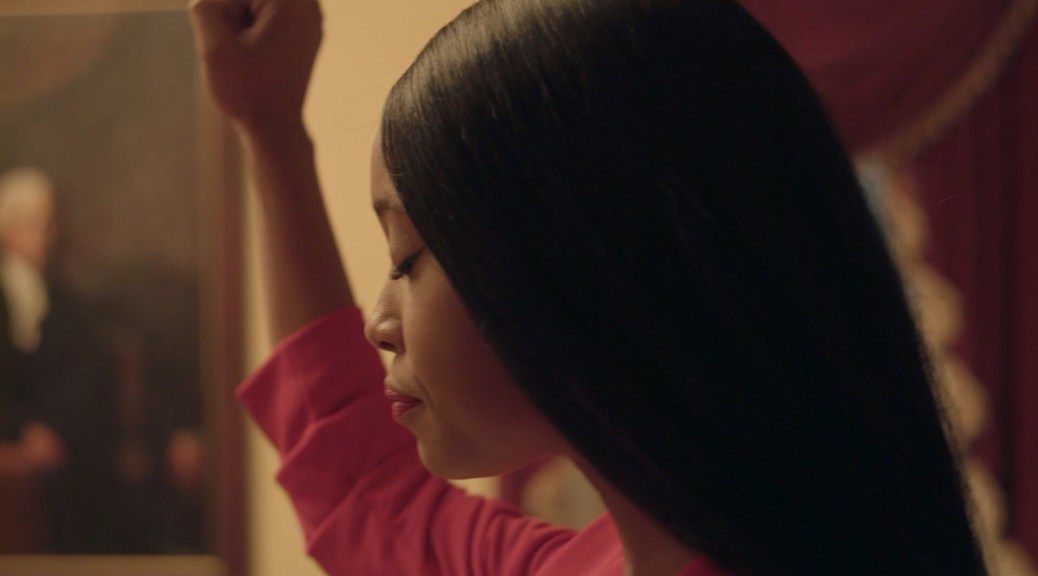
The long-awaited webseries, Black Enough, which premiered on Sunday, begins with a question: “What makes up a Black girl?” As the narrator lists the many things which she believes may make up a Black girl, we are treated to visual texture. The movement, the 16 mm film and the substance (which might be a tangible representation of Black Girl Magic) juxtaposed with the spoken poetry inform the viewer that this experience will require engagement and critical reflection.

After all, when was the last time you wondered what makes up a Black girl? For me, it’s a daily ritual, akin to a prayer, to daydream about the magic from which we are created. I find wonder in our quotidian experiences, like focusing on the details of the protagonist, Amaya’s (Tiffany Gordon), college dorm room, getting to know her, and learning her uniqueness. While she’s at peace in her own space, we begin to see her fractures: Amaya is unsure of herself around Lena, her friend from home; at least somewhat interested in making friends with her white roommate who has no home training; and searching for something.

When we see Amaya later in the episode watching a Brownskinned_Barbie (Brandi Jaray Mcleain) YouTube video, attempting to do her hair, viewers understand that she is reaching for this idea of Black Girl Perfection. There is a desire, however slight, to be like Brownskinned_Barbie– pretty, cool, and popular with 4a curls that act right after a single spritz of water. But more than that, Brownskinned_Barbie represents a crucial piece of Amaya’s identity struggle: her hair. Maybe Brownskinned_Barbie is not perfect, but she knows how to make her hair shiny, defined and moisturized– a Black Girl Superpower Trifecta I have yet to perfect. Amaya begins to connect her identity as a Black girl to the appearance of her hair, believing that her hair and her soul need to be in alignment. (For more Black women writing about hair as an extension of self and self-expression, see Tanisha C. Ford’s work, particularly the chapter “Jheri Curl” in Dressed in Dreams.)

Her self-doubt spirals even deeper as she sits in on the first Black Student Union, led by the seemingly perfect Vaughn (Branika Scott). Vaughn’s “welcome speech,” which details the history of the BSU at Weston and finishes with a poetic embrace of all her “brothers and sisters of the Diaspora,” unsettles Amaya. Only when Vaughn chuckles and says, “You’re already Black so you meet all the requirements, right?” does Amaya leave, feeling as though she did not meet the requirements.

The experience prompts her to create the recipe for a “Black Girl Magic Potion” on her mirror, as she tries to find the secret to a supposedly inherent alchemy we are said to possess. One of the last scenes of this episode is of Amaya circling “Go Natural” on her Potion/list, foreshadowing challenges to come.

Amaya’s story and the poetic narration are woven together with interviews with Black women and girls who reflect on their own experiences with our magic, including words from Hanna Watson, Stephanie Crumpton and myself. Altogether– the poetry both spoken and visual, the story, the interviews, the texture of the 16 mm film with the digital– creates a quilt of different pieces of art that are woven together to create a cohesive story, that wraps you in warmth. The warmth is the result of feeling seen and understood as beautiful. Black Enough leaves you feeling whole, and you, the viewer, want that for Amaya, too.


Further Reading:

Dressed in Dreams: A Black Girl’s Love Letter to the Power of Fashion, Tanisha C. Ford

The Souls of Black Folks, W. E. B. Du Bois

More Than Enough: Claiming Space for Who You Are (No Matter What They Say), Elaine Welteroth

Hair,” Elizabeth Acevedo

why you cannot touch my hair,” Eve Ewing


Feature image courtesy of Jeremy Rodney Hall

Doubt, Failure and Rejection

If you follow me on Twitter, or even here on Black Girl Does Grad School, it’s evident that I’ve been in a bit of a funk for a little while. Okay, a lot of a funk and for a long while.

The truth is, it happens and it happens frequently. Grad school is just like that: some weeks you are fine, you feel like you are killing the game, you’re writing, you’re reading, your productivity is through the roof. And some weeks (or several of them…in a row) are about opening rejection emails before you’ve even left your bed in the morning, blank word documents, institutional drama, and the increasingly depressing feeling of trying to keep afloat in the middle of the ocean, knowing that any moment it could swallow you whole.

In particular, rejection letters really have the ability to drown me when I’m already barely afloat. On a day when I’m balanced, feeling healthy and whole, surrounded by love and support, rejections barely cross my radar. On a day where I’m already irritated and isolated (often self-imposed) due to circumstances outside of my control, rejections take me out. Negative self talk is already the soundtrack of my day, I’m feeling like my writing is particularly weak, and then bam– the worst sort of confirmation.

I sort of came to an understanding with myself. I stopped trying to fight the labels that academics were using to make me legible. I instead focused on simply doing work that fed my soul and that I felt was a direct expression of me walking in my purpose, worrying less about categorizing it and making it marketable, and more on making my words fly. This mental shift helped me prioritize, focus on and execute my work in a way that was meaningful to me.

And it worked.

Until it didn’t.

I now believed in my capacity to produce substantive, rigorous and complex work; I was focused enough to write it; I was becoming brave enough to submit it but nobody seemed to believe in me as much as I now believed in myself. It was enough to crack even the strongest of foundations and then the doubts seeped in. The worries that I had finally managed to shake reached through those cracks, grabbed ahold of my soul and squeezed. As often as I jokingly recount the tale of how I became Peanut Festival Queen of Suffolk, Virginia, the nagging thought that follows like a bad aftertaste is, Did I peak in high school? It seemed that making your dreams come true was a concoction of ambition, consistent hard work and a dreamer’s heart, but I lacked that dash of magic that seemed to be the key.

When all is said and done, I know I usually like to end my blog posts with a neat bow. I am nothing if not a (somewhat performative) optimist. I like to believe that even if I haven’t yet, I will overcome adversity and the fruits of my labor will be rewarded. And while I do have faith that everything will work out for me, I’m still living in a moment in which I am constantly stewing in a stale pot of doubt, failure and rejection, instead of perfecting my recipe for Black Girl Magic. I’m learning to live in the space between my imperfections and my potential, coming to embrace the harmony that failure and resiliency produces. Practically speaking, it means I honor my feelings, because even if I know that my future is bright, today’s forecast is overcast and rainy. It means that I take a moment to be transparent in my writing about what this moment is for me, instead of hiding from it, as if it doesn’t exist.

And perhaps…the answers that I have been hearing are not a no.

It’s an implied not yet.