
Category Archives: Mental Health

Rediscovering Wellness

In the past year, I’ve gained an astronomical amount of weight. I can attribute the unwanted gain mostly to comps. I sat, virtually immobile, for an entire semester, eating any and everything I could find as a way to manage the stress of having to read hundreds of books before the end of April. I pride myself on having finished comps with my mental health in tact but my overall wellness was severely lacking.

I found myself constantly looking at old photos of myself from my fourth year of UVA and crying over pants that no longer fit. Though I looked at UVA through rose-tinted glasses, the truth was that I was stressed, often depressed, barely eating and walking uphill to classes every day. I naturally lost weight without trying and it came off suddenly.

One day I was unexpectedly able to wear my mother’s clothes.

Then another day, I wasn’t.

My descent to this pit of bad eating practices and barely moving came on over the course of a year. I formerly despised fast food, eating it only when I visited my parents. Now, I don’t want to even think about how many times I ate Popeyes and Cookout in the last month. I found myself too emotionally distressed or mentally fatigued to move, let alone cook. I had somehow replaced my stove top popcorn, lightly salted, for salt and vinegar chips. The decision I made at age ten to stop drinking soda had become void.

I was, in short, a mess.

But I didn’t wake up to my serious lapse in health until a visit to the doctor a few days ago. If the number on the scale didn’t shock me, the realization that I would be unable to safely continue taking one of my medications because of my weight certainly did.

I was letting grad school not only steal my mental health but my physical wellness too.

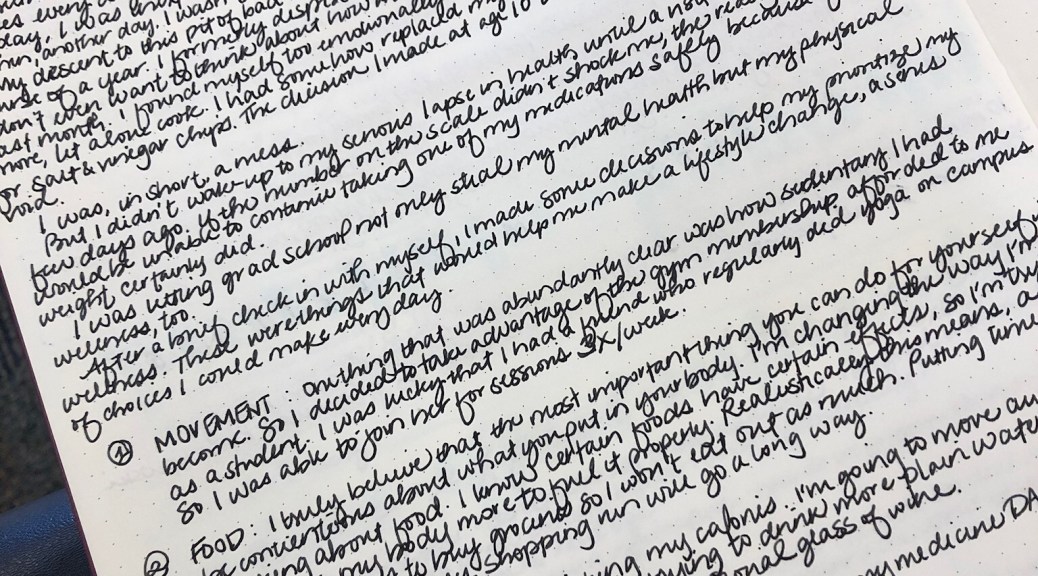
After a brief check in with myself, I made some decisions to help me prioritize my wellness. These were a series of choices I could make every day that would eventually add up to a lifestyle change:

  • MOVEMENT: One thing that was abundantly clear was how sedentary I had become. So I decided the first thing I could do was make the decision to move more. My school offers a free gym membership that I signed up for, and with the encouragement of a classmate, I joined her for my first ever yoga session. Together, picked three days out out of the week where we would do a yoga class. I decided I would do this for a couple weeks, to start build strength and endurance, and when I felt stronger I might add a cardio class to my line up.
    FOOD: I sincerely believe that the most important thing you can do for yourself is be conscientious about what you put in your body. I decided to change the way I think about food. Food, going forward, will be a manner of fueling my body, after giving careful attention to what it needs. The right food can be medicinal even. Realistically, this means making a concerted effort to plan out my grocery lists and buy a variety of good “fuel” to keep in my apartment so I’m less inclined to eat out.
    DRINK: I’m going to stop drinking my calories. I’ve decided to move away from flavored bottled waters and powders, and making an effort to drink more plain water and tea.
    MENTAL HEALTH: I’m recommitting myself to taking my medicine daily; going to therapy at least every two weeks; and reintroducing journaling into my every day routine. In addition, I want to integrate a regular morning and evening routine to help me steel myself for the day and then unwind from the chaos, which will include: meditation, journaling, coffee/tea, outside time with Genghis, spiritual practice, gratitude logs and prayer.
    SPIRITUAL WELLNESS: I am recommitting myself to Sunday’s as a day of rest and worship, I will do no work on Sundays. (I usually write my BGDGS posts before Sunday, so not to worry, I will be breaking no rules by continuing to post on Sundays.)
    JOY: I will relentlessly prioritize my joy and continually choose to do things that I love. This means, more time with friends, visiting the farmers market, visiting the water for rejuvenation, and rekindling my love of making art.


A few things are clear to me: one, is that I have failed to truly practice what I preach, which is to hold onto your wholeness while in pursuit of the PhD. Another is that I will not finish if I am not taking care of myself with the same vigor with which I approach my work. The last is that I deserve better that what I have given myself recently. I deserve a clean space, nourishing food, regular wellness practices and the space to pursue my ow joy. Nobody can give me those things except for me, and I heartily accept the challenge of putting myself first.
How I’m Staying Sane During Comps

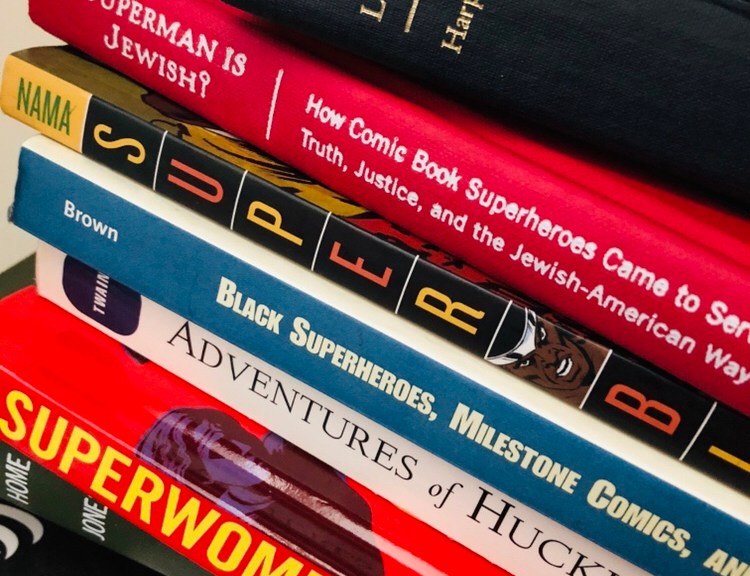
Comps was the first thing I asked about when I came to my grad program’s admitted students day in 2016. I wanted to know how it worked, what the exams were like, how you made your lists, how you studied for them– and my now friend, James, said to me: “Worry about that when you’ve done your Masters.”

Well, James, it’s definitely time to worry about them.

In truth, I have moved past my initial fear and anxiety surrounding the exams. I’ll worry about taking the actual tests in April. Right now, I’m just focusing most of my energy on reading, organizing my schedule for readings, note taking and meeting with professors. So I thought I would take this time to break down how I’m structuring my time, making the most out of meetings with my professors and caring for myself during what would otherwise be a pretty stressful time.

Reading

The most productive piece of advice I can give you is to make yourself a reading schedule in whatever feels like the most effective way for you get the job done. I have an Excel spreadsheet open at all times with five tabs: four tabs for each of my four lists and a tab for my reading schedule.

For my sheets with the lists on them, I have columns for the title, author, date published, and whether or not I’ve read it. The books are broken down into smaller sections, which group the books according to time period or theme, about 4 or 5 sections per list. At the bottom of each list, I’ve got a running count of how many of the list I’ve read and how many I have left to read.

PROTIP: If you read something in a graduate level classroom, I have typically marked those books as “read” but highlighted them as something to come back to at the end to review if I have time.

My reading schedule is fairly rigid but also pretty flexible at the same time. I read on average 10-12 books per week, but I’m flexible about when during the week I read them. I could read three books two days out of the week, two books two more days, and take a day to rest. I could read one every day, and then a few days I read two. Whatever works so long as I get the books that I’ve listed for that week read with notes.

Meeting with Professors

Every professor is going to be different but so far, I’ve found the most effective use of everyone’s time is to just send your professor a quick email update with what you’ve read since the last meeting and single out a few texts that you really want to talk about or have questions about.

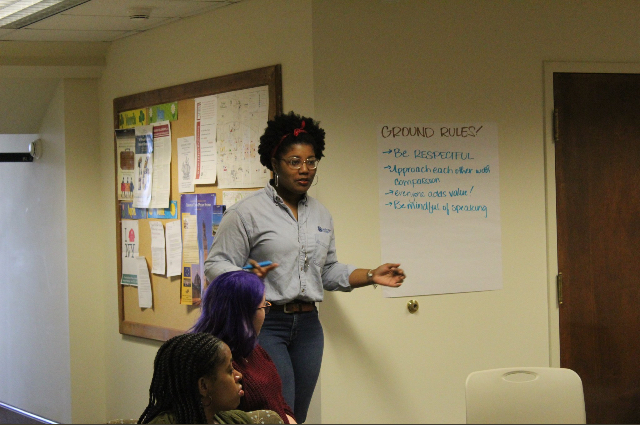
But the best advice I could give you about meeting with your professors is to establish some ground “rules” for how meetings should go: What do they expect from you? Do they want written reviews? Email updates? Can you email questions in between sessions? How often do they want to meet? How best can you utilize that time?

PROTIP: Take your notes and any texts you want to discuss so it’s easy to refer to. (Don’t bring your entire library cart. Your meetings won’t last particularly long, as they do have to work after all. 3-4 texts seems to be working for me.)

Self-Care

And most importantly, I’m caring for myself during this time. I have

  • picked up a relaxing new hobby
  • started going to the gym (semi) regularly
  • Been taking a weekly Mindfulness class
  • Started writing comic book scripts for a series I want to publish one day (writing 30 minutes a day)
  • Started cooking more meals at home and
  • Been spending time with my family.

Even though doing comps requires doing an insane amount of reading, in reality, it’s kind of nice if you let yourself believe it. Most days, I’m in bed or on my couch with a stack of books, some coffee and my dog, reading and taking notes.

In order to make the best use of my time, I’ve set my days up to look like this:

  • 7 AM-8 AM Wake up
  • 8 AM- 9 AM Morning routine (walk dog, breakfast, coffee, meditation, etc.)
  • 9 AM- 12 PM Work Block #1
    • Using the Pomodoro Method, I try to read at least one book in this three hour block (and if time permits, take notes)
  • 12 PM-2 PM Afternoon Break (lunch, gym, walk dog, catch up on TV, nap, etc.)
  • 2 PM- 5 PM Work Block #2
    • Using the Pomodoro Method, I try to either finish the first book or read a second. (if time permits, notes)
  • 5 PM-7 PM Evening Break (walk dog, dinner, self-care time)
  • 7 PM-8:30 PM Work Block #3
    • This is time that I reserve for note taking, making connections between texts, reflecting on them, etc.
  • 8:30 PM- 10 PM Evening Routine (walk dog, shower, journal, write for fun, catch up on TV, meditate)
  • 10 PM-11 PM Sleep

Granted, this is what my ideal comps day looks like. Not every day pans out like this, I’m okay with that. Generally speaking though, I do like to work between 7 and 8 hours a day, broken up into blocks of 2-3 hours. This method helps me focus, but do what feels right to you!

The last thing that I do for myself every week is I give myself at least a half a day, to a whole day, off every week. I always give myself Sunday mornings off for church. I can read for the whole rest of the day if I want, but from the time I wake up on Sunday to the time I get back from church, I am offline.

Structure and organization will most definitely help you get through comps, but don’t be rigid to the point of breaking with your scheduling. It’s there to guide you, but do know that life happens. Just do the best you can. That’s all anyone can ask of you.

Week 14: My Scholarly Philosophy

I often ask myself what type of scholar I want to be, and not in a hypothetical way. I ask myself this question so that I can think through how I write, for whom I write, and why I write. I ask myself this so that my scholarship matches the way in which I live my life, so I’m not just words, but so that I live my beliefs as well. I also ask myself this so that I know how I will orient myself in my classrooms and how I will approach teaching my future students.

In order to figure out what type of scholar I want to be, I often look to senior scholars for examples. This process was admittedly very stressful at the start of my graduate school career because I was not sure how I wanted to market myself as a scholar. As time has gone by, the more experience I get, the more I read, and the more people I interact with, the more I can add to my “scholarly philosophy,” or my personal approach to scholarship and how I will maneuver the Academy.

This time when I asked myself what type of scholar I want to be, it was a direct response to reading Dr. Roopika Risam’s new book, New Digital Worlds: Postcolonial Digital Humanities in Theory, Praxis, and Pedagogy. The arguments themselves were compelling, but I found myself captivated by her methodology. As advertised, the book was indeed equal parts theory to praxis to pedagogy, and I found this endeavor to be postcolonial in and of itself. I admired the way she took care with her terms, sacrificing no nuance in her quest for clarity and readability, something I am to do myself. In the book’s orientation towards both postcolonial scholars and digital humanities scholars, arguments had to be clear to both audiences, resulting in using many rich examples of digital humanities projects which do postcolonial work to illustrate her point. For me, the high point of the text was the chapter on pedagogy, which offered very tangible ways to bring the postcolonial and the digital into classrooms to spoke to my heart, such as using comics, editing Wikipedia pages, creating podcasts and social media pages for characters from books. Risam ends with a “Call to Action:” a cautiously hopeful rallying cry, which I heard and took to heart. In her work, Dr. Risam gave me a model for the type of scholarship I ultimately would like to do.

I want to write scholarship that is rigorous, but still accessible.

I want to cultivate a dynamic classroom environment in which my students feel safe to question, learn, grow and create.

I never want to be trapped by my own words; that is to say, I want to build infrastructure to change the way we think about higher education and knowledge production and its dissemination, not just write about change.

I want to engage in critical making as it pertains to world building in the real world. I want to create communities, scholarly and otherwise, where people are cared for and nurtured.

I want to be an advocate for my students.

Fortunately, I have had a whole host of good examples of scholars who have shown me how to do the work I desire. Dr. Roopika Risam gave me a model of how to write book that does that work. Dr. Jessica Marie Johnson has shown me how to think critically about citational politics; how to express gratitude for everyone and everything that has impacted your thinking. Dr. P. Gabrielle Foreman and Dr. Lynn Weiss have shown me how to truly care for students. Dr. Liz Losh has shown me good mentorship, how to organize a careful syllabus, and how to think ahead.

Thanks to them, I look forward to creating classes which incorporate theory, guest speakers, project analysis and critical making; classes that experiment; and which take input from the students. I am already looking forward to teaching an Afrofuturism class that draws from literature, film, comics and music, while employing digital humanities final project ideas. I aim to be firm but reasonable, rigorous but kind in the classroom. My goal with teaching will not only be to teach my students the content, but to also have them consider new ways of showcasing that knowledge. There will always be something to be said for a well-written paper, but why does knowledge production and dissemination have to know bounds when the content defies imagination?

I will write the traditional dissertation so that one day I can advocate for the grad student that wants to write a novel, create a digital humanities project, or start a nonprofit for their degree. But this is not to say that my dissertation will not have a signature Ravynn flair.

I will find a way to not only write peer reviewed articles but fiction as well, and I will start that magazine. Making art, not just analyzing it, is going to be a critical part of my praxis.

I am going to get through this doctoral program and I am going to demystify this process for those that come after me. Assuming I work with graduate students, I am going to be the mentor that asks my students to co-author with me, that helps them network with my peers, that sits down with them and helps them chart a trajectory through grad school. And assuming I work with undergrads, I am going to hope that they leave my classroom better than they did before walking in.

It comes down to this: while I was preparing my comps lists, I showed my dad what I was working on. After the shock of seeing that I had to read nearly 300 books in less than a year wore off, he asked me, “Is reading these books going to make you a better person?” I hesitated because the truth was, I knew this process was going to make me smarter, but ultimately he wanted to know if this would help me become a good person. So, I told him the truth: “I hope so.”

The truth is I just want to be a good person that does some good in this world. I hope having a philosophy for how I will approach my chosen career path will help me do just that.