

My first year as a PhD student has come to a close, and now after two months of much needed distance I can say that I somehow survived. I made it out with my skin still attached, I scraped past the beast and kept my teeth. I refer not to the “nightwalker” that is the looming deadline, or the paralyzing gorgon of self-doubt. I am not bemoaning the money that grad school has sucked out of my pockets like Charybdis did the sea. The hazard that I escaped is one that I had forgotten between my stints as a student: I had forgotten how it feels to be a problem.
Before I lose anyone on that point let me be clear. I am grown. I am not sitting at the cramped table of the intimate basement classroom tossing spit balls and forgetting to raise my hand. Oh no, this is PhD life honey! I am a problem in the same way all Black folks are in academia. I am an issue because I placed my body and its otherness into a space that fought so long and hard to maintain its monogamy. I hear people tell me, “You’re in the door girl! Now all you need to do is work!” To that I say, sure; if the proper symbol for the Black student’s entrance into academia were a door, then that would be an appropriate stance. But that expression isn’t fitting here. In entering the university, the Black student has not “gotten in the door,” the Black student has instead made her way through the first in a series of gates. These gates are meant to compartmentalize, to discourage, to limit and to control our experiences in the university.
The second of these gates to come crashing down in front of my feet was the gate of assumptions. The otherness of my body came with a great many numbers of expectations. My body belongs to a Black person, and with this package comes ideas about my personality, my speech, my history, my motivations, my interests and of course my abilities. My body also belongs to a Black woman. The otherness of my womanhood only tacks onto these expectations and with them comes a danger. In this body, in this skin I have to be careful. This gate, and its expectations, reappear over and over during the academic odyssey. It comes back y’all. It is battled using the greatest and most important tools in the Black student’s arsenal: The Black Performative.
For the sake of keeping things simple, I’ll speak on the most essential tools in the kit that is The Black Performative; these being the successful voice, the successful body, and mindful usage. Girl, Sis, lovey and my brother too; y’all know what the successful voice is. It is the change in our tonality, in our speech pattern, in the use of our dialect. Some of us call it “the school voice,” but it follows us. We pull it from our pockets on the phone, at the checkout, even when someone strange bumps into us. It is a defense mechanism that is literally needed to succeed in academia and so to call this tool the successful voice is very easy and very appropriate. I am immensely guilty of indulging in my successful voice. As a Black woman with southern roots I speak a very different English at home, one of which I am proud to say I could break down the grammar rules of on a dime. My home speech is unique, it is the remnants of an old code spoken in Dothan, Alabama. It is complete with its own rules and unique vocabulary that, outside of the comfort of my home loses all of its meaning, but y’all kin come takes muh words from muh cold dead hands. Ain’t not nare ‘nough yenom on earth to pay me to divorce muhself from muh language.* And the act of requesting me to do so is pure barbarism! I feel strongly for my words and advocate for inclusion of multiple Englishes in higher learning, but I am still guilty of falling into my performance. Should I blame years of knowing that it was necessary, do I not want to make things harder on myself as I near the end?
Digging back into that tool box, we come to the successful body. In the year that flew by between completing my MA and beginning my PhD I had forgotten the stress that comes with my physical presentation. See that pesky gate of assumptions coming down again? You may say, “Now Justine calm down we all need to look professional.” Sure darling, that’s true, but what is acceptable and professional in my culture doesn’t always fly in an academic setting, nor is it always worth the aggravation. I’ve taken care to make sure my shape, you know the body I physically live in, doesn’t show too much. God forbid, I am too obviously a possessor of two “X” chromosomes. I’ve waited an extra week before changing my hair for the eighth time in a semester just to push back that “your hair is always different conversation” and I have bitten back venomous words when classmates with whom I have never had conversations with reach out to grab, stroke, and pull my hair while they shower me with foreign compliments. God, I had forgotten what it felt like to be a problem. I have to smile through all of this, attitude in check, resting bitch face buried beneath a smile that reminds me of Barbie’s friend, Christie. I grew up in the 90’s and back then Christie (the Black Barbie) didn’t have any African features aside from her brown skin.
That 90’s Christie doll is a perfect embodiment of the last tool I’ll speak on today. She looks trapped in another body, carefully presented, forced to smile 24/7: This is mindful usage. Mindful usage isn’t about the presentation of the Black student’s body, it is about how the Black student moves in a public space. Those pesky assumptions that we have to fight against just don’t stop popping up. If I don’t mind how I move my body I typically get one of two responses: I am perceived as hypersexual or more annoyingly I am slapped with the violent Black woman sticker. I have to divorce myself from my non-verbal grammars, the languages I can speak with my hands and my neck, the nonverbal cues that are common place in my house, in my hood, in my space; they get left behind, unless of course I want to wear that “Black women have such attitudes” badge. I have slipped before and cocked my neck, given a sarcastic fluttering of the eye. This has led to some uncomfortable moments, but nothing of consequence, right? Oh, certainly not so horrible in the classroom? Well that depends on which side of the classroom I’m sitting. Yeah, I’m a PhD student, but I’ve been teaching at the college level since before I began this adventure. Being a Black woman at the front of the college classroom is altogether a different experience. I could write a book on that one. Girl, Sis, lovey and my brother too, the academic odyssey is a lot like sailing between Scylla and Charybdis, navigate as best you can. And I urge you, try to keep as many bits and pieces of yuhself in dat boat as yuh kin.
*Nare means “not any” but is more firm! Yenom is an old code for “money”
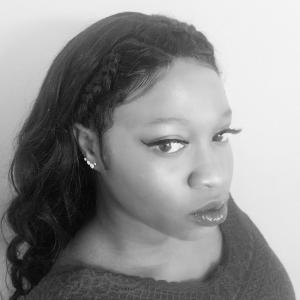 Justine Nicole Wilson is a second-year Ph.D. student at St John’s University where she majors in English and received her MA in English from Stony Brook University (Class of 2015). Justine’s research interests span trauma literature, the graphic novel, mythology, folklore and children’s media. Justine’s recent work aims to dissect trauma as “the common language of heroism,” and explores our societal consumption of trauma as a product. She is in the beginning stages of drafting her dissertation prospectus which will focus on the portrayals of mental illness and trauma in the Superhero genre.
“A nerd is someone who is as social as possible and that’s everyone.”
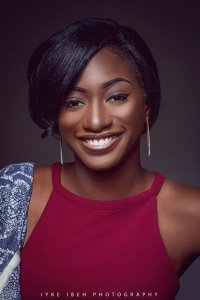 Sharon Bolanta (her friends call her Shay) is a Nigerian currently pursuing a PhD in the Republic of Ireland, at the University of Limerick. Her research is on the fabrication of smart hydrogels for biomedical applications.
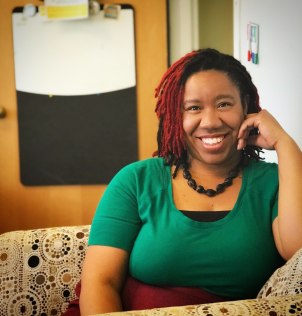 Asia Renée Randolph is relationship-focused and a close friend had this to say: “[Asia is] an incredible friend. Our relationship is one of my favorites because I can count on [her] for honest feedback and the best support. [She is] one of the most authentic, thoughtful, and resilient people I have ever met. [She] is stronger than I think [she realizes] and I know [she is] unstoppable.” -SLQ
 Black Girl Does Grad School