Creating and Maintaining My Wellness Routine

At the beginning of the semester I wrote a post about rediscovering my wellness, detailing my not so great habits that led to a sedentary lifestyle, my descent into poor eating decisions, and what I intended to do about it. Six weeks after committing to some of the changes I laid out in the same post, it’s time to do a wellness check in.

When I added yoga classes to my semester timetable, I was unsure how this would all play out. I had no idea that after just a few classes I would have the Yoga Bug. Six weeks and nearly twenty classes later, it feels weird not to do a few poses even if I don’t have a class scheduled for that day. One of my new favorite things is showing off my new poses to my parents, who are increasingly shocked at how difficult some of them look. As a result of my 3-4 times a week practice schedule, I look and feel stronger, my mood is stable, and I’m proud of my diligent work ethic.

If I could recommend yoga to everyone, I would. My current practice includes Yin yoga one hour per week and two Vinyasa classes. I also took a four week “Intro to Yoga” mini series, where I got to practice foundations and learn modifications to poses that help me feel more confident practicing in class settings. However, there are lots of things that don’t necessarily make yoga classes accessible or comfortable for everyone. Classes are free for me as a student on a campus, but not everyone has that luxury. Stereotypes about yoga are stereotypes for a reason: classes typically are filled with thin white girls, which often makes me feel hyper visible and acutely aware that I cannot wrap my arm around my big thigh to come into Bird of Paradise like everyone else can. And, truthfully, who really has the time to go to classes?

Of course, there’s always the option to do YouTube yoga classes or find studios that cater towards folks of color, if you’re in an environment where that sort of thing might be possible, but there are so many limitations. In terms of finding time for wellness practices, I do have actual suggestions. Sitting down at the beginning of the semester to block out my regular obligations on paper helped me see how much time I truly had to do my own thing. I started with blocking out time I knew I had to devote to TA’ing: I blocked out lectures, discussion sections, meeting times, and office hours. From there I added regular meetings and appointments. Then I was left with a lot of space. I saw where I could insert an hour practice here and another there. Once I was satisfied, then I added regular dissertation work time. I think for the average PhD student, we tend to work around our writing, but I realized that if I was going to commit to my wellness, my priorities had to shift. Writing would fit into my predetermined schedule, rather than be a monster that took up all of my time like an inescapable dark void.

To be sure, I have made other changes as well. Really, it’s making decisions every day that lead up to a lifestyle change. I have been working on developing boundaries between my work life and my home life, which means that if I can help it, grading stays in my office. Do I always honor that? Absolutely not, but I try. I limit my consumption of fast food and do small, weekly grocery hauls so that I always have fresh and good things to eat at the house, even if I don’t feel like cooking. I also rejoined the Mindfulness Meditation group that I was a part of last year to encourage regular meditation practice.

It’s worth remembering that even though I was shaken into a recognition that I was failing myself and my own health, these are the things I needed to do for myself anyway. Yes, I am an overworked graduate student and that by itself comes with a load of stressors that wellness practices can help, but I also live with Bipolar II disorder. Managing moods has always been…a task. I often walk through the world as if a fog has settled right over my face and I can’t see beyond the joy or sadness, whichever, or whatever, is present in that moment. It’s super cliché, but when doctors tell you moving and exercise will help your mood, it actually will. I’ll be perfectly honest, I never wanted to do that. I hate exercise. But between yoga, being properly medicated, and eating better foods, I’ve never felt more clear-headed.

While I’ve spent most of this post being a walking advertisement for yoga, I do want to acknowledge the fact that it’s really difficult for some people to enjoy for a whole host of very valid reasons. And beyond that, finding a good yoga studio, teacher, and specific practice can be very much like finding a good therapist. Some teachers’ methods of practicing will really resonate with you, and others will turn you off. You have to be willing to try a few varieties to know what you enjoy doing: you may love the fast movement Vinyasa but find Restorative Yoga entirely too slow. And you might like a teacher and their class, but the studio might not feel welcoming. All of that is okay.

What’s most important is developing your wellness toolkit. Right now, mine includes yoga, good eating, meditation, journaling, art and warm comfort drinks, but do know that you should regularly attend to your wellness toolkit. Think of them as seasonal. Things that work for you right now, may not work for you in six months. Update as needed. Do things that help you keep in tune with what your body needs from you. It’s hard, but let me tell you, it’s well worth the effort.
Spirituality, Dance and Magic | #BlackGirlMagicPotion Recap

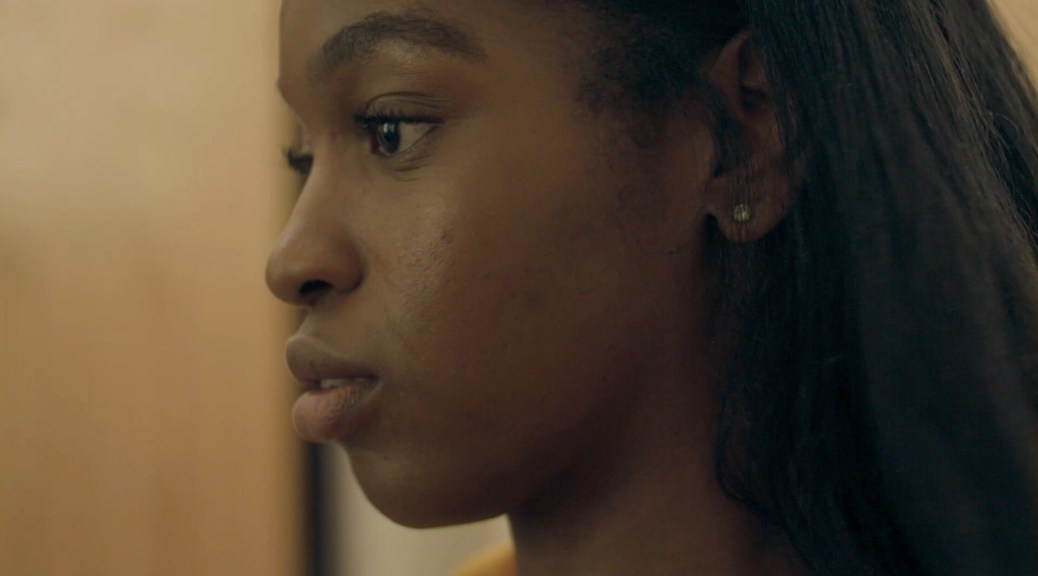
This week’s episode of Black Enough, “#BlackGirlMagicPotion,” explored the relationship between dance, religion and/or spirituality, and magic. The magic of Black girlhood, we see in this episode, lies in your daydreams, in your deepest desires, in what your core essence is made of. And for Amaya, the expression of her very essence is dance.

This is made clear from the beginning of the episode, when a blaring alarm abruptly interrupts Amaya’s otherwise peaceful dream in which she dances alone in a studio. The interiority we see with Amaya is matched by a few shots of 16 mm film featuring a figure playing in substances that we might understand as physical manifestations of Black Girl Magic. The 16 mm scene provides an autobiographical, personal touch that is complemented by the vulnerability of the interview that overlays it.

The Amaya’s narrative then moves forward to her dorm room, where a conversation with Lena is put on pause by a knock on the door. Vaughn, the president of the BSU, and, Amaya’s BSU “Big Sis,” is there, encouraging Amaya to join the BSU. The scene cuts to a hilarious and cringe-worthy sequence of Amaya’s attempts at engaging in the representations of Blackness that she has seen throughout her life. She wriggles around her room, trying to milly rock, and trying out backwards baseball caps, before stumbling over saying “my nigga.” We feel her discomfort and our heart goes out to Amaya when she goes into evasive maneuvers to avoid the invitation.

But she does, in fact, have somewhere to be: church.

Although Amaya seems to understand, at least to some extent, that dancing constitutes the basis for her personal brand of magic, there is still some fracturing of identity that occurs. The religious part of her, the exterior, the diegetic narrative (or the narrative we follow in the storyworld of Black Enough), is depicted through the digital film. It is clear and bright, but we also know that there’s something deeper. This is when Amaya’s “spiritual practice,” her dancing, her rich inner life, begins to infiltrate the image of self that she puts forth to the world while she’s attending church.

She does what one is supposed to do to feel close to God: she goes to church, she prays, she reads her Bible. She’s religious in those moments, following a set of practices that inform her worship. However, when she’s dancing, she is more spiritual–it is the purest form of religiosity in some ways, more freeing. Her particular spirituality is an expression of her religious nature. This, dancing, is how she shows God she loves Him and how God is working through her. Dancing thus becomes a spiritual practice in that it is less about rules and guidelines and more about connectedness, more about feeling.

Circling back to Black Girl Magic and the potion Amaya is concocting on her mirror, I believe it is safe to say, though she likely does not include it on her list, that dancing is one of the ingredients in her potion. Part of the magic for some Black girls is this feeling of infiniteness when you know God loves you. As Elder Ntozake Shange once said, “I found God in myself and I loved her fiercely.”

There’s a spirituality surrounding Black Girl Magic, which I love to think about because it further points to its uniqueness. Everyone’s brand of Black Girl Magic Potion is tailor made to their specifications and unified only by the fact that we all have a bottle, no matter how different the contents. Religion sometimes implies that rules and order regulates worship–spirituality can be the freedom of expression of what you believe, the freedom to dictate and design your own love, in the same way that you brew your own personal brand of Black Girl Magic Potion. So for Amaya, dancing is the purest expression of her spirituality, and by extension, her magic.


Further Reading:

For Colored Girls Who Have Considered Suicide When The Rainbow Is Enuf, Ntozake Shange

Sassafrass, Cypress and Indigo, Ntozake Shange

Jezebel Unhinged: Loosing the Black Female Body in Religion and Culture, Tamura Lomax


Creative Note-taking

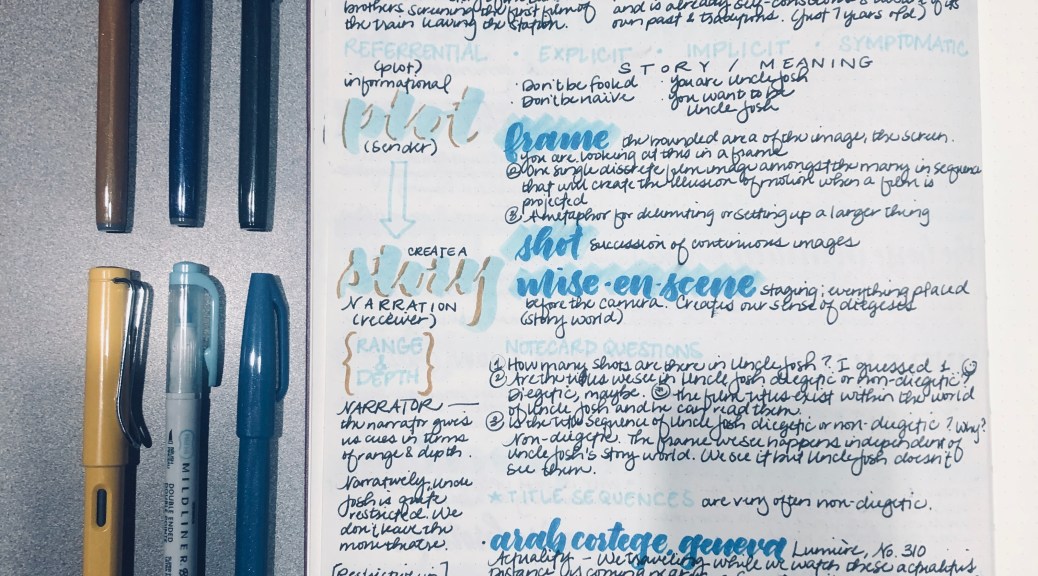
If you follow me on Twitter, or on my creative instagram account (@RavynnCreates), you know that I love creating aesthetically pleasing notes. People often have questions about them, so I thought I’d create a FAQ post about my notes.

  1. Why do you make your notes like that?

Well, first, it’s super fun! I love making things. It also helps me focus, and it makes my notes easier to read and study when I have to go back to them.

2. What do you mean it helps you focus?

Making creative notes is almost like making a mind map. I think about the relationship of sections and words. For example, if we’re talking about the features of the “Classical Hollywood Narration,” it helps to make that heading large, and make the features smaller underneath, or close to the heading. Sometimes it helps to box things in so I know everything in that section goes together. It can also help to color code. If my heading is gold, I might use a different gold pen to number or bullet point everything that falls under that category. Sometimes I use a combination of all of these methods.

3. Do you make them during class? Like while the professor is lecturing?

Yep. Again, it helps me focus.

4. So you don’t just take quick notes and then rewrite them?

No. I do not.

5. What do you use to take notes? Pens? Notebooks?

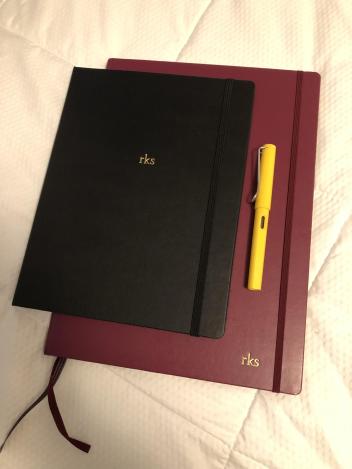
My semester notebook is a burgundy Leuchtturm A4+ Master Slim with 121 dotted pages that I got from Jenni Bick in Dupont Circle in DC. Yes, it is personalized.

I use a variety of different pens. For headings and small brush lettering, I use Pentel Sign pens. For shadows and highlights, I use Mildliner Brush Pens. For detailing, I use Metallic Gelly Roll pens. For regular writing, my main text, I most often use a Lamy Safari fountain pen. If I’m not feeling the Lamy (or if I have run out of ink), I use Zebra Sarasa 0.7 ballpoint pens.

6. Wow, that’s really specific. Why do you use those brands?

Leuchtturm journals have thick pages that don’t ghost (show ink on the other side) and they are pre-numbered. Pentel pens are super reliable, and they come in really great, bold colors. Mildliners, I don’t use as much, but I still like them for background and contrast. Gelly Roll pens have really strong color, and they’re also reliable and relatively easy to find. I’m using a Lamy pen because I wanted a good fountain pen and I thought it might be cool to invest in a utensil that I would love to use. It’s beautiful and yellow and I do in fact love it! When my students from Keio offer me stationery gifts, they’re often Sarasa/Zebra pens and Japanese stationery is the best, so usually I’m just using the pens they gift me.

7. So do you just, like, travel with all those notebooks and pens?

Yep.

8. How many pens and notebooks do you carry with you daily?

Between 2-3 journals. I always have my semester bullet journal with me and I often have my dissertation journal. Sometimes I’ll bring my leather bound diary if I haven’t written in a while.

I honestly don’t know how many pens I have at any given time. I have at least 3 of each type of pen in different colors (except the Lamy) in my purse. I mean…probably at least two dozen.

9. Do you let people borrow your pens?

No.

10. Really?

Really. I keep a couple of regular Bic ballpoint pens in my purse to give to my students if they need a writing utensil in a pinch.

11. But how do you make such pretty pages?

Honestly, I don’t know. It’s the equivalent of doodling. My hands just kind of do their own thing. I don’t lay out my spreads prior to class, they just sort of happen. I more or less start on the top left of the page and just build from there.

12. Do you have any suggestions for folks that want to try creative notetaking?

I do! First, try not to take it so seriously; let it happen naturally. The more you try to make it pretty, the more pressure you put on yourself and then you likely won’t be satisfied with the way your notes look. Second, experiment with fonts and colors in relation to others on the page. If you have a keyword in gold script on the right in a square with writing around it, maybe try bold blue uppercase letters for your next piece. Third, practice! I’ve been making notes like this for years and it took me a while to get to a point where I could make these pages. Lastly, comparison is the thief of joy. Your notes will not look like mine. My notes will not look like yours. Embrace the uniqueness of this little way of expressing yourself!