“Agented!”: Writing Across Genres

If you follow me on Twitter or Instagram, you’ll know that I recently announced that I am now represented by Leah Pierre of Ladderbird Literary Agency. I’m super excited to begin working with her and hopefully get my words on a bookstore shelf near you.

That said, I’m sure there are questions, so I figured a quick Q&A would be helpful!

  1. How did you find your agent?

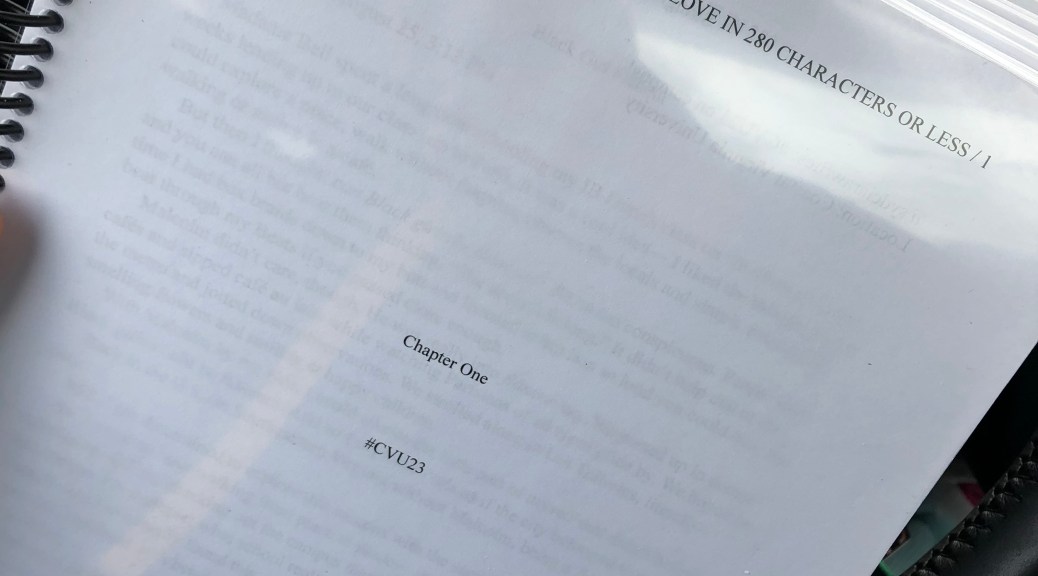
One morning in October, I woke up to find there was this Twitter pitching contest happening, #DVPit, which happens to specialize in connecting marginalized voices with agents and editors. I had finished drafting Love in 280 over the summer, so I thought, well, may as well give it a shot. I got interest from three agents, two of whom I submitted queries. When one of the agents passed on my manuscript in December, I actually emailed her to ask if there was anyone else on her team that’d be interested– I’d been doing a lot of reading about Ladderbird and wanted to be there. Incidentally, this agent had been trying to forward my manuscript to Leah, and maybe a month later, I got my offer from her.

  1. Why do you need an agent?

You don’t necessarily need an agent if you’re doing academic writing and publishing, but I write novels and am interested in trade publishing, which is much harder to enter without an agent. Many editors, particularly at bigger publishing houses, don’t acquire manuscripts from unagented writers. So, if I want to have a larger audience, having an agent means I have a better shot.

Also it’s great to have someone who loves your words in your corner to advocate for you and help you navigate the industry. I am absolutely transparent about the fact that I have no idea what I’m doing in the Academy and also in publishing, but I’m just writing what I need to write, the way it needs to be written, and worrying about whether it will find a home after.

  1. What happens next?

Now we do some edits to the manuscript before we start sending it to editors. I’m unsure how long this process will take and there’s always a chance we can’t sell the book, but even getting this far is exciting to me.

  1. Why are you writing across genres?

It’s just right. I’ve always written novels and short stories as long as I can remember. I used to write novel length stories about what I thought my friends’ lives and my own would be like in twenty years. I wrote Harry Potter fan fiction and X-Men stories to entertain people. I entered NaNoWriMo every year (and won) for about five years. I used to write comics and whole newspapers for my family. I’ve blogged for years and found homes for my words across the internet. I have always been a creative writer and trying to tell myself that I was only ever going to write academic pieces for the rest of my life was disregarding everything I had ever done in my life up until this point.

I write across genres because different stories require different forms or containers to be most effective. Some ideas require an article, others a short, still others a novel. And within those forms, I’m still going to experiment and push boundaries because that’s just what I do.

This is me walking in my purpose. This is right.

  1. How do you balance it all, your academic writing and creative writing?

I get this question a lot, actually.

It’s all about time management. I know that my academic writing pays the bills, so to speak, so I prioritize that. I set a weekly writing goal, which I then break down further. If my goal is 1,250 words per week, I need to average 250 words per week day. It only takes me an hour or so per day to get there, so I have the rest of the day to read and research, and work on my other projects.

One thing that happens is that I often get carried away by my creative projects and I can write a lot more and faster than I write my researched work. I usually cap a day’s work at 1,000 words for creative projects, and try not to write much more than that on a give day so I don’t get carried away.

Remember, some people work better with word limits/guidelines, others with time limits. Find what works best for you and work with that.

(I really should hold a time management webinar; if you’re interested leave a comment below.)

  1. Are you happy?

Yes.

BGDMedS: Learning More Than Medicine

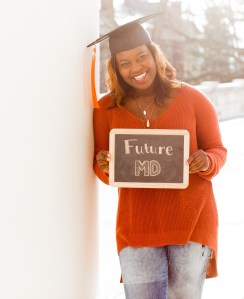
by Kayla Holston

“Kayla, you choose the music. You’re the most urban.” As a medical student at a PWI (Predominantly White Institution), I’ve become comfortable with being the only Black person in the room. From the engineering undergrad at the University of Virginia to the Master of Public Health at Emory University to now medical school at another white institution, PWIs have become quite familiar. But, whenever I forget just where I am and what assumptions I’m surrounded with, comments like this remind me.

My journey as a graduate student has been about finding out who I am when the security of undergrad has been torn away—who I am outside of school. Am I a yoga enthusiast, a family girl, or a travel fanatic? As it turns out, I am all of those. What I have discovered, though, is that I am also a pensive Black woman who can be disloyal to herself when it comes to confronting racism. And here’s how realized that:

At my school, our curriculum is divided into blocks, and each block focuses on a system (e.g., cardiology, pulmonology, neurology). During each block, we spend a few weeks dissecting Sally, our group’s human gift. One afternoon, two lab mates and I decided to go to the dissection lab while it was empty to re-dissect Sally as a form of studying. Since we were alone in the room, we decided it would be nice to play some music. That’s when it happened: “Kayla, you choose the music. You’re the most urban.”

All I could do was laugh. More of a crying laugh, but you know. I thought to myself, if Sally wasn’t here, I’d let you have it. Out of respect for her, I’ll shut up. That’s what I told myself but, honestly, I laughed because I wanted to make him feel more comfortable in a moment he had made uncomfortable. He laughed with me, and I became the “cool Black girl” who didn’t get upset over “silly jokes.’” Now he “jokes” whenever he sees me.

Being a Black medical student puts me in a weird place—I don’t want to be the difficult Black girl. Team learning is even more important here than in my past curricula, and I don’t want to ruin relationships with my assigned team members and then find myself struggling to group study with them. The comment my lab mate made illuminated a quality in myself that I am now grappling with. In academic situations, I tend to be conflict-averse at the expense of my mental health. I believe the reason is a combination of not wanting to hinder my learning (obviously) and not wanting to make situations awkward for myself and others.

I wish I could say, after this realization, I cut off every prejudiced person and clapped back to every racist remark. Still a work in progress. What I can say, though, is that I have become intentional about my mental health and the company I keep. I have embraced therapy for all facets of my life, began regularly engaging in mindfulness through yoga, and, most importantly, allowed God to be my center of peace. (Quick pause: Different approaches work for different people but, if you have not tried it yet, I highly recommend hot yoga as a healthy way to relieve stress and stay fit. But first, try God. Nothing will give you peace until that part is handled.)

Anyway, I have also become okay with the idea of a close, small circle. It is kind of crazy how we feel obligated to spend time with people just because we have in the past. I finally asked myself, why do you let this white girl (excuse me, white passing) keep talking to you like you’re stupid? Why do you voluntarily do Friday dinners with her? So, guess what? I. Just. Stopped. Not groundbreaking, but for me it was. I thought I needed to keep every friend I had because, if I didn’t, I wouldn’t have anymore friends and medical school is tough without camaraderie. Well, medical school is challenging either way, so may as well do it with woke people, even if there are only three.

So, what advice would I give to a future BGDMedS?

  1. Spend some time figuring out who you are because your identity will be illuminated and tested during this trying but exciting time of your life.
  2. Make a plan for caring for yourself before you get here. If you don’t, it probably won’t happen.
  3. Surround yourself with love and truth, nothing more and nothing less.

There are plenty of people who decide who I am before I open my mouth. But, even when I don’t know who I am, God is certain of my identity. So, I abide in him, embrace what He says of me, and care for myself. I hope you will too.


micahkaylagrad-23copuKayla Holston is pursuing an MD  after earning a Master of Public Health in Health Care Management at Emory University and a Bachelor of Science in Biomedical Engineering & Cognitive Science at the University of Virginia. She is particularly interested in utilizing her educational background to improve patient flow and healthcare staff workflow in order to improve efficiency in understaffed health systems. Kayla’s current research focuses on improving quality and staff workflow in a Malawian health center in collaboration with Malawian medical providers and architecture professionals. Her second research focus is in orthopedic surgery, particularly with regard to how psychosocial factors affect hip pathology and postoperative outcomes. Professionally, Kayla hopes to blend the roles of a physician and healthcare administrator to continue projects like this, serving patients on both an individual and organizational policy level.

New Decade, New Me: Post-Student Life and Embracing Candidacy

January– the start of a new year and a new semester. This semester is a little unusual for me because this will be the first semester since I’ve started graduate school that I have “off.” The deal is that if you are a teaching assistant (TA) or a teaching fellow (TF) one semester during the academic year, then that semester of work for the entire year. This is absolutely an institution-specific thing, a program-specific policy even. I have friends in another department at my school who have some sort of graduate assistant duties each semester, no matter what. However, they’re guaranteed at least one full year of funding where they have no obligations except to write. It all varies.

So much feels like it’s changed since I last wrote. Last semester (Fall 2019) seemed like the end of an era in a lot of ways. It was the first, and likely last, time that I’ll be a teaching assistant; the next time I set foot in a classroom for an extended period of time, I will probably be teaching my own course. It also marked the end of a series of trials and tests; with coursework, comps and prospectus behind me, as well as the experience of getting my feet wet with pedagogy under a tenured professor, I finally feel ABD (all but dissertation). I feel like everything I do from here on out is for me, on my time, on my terms, and I can begin to craft my career the way I want to, as opposed to satisfying the whims of others.


I’m not a student anymore.

And that means I’ve been spending a lot more time than usual thinking about how I want my career to look, studying the careers of others, reaching out, daydreaming, and hustling. A lot of things have been put into motion that I can’t necessarily say much about at the moment, but in the last few months of 2019 and into this first month of the new decade, I feel myself finding my footing as I begin to walk in my purpose.

The one thing that’s abundantly clear is that I want to write. It seems so obvious to say, but nothing feels like writing for me. Nothing feels like the moment when I get the first words down on a new document or in a new journal; nothing like working through rounds of revisions; and nothing like seeing those words find a home and make their way out into the world.

An important note is that I want to be a writer with range; I recently got to see Lamar Giles in conversation with Meg Medina and the discussion about range has stayed with me. My scholarship, my blogging and my essays are starting to find homes and an audience. I want that for my fiction, too– my novels and short stories. And one day I want to write a comic. I would love to write lots of comics, but let’s just start with one. (I won’t say who I’d want to write but let’s just say her initials are LL.)

One day, I’ll write a post about how I balance all the different types of writing that I do/want to do. For now, just assume I spend a lot of time juggling and dropping the various balls.

As I get further down my path and closer to aligning myself with my own goals, I have come to resent grad school less and less. Yes, I could write a book about what’s wrong with higher education as it stands, but the time I got to hone my thinking, develop my writing, read widely, meet people– specifically, authors and writers…those are skills I can take with me, no matter where I end up. I don’t think I ever would have wrote the novel I drafted last summer if I hadn’t been in grad school, day-dreaming about digital Black girlhood, blogging and writing. I maybe wouldn’t have made the time, or perhaps never even had the idea.

Things happen for a reason, and they’ll reveal themselves in time.

At any rate, there’s still the practical business of having a semester off. What will I do? Well, I still have plenty to do. I still have a whole dissertation to write, research to do, stuff to read to get there. I’ll be making some appearances at conferences: Chesapeake DH in February, SXSWEdu in March and the Lemon Project Symposium later that month. I’m still the graduate advisor of the Africana House on campus so I’ll be working a little more closely with the students this semester. Of course, I’m already back to yoga, but I’m adding in a new cardio class for fun. And I’ll probably be writing across the internet (I’ve already had pieces in Black Youth Project, Wear Your Voice, and ZORA) in addition to my dissertation work and noveling.

I have some cool projects and news dropping soon, too, so stay close to the blog (and Twitter) to be the first in the know.

I’m so glad I’m finding my magic in this liminal space between life as a student and a lifetime as a scholar.

My attempt at joining the Academy