
I’m Good Luv, Enjoy: Navigating Other People’s Dreams While Reaching For Your Own

by Trayc Freeman

If you think it’s annoying to constantly have the “what’s next for you” conversation during undergrad and grad school, just wait until you start having the, “Oh no you should actually do _____!” conversations in the adult/professional world.

I found my research passion my very first semester of my master’s program when I took a class called Civil Rights and Education. After writing a paper on Booker T. Washington High School in Norfolk, Virginia during massive resistance, I was hooked on oral histories, and talking about the benefits of segregated education for Black students. That semester, I was presented with an opportunity to attend the ASALH (Association for the Study of African American Life and History) conference; The other two semesters flew by and it all contributed to seemingly showing me the career path I wanted to embark on. While I haven’t gotten to the path yet, I have a (somewhat) clear idea of how I’m going to get there.

The idea for this piece came to me as I sat in a conference on the recruitment and retention of minority librarians. With the few academic conferences I’ve been to prior to this one, I’ve always walked in feeling immediately that I was “home” and left out feeling renewed and re-energized; I’ve left ready to put in even more work! And while this conference was interesting, it didn’t give me that feeling. Fast forward to a week later, I was able to attend a good friend, and personal Sheroe’s, dissertation defense; being back in that space, even for a short while, gave me all of those feelings I mentioned earlier. That’s how I know where home is for me.

I’ve been working as an evening manager at a library for 2 years now and have never said to myself, “I think this is where I want to be for the long haul.” Yet, as of late I’ve had a lot of co-workers seemingly become convinced that I should get an MLS (Masters of Library Sciences) degree for no other reason (that’s been expressed to me) than, “well you’re doing the work anyways.” No one has explained what the degree track looks like and only one person, who actually wasn’t even a co-worker but a fellow conference goer, has told me how it could be even slightly beneficial to any of my interests and goals. When I tell these same people what I actually want to do, I’m rarely offered any resources or advice; I’m only reminded that I should really take advantage because my job would pay for library school.

Being a 2-time PhD reject, who’s about to go into admissions attempt number 3, I can say first hand just how much it sucks when you finally figure out where you want to go in life, only for the door to constantly be slammed in your face. It’s even worse when someone who’s trying to be helpful, whether it’s a co-worker, a friend or family member, tries to nail the door shut with their own ideas and suggestions for your life. The good news is that no matter how frustrating I find these conversations to be, I’ve also found them to be extremely valuable. Having to constantly, for lack of a better word, defend your education and career goals really causes you to sit down and fully think about what you’re trying to do. I’m sure we’ve all departed from at least one dream career we thought we had in life; for me that was being a singing lawyer (I was young and liked Ally McBeal, don’t judge me). But by having your choices constantly called into question, if for nothing but your sanity, you really sit down and ask yourself, “what is it about this that makes me want it so bad?” You also discover that not everyone’s dream for you is a bad deal; in fact, some of them are very logical and, for a few minutes, really will have you reconsidering your life. However, while logical, if you can’t see yourself fully immersed in that dream, you have to learn how to communicate that that’s not for you. I’ve learned this while dealing with several family members who think I should try out a teaching career (bless their souls).

The point of this entire piece was to say you should always follow your dreams first! I feel like that’s lowkey cliché, but I’ll say it anyways. With our personal dreams comes the eventual vision to carry them out. It also comes with unshakeable faith and resilience, and the ability to revamp our blueprints accordingly (I’ve revamped mine about 8500 times– I’m 26). Your dreams also come with an understanding that you may make others uncomfortable, especially when it comes to a career because they aren’t able to see the ideas and strategies that are all turning in your head. But it’s important to understand that most folks honestly just want what’s best for you even if their presentation does not come off that way. And if you change your dream, or at some point even take on the dream that someone else had for you, that’s cool too. So long as you worked to achieve what you want to do and didn’t just allow others to cast their dreams onto you because it makes it easier to deal with them (i.e. our parents). With that being said, I hope everyone who reads this finds and goes for their true dreams regardless. And, if in a few years I actually do decide to get an MLS and take on a career as a librarian, send me a link to this piece and laugh at myself for putting it off for so long.


Trayc D. Freeman is a “Double Hoo” from the University of Virginia, earning a Bachelors in African American Studies in 2015, and a Masters of Education in Educational Psychology (with a Social Foundations concentration) in 2016.  She currently works at the Fiske Kimball Fine Arts Library, but hopes to eventually pursue a Ph.D, focusing on Black education, more specifically, the benefits of segregated education for Black students. From there she’d like to go on to academia, becoming a professor and historian of Black education. In the meantime she runs her own Black history blog, and is working to add an “Executive Producer” notch on her belt, working with UVA graduate and professional track athlete Jordan Lavender on her up-and-coming bi-weekly Youtube vlog “#DoItLikeJLav.”

Will I Die Alone: For Black Girls Who Are Hopeless Romantics When Degrees Aren’t Enuf

By: Korey Johnson

“No. Don’t never go looking for love girl. Just wait. It’ll come. Like the rain fallin’ from the heaven, it’ll come. Just don’t never give up on love.” – Sonia Sanchez

I fell in love with Black love at an early age. My earliest recollection is Omar Epps swooning over Sanaa Lathan in the final scene of Love & Basketball when he utters “double or nothing,” with those dreamy, passionate eyes and sexy smirk. That scene to me signaled the power of black love to triumph and conquer all things. From that day forward, I’ve always imagined a fairytale type of love that would just thrust itself upon me.

As I sit here now, as a final year J.D. Candidate, reflecting on 7-year-old Korey’s infatuation with love, I can say that my ideas of love, marriage, and a family have morphed into a plan unfulfilled. Growing up, my mother’s mantra was “School. Husband. Family,” in that order. When I matriculated through I guess in my adolescent mind, I assumed that each of those would come with the tide of time.

It hasn’t.

In fact, it feels like everyone’s romantic lives are booming while mine is nonexistent. My friends are having babies, getting married, and finding the “loves of their lives”. Meanwhile, I’m writing papers, pulling all-nighters, and stressing about career options that have yet to present themselves. After undergrad, my mother’s mantra transitioned to “you’ll find your man in law school.” Little did she know, the only dates I’ve been concerned with in law school are due dates and deadlines for papers and job applications.

What my mom didn’t tell me was that dating in Grad School completely sucks. The suitors are either 1) emasculated and threatened by my career goals or 2) obsessed with it. They often aren’t looking for something serious – which for me seems like a waste of time (what other reason would I be dating for). And to top it all off, they usually aren’t very understanding of Grad School woes.

With that being said, I’ve always wanted love but never really had the time for it.

As a black woman professional, dating has always been my second priority – my education and my career being my first. In my mind, as the hopeless romantic I am, I figured love would just find me. You know, just fall right in to my lap at just the right time. Maybe while I was at the library or in class or walking to a job interview. Somehow, someway, it would find me. Right?

Wrong.

Then, I had a coming of age moment with my mentor. I told her that I had a fear of dying alone– without a life partner, without kids, and without anyone to share my life with. I know this seems a bit extreme and dramatic, but the feelings are absolutely real. I’ve developed so many relationships with Black women lawyers and legal minds, most of them are single with no kids. They all work extremely hard – so much so that they have very little time to do anything else. (Rightfully so, because Black women have to work twice as hard in professional work environments but I guess that’s a whole different topic for a whole different article). Now, that’s not to say those Black women lawyers are not happy with living the Bachelorette lifestyle – most of them are completely comfortable with where they are in life and their careers.

But for me, my family goals are just as important as my career goals.

My mentor explained to me that my ideas of love and a family weren’t realistic. When she said this I was baffled and then she explained why. In short, she explained to me that everything that I had achieved in school was a result of hard work, dedication, and ambition. I agreed. Law school wasn’t just something that fell in my hands, I worked hard to get here. Moreover, I’ve been working my butt off to stay here, get good grades, and secure employment post-graduation. She then paralleled that energy to the energy (or the lack thereof) that I’ve placed in to my dating life. How could I ever expect to love to find me, when I never placed any energy in cultivating it.

It was this conversation that has transitioned my idea of love. It is not some object to be possessed. It is not something that we can just pick up and find on our path to becoming successful. Instead, it is a journey. It is something that is cultivated and takes work just like everything else in my life. And quite frankly, I guess when I’m truly ready for it – I’ll be ready.

Now, don’t get me wrong. I am in no way saying drop the books go get a man – I know what patriarchy looks like and girl this aint it. And as Sonia Sanchez says in the opening quote, we should never go looking for love. But what I am saying is that we have to be willing to reap what we sow in not just our academic life but in all other facets of our life. When the opportunity of love or a family presents itself, we need to be willing to explore those opportunities the same we pursue our passions in our academic pursuits – if family or marriage is a priority of yours.

So, for the Black girls like me, contemplating whether you’ll die alone or not – I guess with everything else in our lives – only we hold the key to our destinies. We are the captains of our fate. So maybe we won’t or maybe we will, but either way we will actively choose our romantic path and not let it choose us.


Korey Johnson is a third-year law student at Howard University School of Law. Korey holds a B.S. in Political Science and B.A. in Communication Studies from Towson University. As an activist by nature, her research is focused on developing a black feminist jurisprudence that is centered around political and social self-determination for Black women. Poetry is her drug of choice, she is a loyal member of the Bey-hive, and an avid watcher of The Office.

Black Girl Does Oxford

by Kristen Barrett

Sometimes chasing your childhood dreams exposes you to some mind-rattling realities. You dream of writing a young adult novel only to learn about the competitive world of publishing. You dream of pursuing a Hollywood acting career only to learn about the “casting couch.” You dream of attending a prestigious United Kingdom university only to learn about its paucity of black students.

I distinctly remember the first time my mother mentioned the Rhodes Scholarship to me, a bright-eyed eighth grader in love with Jane Austen. In those days, I daydreamed about the British countryside and imagined myself studying Chaucer at one of the most prestigious educational institutions in the world.

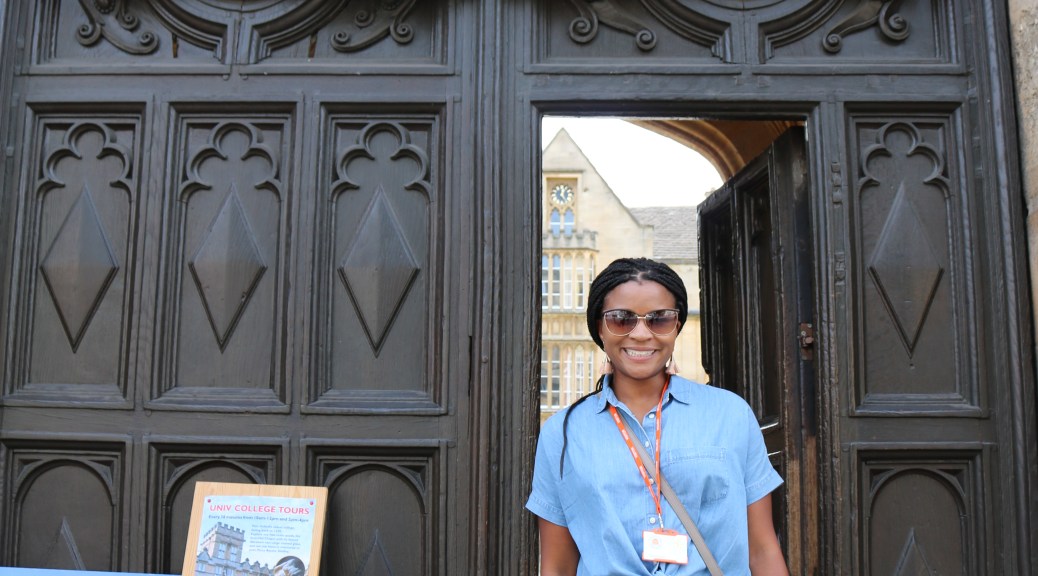
Fast forward to my matriculation as a Jefferson Scholar at the University of Virginia. I set my sights on a more immediate goal: attending the UVA in Oxford Summer Program. The Jefferson Scholar Foundation pays for every scholar to participate in one study abroad program the summer before their junior year, and from the moment I heard about UVA in Oxford, I knew that would be the program for me. Luckily, the head professor accepted me into the program, and I arrived at University College on July 1 filled to the brim with excitement.

Approaching the other UVA students, I noticed something immediately. I was the only black student in the program. A familiar feeling churned in my stomach. An engulfing self-awareness that can easily morph into a feeling of empowerment or isolation, responsibility or burden, opportunity or affliction. From this moment, I knew that depending on my attitude I would either feel like a representative of black excellence the program needs or merely a cultural outsider.

This feeling became all too familiar to me in high school. Growing up in my 90 percent white all girls school, I carried this awareness with me every day. Almost always, it would empower me to embrace my racial identity and to explore the joy of pursuing interracial relationships. But sometimes, on those low energy days, it would bury me in insecurity.

When dreaming of Oxford as an eighth grader, I never considered how white such an institution would be. Considering Oxford’s undergraduate numbers, only 2 percent of undergraduate students are black, and some of the colleges go years without accepting more than two black students. I did not consider how the United Kingdom’s identity politics vastly differ from the United States’ or that racism toward blacks exists on both sides of the pond. I did not ask myself: what affects my happiness more, the prestige of the institution or the ethnic makeup of the student body and faculty?

This quandary and its accompanying feeling hung over my head during my first few days at University College. It pushed to the forefront of my mind when I saw that all of the program’s professors were white men. It left a bad taste in my mouth when I noticed the only black people in University College were the ones who served us tea. It caused me to question my place in the program.

The story could end there, but it doesn’t. After receiving some motivational words from my best friend back home, I gave myself an ultimatum. I could waste precious energy worrying over whether I belonged or I could claim my deserved space in the program myself. I chose the latter.

For the rest of my time in the program, I chose empowerment, responsibility, and opportunity over isolation, burden, and affliction. I embraced my status as “the black girl,” and I ran with it. This was one black girl no one was about to forget. I incorporated race relations into my political discussions with my friends; I made allusions to black romantic comedies like The Best Man; and most importantly, I expressed all my idiosyncrasies that come along with me — whether they were stereotypically “black” or not. I was not the spokesperson for my race, but I was the spokesperson for Kristen Rochelle Barrett.

This outlook immediately improved my experience at University College. With my insecurity held at bay, I delved deeply into my course on politics of the European Union, frolicked gleefully around Oxfordshire with my new friends, and to no one’s surprise found that my dream university lived up to all of my expectations. The scholarly college town with Harry Potter style cafeterias and boutique store-lined streets won my heart.

Oxford taught me a lesson in self-confidence. What I like is what I like. Given my love for nineteenth century transatlantic literature, it is highly likely that I will end up in a graduate program with very few black scholars. My experience in Oxford reassured me that I can not only survive but also thrive in such an environment. I do not need to be surrounded with people similar to me in race, religion, gender, etc. in order to flourish as a person. As long as I have a support system of dutiful friends and family, I will blaze trails.


Kristen Barrett is a rising third year at the University of Virginia, where she is pursuing a major in English and a minor in Drama. Her hometown is Nashville, TN. Her favorite black intellectuals are Toni Morrison, Maya Angelou, and her parents. She is passionate about encouraging black girls to pursue higher education, and she wants to attend graduate school herself in order to study depictions of people of African descent in transatlantic nineteenth-century English literature. Only God knows what the future holds, but she is ready for the #BlackGirlMagic!

My attempt at joining the Academy