Category Archives: Ravynn

“Double Consciousness” Recap: “What Makes Up a Black Girl?”

“Stamped with a magic so spiritual that angels and colonizers alike wanna get like us.”

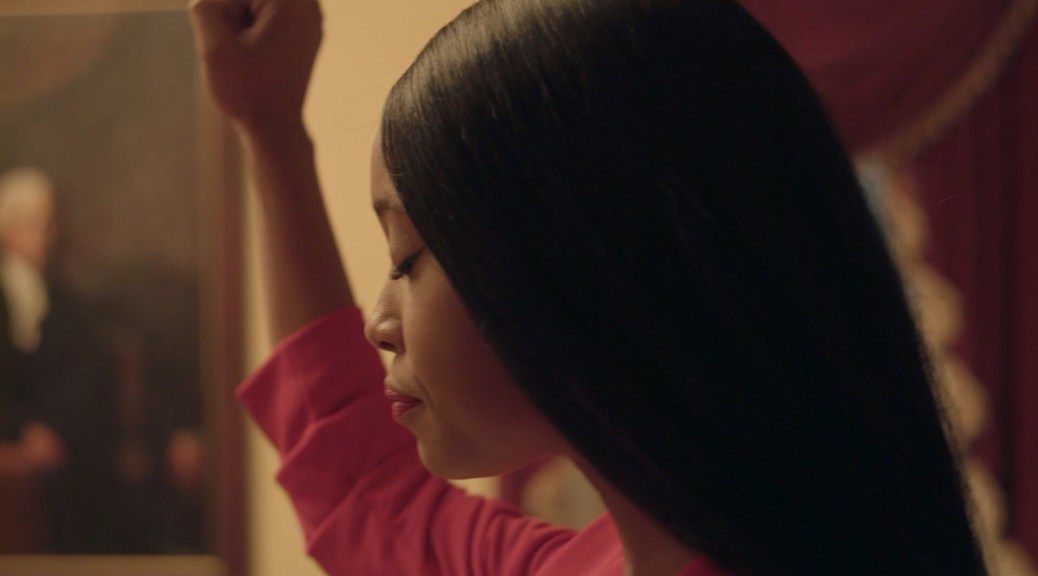
The long-awaited webseries, Black Enough, which premiered on Sunday, begins with a question: “What makes up a Black girl?” As the narrator lists the many things which she believes may make up a Black girl, we are treated to visual texture. The movement, the 16 mm film and the substance (which might be a tangible representation of Black Girl Magic) juxtaposed with the spoken poetry inform the viewer that this experience will require engagement and critical reflection.

After all, when was the last time you wondered what makes up a Black girl? For me, it’s a daily ritual, akin to a prayer, to daydream about the magic from which we are created. I find wonder in our quotidian experiences, like focusing on the details of the protagonist, Amaya’s (Tiffany Gordon), college dorm room, getting to know her, and learning her uniqueness. While she’s at peace in her own space, we begin to see her fractures: Amaya is unsure of herself around Lena, her friend from home; at least somewhat interested in making friends with her white roommate who has no home training; and searching for something.

When we see Amaya later in the episode watching a Brownskinned_Barbie (Brandi Jaray Mcleain) YouTube video, attempting to do her hair, viewers understand that she is reaching for this idea of Black Girl Perfection. There is a desire, however slight, to be like Brownskinned_Barbie– pretty, cool, and popular with 4a curls that act right after a single spritz of water. But more than that, Brownskinned_Barbie represents a crucial piece of Amaya’s identity struggle: her hair. Maybe Brownskinned_Barbie is not perfect, but she knows how to make her hair shiny, defined and moisturized– a Black Girl Superpower Trifecta I have yet to perfect. Amaya begins to connect her identity as a Black girl to the appearance of her hair, believing that her hair and her soul need to be in alignment. (For more Black women writing about hair as an extension of self and self-expression, see Tanisha C. Ford’s work, particularly the chapter “Jheri Curl” in Dressed in Dreams.)

Her self-doubt spirals even deeper as she sits in on the first Black Student Union, led by the seemingly perfect Vaughn (Branika Scott). Vaughn’s “welcome speech,” which details the history of the BSU at Weston and finishes with a poetic embrace of all her “brothers and sisters of the Diaspora,” unsettles Amaya. Only when Vaughn chuckles and says, “You’re already Black so you meet all the requirements, right?” does Amaya leave, feeling as though she did not meet the requirements.

The experience prompts her to create the recipe for a “Black Girl Magic Potion” on her mirror, as she tries to find the secret to a supposedly inherent alchemy we are said to possess. One of the last scenes of this episode is of Amaya circling “Go Natural” on her Potion/list, foreshadowing challenges to come.

Amaya’s story and the poetic narration are woven together with interviews with Black women and girls who reflect on their own experiences with our magic, including words from Hanna Watson, Stephanie Crumpton and myself. Altogether– the poetry both spoken and visual, the story, the interviews, the texture of the 16 mm film with the digital– creates a quilt of different pieces of art that are woven together to create a cohesive story, that wraps you in warmth. The warmth is the result of feeling seen and understood as beautiful. Black Enough leaves you feeling whole, and you, the viewer, want that for Amaya, too.


Further Reading:

Dressed in Dreams: A Black Girl’s Love Letter to the Power of Fashion, Tanisha C. Ford

The Souls of Black Folks, W. E. B. Du Bois

More Than Enough: Claiming Space for Who You Are (No Matter What They Say), Elaine Welteroth

Hair,” Elizabeth Acevedo

why you cannot touch my hair,” Eve Ewing


Feature image courtesy of Jeremy Rodney Hall

Teaching Writing

The most gratifying part of being a Teaching Assistant (TA) this semester has been the work I’ve been able to do with students on their writing. I didn’t even realize how important teaching writing was to me until I had to do it. But I love when students email me, knock on my door or catch me after class to ask to work on their papers. I love when I have a question about a sentence or a phrase, then they tell me what they were trying to say, and I’m able to reply, “Yes. You need to write exactly what you just said.” And I love handing back A papers to students who think they’re weak writers because someone told them once upon a time that they weren’t.

I had a chat with my students recently about writing. I encouraged them to shift the way they think about it, with the understanding that in some ways, they can’t. Taking approximately 15-18 credits requires likely dozens of papers a semester and it’s very difficult to give the proper amount of time and attention to each and every paper. You often don’t have the time to write drafts well in advance to get feedback from your professor or TA. You’re simply trying to crank those babies out to make sure you have something to turn in.

When that’s your reality, it’s difficult to think of papers as anything but a means to an end, a hoop you have to jump through. In all honesty, I can count on one hand the number of papers I actually remember writing in undergrad. Remember, as a French and Comparative Literature double major, and an International Relations minor, I probably wrote hundreds of papers. And yet.

Still, with all of that in mind, I still proposed a perspective shift. Instead of thinking of writing as another thing you have to do, think of it as an opportunity to share the thoughts and opinions you have about our films, backed up with evidence and careful analysis.

Yet another problem I’m up against as a TA is the way we present writing as an individualistic enterprise. Because folks have so many papers to write during the semester, it feels like you have to lock yourself up in a study room in the library until you have no more words. I reminded my students that that’s absolutely not how writing works professionally. Every writer that we read in class, every book that you get in the bookstore…all published writers have editors. They have friends and family and mentors that read their words with a red pen of love at the ready. They workshop their words. That’s why the “Acknowledgements” section of books exist. Writing is a communal process, but we present it as something you do alone. So I try to make it as clear as possible that I am willing and able to work with them on their words, because they shouldn’t have to be in this alone.

I try to be as sincere as possible when I tell them I look forward to reading their words. Yes, it is my job to read and comment, but I’m curious as to what they think and how they think, especially if they’re quieter in class and discussion. Papers are a chance for you to flex a little, but it gives you the time and space to think through your response if you’re not as willing to jump in to a conversation with only a half formed thought. I try not to think of their papers as more work for me, but a chance to get to know my students a little better. I think of my comments as engagement with their thoughts.

I perhaps do all of these because I want them to love writing as much as I do. I know my efforts won’t matter to many of them, no perspective shift will occur. And that’s fine. But as long as I’m clear that for at least this semester, they have someone who cares deeply about writing and their words, I will have done my job.

So many articles exist on best writing practices and how the greatest writers write, but so much of that is crap. No, you don’t have to write every day to be an effective writer. You should practice as regularly as you can, but every body is different, every life is different, every circumstance is different. As much as I would love to write fiction all day every day, I mostly write during the summer and winter break when I have extended periods of time to devote to that manuscript. Do I write every day? Mostly every day, yes. But I consider many different things to be a part of the writing process. Tweeting is writing, blogging is writing, journaling is writing, reading is writing, note taking is writing, outlining is writing, drafting is writing, revising and editing is writing. I do at least one or more of those things every single day, but not because I’m practicing every day writing. Writing is part of my self-care, my self-expression, how I feel whole.

What I didn’t know also makes me feel whole is helping someone else craft clear and substantive prose, helping someone find their voice and run with it, and encouraging them at every step of the process. I love being a sounding board, an editor, a cheerleader– all important parts of writing. I love it all. Teaching writing is difficult, as is writing, but I still manage to find joy in it every day.

Doubt, Failure and Rejection

If you follow me on Twitter, or even here on Black Girl Does Grad School, it’s evident that I’ve been in a bit of a funk for a little while. Okay, a lot of a funk and for a long while.

The truth is, it happens and it happens frequently. Grad school is just like that: some weeks you are fine, you feel like you are killing the game, you’re writing, you’re reading, your productivity is through the roof. And some weeks (or several of them…in a row) are about opening rejection emails before you’ve even left your bed in the morning, blank word documents, institutional drama, and the increasingly depressing feeling of trying to keep afloat in the middle of the ocean, knowing that any moment it could swallow you whole.

In particular, rejection letters really have the ability to drown me when I’m already barely afloat. On a day when I’m balanced, feeling healthy and whole, surrounded by love and support, rejections barely cross my radar. On a day where I’m already irritated and isolated (often self-imposed) due to circumstances outside of my control, rejections take me out. Negative self talk is already the soundtrack of my day, I’m feeling like my writing is particularly weak, and then bam– the worst sort of confirmation.

I sort of came to an understanding with myself. I stopped trying to fight the labels that academics were using to make me legible. I instead focused on simply doing work that fed my soul and that I felt was a direct expression of me walking in my purpose, worrying less about categorizing it and making it marketable, and more on making my words fly. This mental shift helped me prioritize, focus on and execute my work in a way that was meaningful to me.

And it worked.

Until it didn’t.

I now believed in my capacity to produce substantive, rigorous and complex work; I was focused enough to write it; I was becoming brave enough to submit it but nobody seemed to believe in me as much as I now believed in myself. It was enough to crack even the strongest of foundations and then the doubts seeped in. The worries that I had finally managed to shake reached through those cracks, grabbed ahold of my soul and squeezed. As often as I jokingly recount the tale of how I became Peanut Festival Queen of Suffolk, Virginia, the nagging thought that follows like a bad aftertaste is, Did I peak in high school? It seemed that making your dreams come true was a concoction of ambition, consistent hard work and a dreamer’s heart, but I lacked that dash of magic that seemed to be the key.

When all is said and done, I know I usually like to end my blog posts with a neat bow. I am nothing if not a (somewhat performative) optimist. I like to believe that even if I haven’t yet, I will overcome adversity and the fruits of my labor will be rewarded. And while I do have faith that everything will work out for me, I’m still living in a moment in which I am constantly stewing in a stale pot of doubt, failure and rejection, instead of perfecting my recipe for Black Girl Magic. I’m learning to live in the space between my imperfections and my potential, coming to embrace the harmony that failure and resiliency produces. Practically speaking, it means I honor my feelings, because even if I know that my future is bright, today’s forecast is overcast and rainy. It means that I take a moment to be transparent in my writing about what this moment is for me, instead of hiding from it, as if it doesn’t exist.

And perhaps…the answers that I have been hearing are not a no.

It’s an implied not yet.