Writing (and Defending) A Prospectus

In my Ph.D. program, after successfully completing your comprehensive exams, you then produce a prospectus. The prospectus is, in many ways, a speculative document. Think of it as a proposal for the dissertation: you are creating something that outlines the main research questions, the methodology, the existing literature, and your proposed intervention, while also giving your committee a sense of your timeline to completion. A prospectus is multi-faceted and multi-functional, thereby making it one of the most difficult genres of writing.

To start writing my prospectus, the first thing I did was check my handbook to see what the parameters and expectations were. These were the instructions given:

“The prospectus will give a full description of the inquiry to be undertaken. It will identify an issue or problem, explain how this bears upon or intervenes in a particular field of scholarship, relate the topic to previous and on-going works, detail the several parts of the project and show their interrelations, name the key primary sources, outline the principle methods, and suggest a timetable for completion. Such a prospectus should run between 3500 and 5000 words (approximately 14-20 pages) and should include as a supplement a bibliography of the principal primary and secondary sources.”


Next, I broke this up into sections that I knew I needed to answer:

  • Description of the inquiry
  • Identify an issue or problem
  • Explain how this intervenes in a field of scholarship
  • Relate the topic to previous or on-going works
  • Detail the parts of the project
  • Name the sources
  • Methodology
  • Timetable to completion

After I had the barebones structure, I reached out to a few trusted colleagues who were ahead of me in the same program, hoping to see their prospecti. I asked for and received about three prospecti to examine. Looking at their documents gave me a sense of how to structure my own.

Admittedly, I did something a little unconventional in terms of writing my first draft. The week after my oral comprehensive exam, I did a week long writing retreat sponsored by William & Mary Libraries, and spent five entire days just writing. I simply worked on drafting responses to each of the sections, and took advantage of being in the library to help build my bibliography and source material. By that Friday, I had a 20 page outline for what would eventually become my prospectus.

Following the retreat, with the exception of adding a section about the creative component I wanted to produce, I left it alone for almost the entire summer, coming back to it just before the start of the fall semester. Being able to leave it was a Godsend because I was able to reapproach my questions and methodology with fresh eyes and new ideas. I spent about two weeks stitching together my blocks of text, smoothing them out, connecting them more seamlessly until the document flowed as a cohesive unit.

Once I was happy with the way it read, I started to send it out to my chairs. Both offered substantive content and structural edits, which I took to heart and used to make my prospectus stronger.

After making the appropriate edits, I emailed the professors who would serve as my committee for my Prospectus Colloquium. In many programs, the defense of the prospectus is a much bigger deal than it is in mine. For some, one is not considered a candidate or “All But Dissertation” (ABD) until successful completion of the prospectus defense. In my program, we don’t even consider the colloquium “a defense;” it’s much more of a conversation about the project, a low key way to offer feedback that should propel you forward and help mold your path further.

Indeed, my colloquium was just that. Everyone was pleased with my proposed project, my methodology, my conversation with theorists, my proposed research and the creative component. They offered a few suggestions of note which would help me structure my chapters and overall narrative. Despite the project being “innovative” and “trail-blazing,” one of my chairs had very valid concerns about my work being legible in a way that would secure me a job.

I’m not sure I allayed her fears when I informed her that I’m not worried about being legible to older, white folks on search committees. My work is for Black girls that were and are like me. As long as I’m writing for them, I’m walking in my purpose and that is all I can ask for. Like I told my mother after the colloquium, I’m at a point where I’m no longer super concerned about landing a job in the Academy after I finish the Ph.D. I have so many skills and passions that something will turn up for me. That said, I have never been one who believed in simply waiting for things to fall in my lap. You must stay sharp and prepared so when opportunity comes knocking, you are ready. For me, that means getting my work out there in a variety of ways so that when the right opportunity comes, I can take it.

For the time being, I need to consider my next steps, which includes making an obnoxious, color-coded outline for my dissertation; pasting a timeline (also color-coded) to my bathroom mirror; creating a dissertation hashtag; and opening a new file in Scrivener. So that’s what I’m doing this weekend.

I’m ready to begin in earnest.


If you are a graduate student in American Studies or a related field, and need help formulating your prospectus, I am happy to send mine along. Just reach out via email or DM and say a little about who you are, what your project is and how you think seeing my prospectus could help you along.

Writing While Bilingual: English and Graduate School Writing

I am bilingual.

That sentence was one of the hardest to write. But harder still was coming to the realization that yes, I am indeed bilingual. See, I grew up in Uganda, a former British colony in East Africa. From the time I was three I spoke both English and Luganda. One way colonialism works is it destroys indigenous languages, by forcing the colonizer’s language onto the colonized. In the case of Uganda, the official language is English. And though I can fluently speak Luganda, I struggle with reading Luganda and writing it is even harder. But Luganda is such a huge and very important part of my life, and it affects the way I think and view the world.

But just as Luganda has been a part of me, so has English. My entire academic career has been in English; beginning in kindergarten and now in graduate school. Thus, I have written and spoken English, the Queen’s English, I’ll have you know, for the majority of my learning. But my introductory writing lessons in English were in Uganda. I was taught to write in English, specifically creative writing, but in a Luganda way. This meant much of my writing was telling, what I like to call wandering stories. When I think about the way I write and tell stories, Amos Tutuola’s novel, The Palm Wine Drinkard, comes to mind. Because the way I grew up involved hearing stories told with a lot of details, tangents, and with multiple characters, some of whom had a tendency to just disappear without having advanced the plot of the story much. So, I learned to write stories the way I heard them told, even though I was writing in a foreign language.

Graduate school writing, I believe, is a form of storytelling.

Graduate school writing, I believe, is a form of storytelling. And when I started my graduate school career, I had not written for over five years. I had been working and having a child. I quickly learned that writing is a muscle– one that if you do not exercise, will quickly atrophy. But never having been one that shies away from exercise, and because I am now a graduate student, I began to collect books on writing. And I learned some good tips such as write your introduction last, use simple English, write an outline, know your audience, and edit, edit, edit. The idea of simple English has always worried me. As a child who read Chinua Achebe’s No Longer at Ease, I am forever stuck on a particular scene in that book where Obi Okonkwo’s character returns home from studying English in the United Kingdom– a decision that had already disappointed the community that fundraised to send him to school. Upon his return he gives a speech which further disappoints his community because he uses “is” and “was” English instead of using big words. I have already disappointed my Ugandan family by not being a doctor, (though I am attempting that with a PhD, it is just two letters after all), a lawyer or an accountant. I am not going to disappoint them further by using “is” and “was” English too.

The writing advice was all good. But there was the messy case of the subject matter of my graduate work; sex and reproduction among women and girls from Africa living in America. Women and girls like me. I am well aware for whom the university was built for, and it was definitely not someone like me. I wanted to write for us; for women and girls that had taken that journey from Africa to settle on this “shining city on a hill.” I wanted this story, the story I was attempting to write during my qualifying exams, to be for us. And I found I couldn’t. Because to write it in the way I wanted to, English, I found, was inadequate. I knew the mechanics of putting together a sentence. I knew a first draft would always be terrible and that it would be the fifth maybe even sixth draft that I would finally send to my committee. But the content and the way I wanted to write that content; English wasn’t working out. In my head it was in Luganda, because Luganda allowed me to say what I wanted to say in the way I wanted to say it. But because I never learned to write it, but only to speak and think in it, English was all I had. And when I wrote in English attempting to fit Luganda into English, my paper was incoherent. I was frustrated and confused. How could I still be struggling with this god awful, clunky language, that I had been using for over twenty years?

While I in my own little world struggling with writing in English, Dr. Toni Morrison went home. And my literary world turned a little darker. A world that I had always found solace in when the real world got too much. I wanted to sit quietly in a corner for days and pore over her work. Read every novel and essay she had ever written word by word, sentence by sentence and turn it over and over again in my mind, and just glory in its beauty. I wanted to reach out to my black women friends and just talk to them about what she and her work meant to us as black women and as mothers. I wanted a month to collectively mourn her passing. But I couldn’t because deadlines.

So, I did the next best thing, I searched for audio and videos of her speaking. And I took a few minutes throughout my day to sit quietly and listen to her voice. And that is how I came across Dr. Morrison’s 1993 Nobel Prize in Literature lecture. That speech was exactly what I needed, and it made me furious. Because it spoke to everything I was struggling with and at the same time I felt there was no answer to my writing dilemma. I saw the whole of academia as those young people who set out to question what I was writing. But I was also the young men, holding language in my hand. A language that had been forced onto me before I was even born. But even though this language was forced onto me I still had all the responsibilities of that came with holding that bird, language in my hands. I wanted to ask Dr. Morrison what to do but she had gone home. But she had graciously left us a whole library of answers and so I went looking for an answer in her words. I picked up another of her books. I picked The Source of Self-Regard, though I prefer the visual painted by the European title, Mouth Full of Blood. And again, because every time I worry about writing, I return to Obi Okonkwo, I went straight to the essay on Chinua Achebe. And there, Dr. Morrison answered my question.

I am bilingual. I write in two languages but mostly I write for myself and those like me.


J. Nalubega Ross is a Ugandan American living in the dry dry desert of Arizona. She is currently pursuing a graduate degree at Arizona State University. Their graduate work is concerned with how people from Africa living in the United States look for information about sex and reproduction. And once they find that information how do they use it make decisions about having or not having sex and whether or not to reproduce. When not reading books for graduate work and avoiding writing, Nalubega spends time watching and commenting on cartoons with her toddler and ranting to her partner about sex and reproduction in the United States.

A (Future) Black Professor’s Prayer | Toussaint Recap

Responsibility

This week’s episode of Black Enough, like the other two episodes, begins with a quotation from Ta-Nehisi that comes across like a prayer. One of the words that my mind clung to in the opening was responsibility. The words implore the viewer to think about the responsibility that Black boys (and Black girls) carry despite the impulse to be carefree. However, I was still mulling over responsibility when we cut to a classroom, where Professor Rekia is giving a rather compelling introductory lecture to a group of moderately engaged students, including Amaya. Jaheem’s late entrance only briefly interrupts the flow Rekia has going.

“We breathe in struggle, and exhale innovation.”

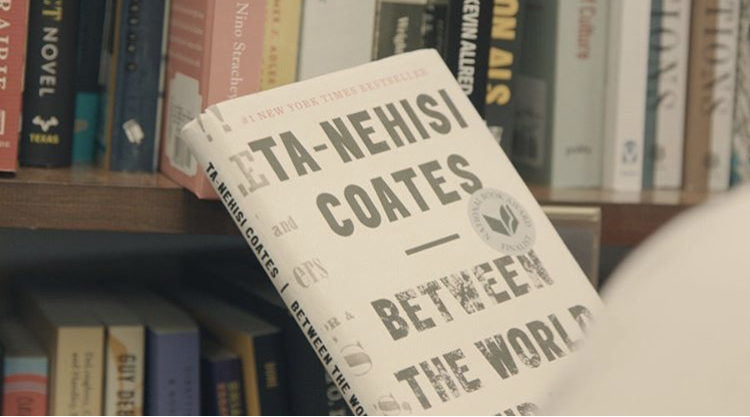
When Rekia has dismissed the class for the day, Amaya and Jaheem strike up casual conversation, that leads to them going on an adventure to find the bookstore together. They chat about the reading, the white girls from Amaya’s dance class, Chicago and the remnants of suburbia in Amaya’s hair. At the bookstore, both Amaya and Jaheem pick up copies of Ta-Nehisi Coates’ Between the World and Me, which Rekia quoted from in class.

“For the first time my eyes swayed across the page as the same pace as my hips…”

It feels only right that this episode ends with words from Dr. Stephanie Crumpton on her discussion of community based Black Girl Magic. The innovation of the professor, the teacher, reminds viewers how formative these figures are in our lives. Crumpton is spot on when she says that we do not make magic on our own; in my opinion, teachers have a very integral part in helping foster (or sometimes destroy) our magic.

Black women scholars are an integral part of this episode, and it had me wondering what it means to be a Black Professor. I often think about the legacies I am a part of, those which I uphold and those I work to change.

So from one (future) Black Professor to her someday students, here is my prayer:

I pray that I am able to care for myself. I will never be able to give you, my student, the breath out of my body. My breath is for me and God, so I pray I will be able to keep myself healthy and holy, so that I can share all that I can with you.

Know that I do this for you. I’m riding for you. I’m rooting for you. All of my struggle is for nothing if I can’t pass it on, if I can’t help to lift you up and encourage you to fly.

Which means that I jump through the hoops to put myself in the best possible position to help you.

And I write. Don’t forget that I write, but that’s for you, too. For my little sister with her nose in a book and dreams bigger than her Afro. For my brother searching for a way to make sense of the world. For my homie that needs to be heard.

I see you.

It is my dream to write about all the ways you will design to teach yourself to fly. I’m here to cultivate innovation, nourish creativity and to push you to think critically, carefully and closely.

But to be the best version of myself to carry out this purpose I read widely, reflect constantly and write fiercely because someone has to imagine a future for us, so why not me?

And everyday that you come to class, I hope you’ll realize why I have you learn the past. There is no future without looking back. We call it Sankofa, we call it Building on the Legacy.

This is the way God works through me.

And it’s worth it when I am able to open up my office door to the Black girl in my 11 AM lecture and assure her that her Black Girl Magic will level up to Black Woman Sorcery, knowing all the while God was preparing me to be a testimony.

This is the way God works through me.


Further Reading:

Between the World and Me, Ta-Nehisi Coates

For Colored Girls Who Have Considered Suicide When the Rainbow Is Enuf, Ntozake Shange

Becoming Full Professor While Black,” Marlene L. Daut