Tag Archives: Black Enough

Metamorphosis | Butterfly Wings Recap

This week’s episode of Black Enough, “Butterfly Wings,” showed many of the characters in struggle– or in the words of creator Micah Ariel Watson, in metamorphosis. Amaya endeavors to find a new look that encapsulates who she is becoming; Jaheem finds that his big bro, Dre, doesn’t rock with his rapping; and Lena stumbles in her engineering classes. Even supposedly self-assured Vaughn lets Amaya in on a little secret– she’s been rejected recently, too. The poetry that provides a narrative through line in this episode is about becoming, and it is decidedly not pretty, easy, or smooth. It is difficult and complicated, and we have to believe that it will make us into something better, otherwise the process will break us.

Perspective is hard in that moment when you are flooded with sadness, anger, anxiety…all the feelings that course through “Butterfly Wings.” In the moment that Dre tells Jaheem that perhaps rapping isn’t for him, he can’t hold on to the feeling of limitlessness that he associates with music and that viewers see just moments before in a bright shot of Jaheem rapping, surrounded by greenery like a Kehinde Wiley portrait. Lena cannot find the self-assuredness she normally exudes when thinking about her path as she cries in the bathroom after class. Only Vaughn manages to find a little perspective when Amaya compliments her hoops during their check-in, and seeming to remember herself, she replies, “You’d be surprised how much power they hold.”

Butterflies grow wings, but Black girls? We grow hoops. Gold ones.”


This episode is about growth; it’s about detaching ourselves from notions about who we believed we were and giving ourselves completely to the journey towards who we will become. It is about sitting in that hard, uncomfortable space where there is no one but ourselves and God, and being still. Then, we work to understand the power of everything that came to a head for us to be who we are in that moment. As Dr. Stephanie Crumpton says so poignantly in her interview, “your grown woman self might be like ‘I remember when I was little I wanted to take over the world’ but your grown self is the one who has to show up.” Dr. Crumpton is insistent on the battle to become– it is not magical, it is work, and one cannot forget that.

And I’m interested in that, as a scholar– how we understand, communicate and transform the battle to become. In my interview clip that’s used at the end of this episode, I discuss my interest in how we as Black people, and especially Black girls and women, take the weight, the chains, or the battles that create us and turn it into wings. I think Dr. Crumpton is absolutely right to insist on making our battle to become visible, but I want to push past this into an even more beautiful plane of existence. Where can Black girls go to become the fullest version of themselves? Where can we exist beyond our wildest dreams, and then some? Where can we take all the battles that make us and craft them not into anchors but wings that propel us higher and further? What are Black girls in our imaginations, when our imaginations are not forced into one conceptualization of the world and the beings in it? When we are allowed to take up as much space as we want, what do Black girls imagine themselves to be?

In short: What does Black girlhood and womanhood look like when we can fly?


I think Watson takes up these questions in the entire webseries, but in this episode in particular. While we may not have comprehensive answers, I do think that Black Enough as a webseries, a form of digital Black self-making, constructs the beginnings of an answer. Despite the many shortcomings of the digital, I find the self-making possibilities in this space infinite and deeply satisfying.

So it makes sense to me that Amaya would begin her journey to feeling whole in the digital.

To modify Shange, “I found God in myself [online] and I loved her fiercely.”

Further Reading:

Check out Tanisha C. Ford’s non-exhaustive list of key texts on fashion, beauty culture and body politics in an African Diasporic context: http://www.tanishacford.com/resources/

Becoming, Michelle Obama

“Alter Egos and Infinite Literacies, Part III: How to Build a Real Gyrl in 3 Easy Steps,” Jessica Marie Johnson & Kismet Nunez

Ravynn K. Stringfield is a Ph.D. candidate in American Studies at William & Mary. Her research focuses on Black women and girls as creators and protagonists of futuristic, fantastic and digital narratives in new media. She often likes to say she writes about Black girls flying. When she’s not researching, you can find her writing for her blog, Black Girl Does Grad School; learning new yoga poses; or bullet journaling.
“Straight and Easy” | Celie’s Rites Recap

Celie’s Rites,” this week’s episode of Black Enough, grapples with beauty and depicts the creation of Black women’s community around hair. Implicit in the question that returns throughout the webseries, “what is Black enough?” is “what is beautiful enough?” 

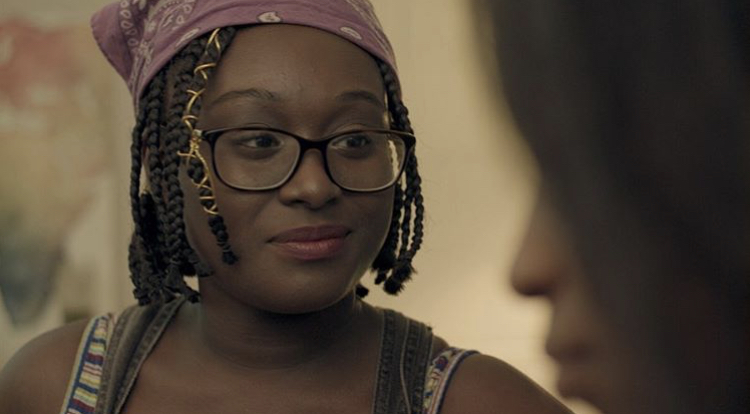
Amaya goes to visit Ember for her appointment for braids, in spite of the catastrophe that was the Weston Crown Scholars’ Spades Night. Ember is kind and takes Amaya in, a move that is perhaps also metaphorical. The music, soft and emotive, helps viewers to understand that this space, Ember’s space, is an arena in which Amaya can be all of herself. Ember deepens this feeling by telling Amaya a little about her childhood understanding of her own hair as she braids. Amaya listens carefully, and inspired by the film the two are watching (which we are to understand is The Color Purple), she offers up her own childhood hair story. 

The two girls fall into an easy silence when Ember’s roommate Hadiyah bursts in. The girls enjoy each other’s company until Dre knocks at the door, looking for Ember. His appearance sparks a shouting match between Ember and Hadiyah, during which viewers realize that Dre is Hadiyah’s ex. Forced to answer the door and cover for Ember, who is supposed to be at a meeting, Hadiyah begins to let us in on a moment of vulnerability. She screams at Ember when she accuses Hadiyah of letting Dre run her life, pleading for her to understand that she is “trying to learn to love [herself] in private again.” 

The episode ends with the three girls creating a sister circle, sealed by the sacred ritual of doing one another’s hair. Ember continues braiding Amaya’s hair, while she helps Hadiyah with hers. They are quiet after realizing they’re each going through something: Ember appears to be on a weight loss journey, Amaya is searching for God in herself, and Hadiyah struggles to remember how to love. They are all exploring what beauty means, and specifically, what it means to Black women. 

The creation of the sister circle around tending to hair is a theme that appears in other works by Micah Ariel Watson, most notably, in her production for stage, Canaan (2018). In Canaan, protagonist Louie’s affections are split between church going, good girl Lisa and activist and revolutionary Camille which causes a rift between the two girls before they even have a chance to meet. After Camille leaves a protest that turned violent, she runs into Lisa, who extends an olive branch in the form of offering to help Camille with her hair. We understand that a sisterhood is forming in that moment, much in the same way we see it in this episode of Black Enough.

Watson is in a long tradition of Black women who are interested in the way community is formed around hair, and also in beauty shops. The beauty shop becomes a public sphere for Black women, in which they can gossip, talk politics and church business, in one of the few spaces that was often for them and them alone. It also is the site where familial bonds are forged. For many, visits to the salon with their mother, auntie, grandmother, sister or cousin, became time that they belonged only to each other and could honor that. I remember always having mother’s full attention on our Saturday morning drives to the salon, as I prattled about nothing and looked forward to the inevitable stop at Dairy Queen for dinner on our way back, as I tossed my long, shiny, relaxed hair just to watch it move. As much of a Daddy’s girl as I’ve always been, I could always count on a good long conversation with my mother as she sat me between her long legs and pulled my hair into whatever style she thought was cute on those days in between our Saturday adventures to the salon.

Though Ember characterizes having relaxed hair as “straight and easy,” there are always complications with even the most seemingly effortless styles. In this case, it comes with identity questions– is it really you if your face is half hidden behind a curtain of hair that was often was never meant to hang that way? Black girls explore our inner, and outer, worlds through our hair. 

What will Amaya discover?


Further Reading:

The Color Purple, Alice Walker

Poetic Justice, directed by John Singleton

The Virtual Beauty Shop: Crafting a Digital Black Feminism in the Blogosphere, Catherine Knight Steele

Black Hair, Black Voice,” Ravynn K. Stringfield

Hair Story: Understanding the Roots of Black Hair in America, Ayana Bird & Lori Tharps


Black Excellence & Hip-Hop? | Talented Tenth Recap

Amaya tries out a new look in this week’s episode of Black Enough, “Talented Tenth.” In the last three episodes, viewers became accustomed to Amaya’s casual look, either clad in yellow shirts and dresses or decked out in her dancer gear. Lena picks at her for buying a whole new outfit to hang out with an old flame (?) in a new context, but in the end, Amaya arrives to play spades with the Weston Crown Scholars in a dashiki and earrings in the shape of the continent.

The Weston Crown Scholars are varying degrees of welcoming to Amaya. Once the game starts, the conversation turns to Barack Obama, the first Black president. The debate is lively, and revealing: Dre questions whether Obama did enough, Ember defends him and his policies, while Vaughn lands on the side believing his very presence in the White House was a political statement in and of itself. Dre accuses Vaughn of engaging in “respectability politics,” when she states that “Black Excellence” has to account for something. Eventually, they ask Amaya to weigh in and she carefully notes his introduction of ObamaCare. When the conversation spins out even further, she cites her Diaspora Studies class as the basis for her interpretation of Blackness as subjective– a move that causes Vaughn to lash out.

After Vaughn’s verbal dressing down, things move on smoothly…until Amaya reneges.

How many of y’all play spades? If you do, and even if you don’t, you probably know that reneging is one of the most telling signs you don’t know how to play. In Amaya’s case, the example is that she played a spade when she had a heart she could have played.

Yikes.


The Weston Crown Scholars are unforgiving, particularly Vaughn and, surprisingly, Tryston. What should have been just a game turned into yet another moment in which Amaya felt as if she did not belong.

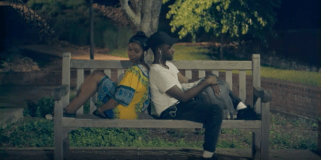
She runs out crying, only to be discovered by Jaheem as he walks home from work. He consoles her with music: back to back, they listen to music in a shot that draws directly from the original cinematic love letter to hip-hop, Brown Sugar (2002).

In a beautiful moment, deepened by “Loveyou” by KAT ft. Deja, Jaheem reaches for Amaya and tells her, “You good.” And in that moment, in the space between beats, we believe Amaya is safe.

While it would be easy to attribute that safety to Jaheem, I want to complicate that notion and consider that it’s the music, hip-hop, that throws Amaya the life line. Amaya is a dancer– music is the backdrop of her entire life. Music is dance’s soul sister, so it follows that with this song Jaheem is able to speak Amaya’s language. For once, she’s not worried about being “enough” in any capacity. Instead, she’s whole.

This is what hip-hop can do for us.


Further Reading:

The Talented Tenth,” W. E. B. Du Bois (1903)

My President Was Black,” Ta-Nehisi Coates (2017)

Beyond Respectability: The Intellectual Thought of Race Women, Brittney C. Cooper (2017)

Brown Sugar Is Still A Love Letter to the Golden Age of Hip-Hop,” Tari Ngangura (2018)