Category Archives: writing

“Straight and Easy” | Celie’s Rites Recap

Celie’s Rites,” this week’s episode of Black Enough, grapples with beauty and depicts the creation of Black women’s community around hair. Implicit in the question that returns throughout the webseries, “what is Black enough?” is “what is beautiful enough?” 

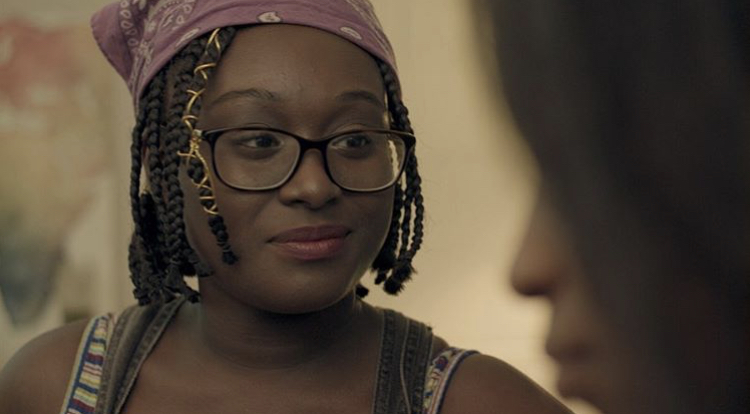
Amaya goes to visit Ember for her appointment for braids, in spite of the catastrophe that was the Weston Crown Scholars’ Spades Night. Ember is kind and takes Amaya in, a move that is perhaps also metaphorical. The music, soft and emotive, helps viewers to understand that this space, Ember’s space, is an arena in which Amaya can be all of herself. Ember deepens this feeling by telling Amaya a little about her childhood understanding of her own hair as she braids. Amaya listens carefully, and inspired by the film the two are watching (which we are to understand is The Color Purple), she offers up her own childhood hair story. 

The two girls fall into an easy silence when Ember’s roommate Hadiyah bursts in. The girls enjoy each other’s company until Dre knocks at the door, looking for Ember. His appearance sparks a shouting match between Ember and Hadiyah, during which viewers realize that Dre is Hadiyah’s ex. Forced to answer the door and cover for Ember, who is supposed to be at a meeting, Hadiyah begins to let us in on a moment of vulnerability. She screams at Ember when she accuses Hadiyah of letting Dre run her life, pleading for her to understand that she is “trying to learn to love [herself] in private again.” 

The episode ends with the three girls creating a sister circle, sealed by the sacred ritual of doing one another’s hair. Ember continues braiding Amaya’s hair, while she helps Hadiyah with hers. They are quiet after realizing they’re each going through something: Ember appears to be on a weight loss journey, Amaya is searching for God in herself, and Hadiyah struggles to remember how to love. They are all exploring what beauty means, and specifically, what it means to Black women. 

The creation of the sister circle around tending to hair is a theme that appears in other works by Micah Ariel Watson, most notably, in her production for stage, Canaan (2018). In Canaan, protagonist Louie’s affections are split between church going, good girl Lisa and activist and revolutionary Camille which causes a rift between the two girls before they even have a chance to meet. After Camille leaves a protest that turned violent, she runs into Lisa, who extends an olive branch in the form of offering to help Camille with her hair. We understand that a sisterhood is forming in that moment, much in the same way we see it in this episode of Black Enough.

Watson is in a long tradition of Black women who are interested in the way community is formed around hair, and also in beauty shops. The beauty shop becomes a public sphere for Black women, in which they can gossip, talk politics and church business, in one of the few spaces that was often for them and them alone. It also is the site where familial bonds are forged. For many, visits to the salon with their mother, auntie, grandmother, sister or cousin, became time that they belonged only to each other and could honor that. I remember always having mother’s full attention on our Saturday morning drives to the salon, as I prattled about nothing and looked forward to the inevitable stop at Dairy Queen for dinner on our way back, as I tossed my long, shiny, relaxed hair just to watch it move. As much of a Daddy’s girl as I’ve always been, I could always count on a good long conversation with my mother as she sat me between her long legs and pulled my hair into whatever style she thought was cute on those days in between our Saturday adventures to the salon.

Though Ember characterizes having relaxed hair as “straight and easy,” there are always complications with even the most seemingly effortless styles. In this case, it comes with identity questions– is it really you if your face is half hidden behind a curtain of hair that was often was never meant to hang that way? Black girls explore our inner, and outer, worlds through our hair. 

What will Amaya discover?


Further Reading:

The Color Purple, Alice Walker

Poetic Justice, directed by John Singleton

The Virtual Beauty Shop: Crafting a Digital Black Feminism in the Blogosphere, Catherine Knight Steele

Black Hair, Black Voice,” Ravynn K. Stringfield

Hair Story: Understanding the Roots of Black Hair in America, Ayana Bird & Lori Tharps


Meeting Nic Stone and Other Adventures in Friendship with Writers

Last Wednesday night, I got to meet Nic Stone.

For context, there are a bunch of contemporary Black and Latinx women writers (primarily YA fiction writers, but many of them write across genres) who I love, read frequently and carefully, and follow on Twitter and Instagram. This list includes, but is absolutely not limited to: Eve Ewing, Morgan Jerkins, Angie Thomas, Tiffany Jackson, L. L. McKinney, Elizabeth Acevedo, Tomi Adeyemi, Nina Moreno, Erika L. Sanchez, Lilliam Rivera, and, of course, Nic Stone.

Over my life, I’ve gotten more or less the same advice about writing, packaged in different forms: read widely and voraciously, and study the careers of those you admire. Naturally, with the advent of social media, watching my favs make power moves has gotten increasingly easy–as has connecting with them.

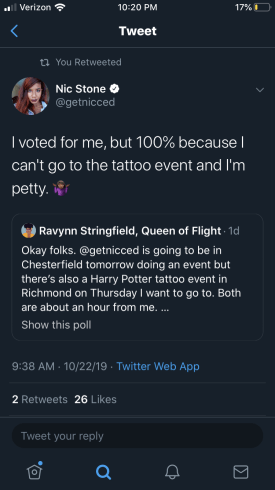
I was doing an early morning scroll through Twitter on Tuesday when I came across a flyer for a book signing and Q&A with Nic and author Lamar Giles in Richmond the next day. Up until the moment I saw that advertisement, I had been planning an impromptu trip to the city on Thursday for a Harry Potter flash tattoo event. Jokingly, I tweeted a poll asking my followers if I should go see Nic or get the tattoo, and to my surprise, Nic voted and quote-tweeted my poll, saying, “I voted for me, but 100% because I can’t go to the tattoo event and I’m petty.” The moment she tweeted that, I knew I was going to be at that book event. She seemed a kindred spirit: a Black Potterhead writer with a petty streak.

Even before the Twitter poll closed, I was already picking out my best Harry Potter themed outfit and planning my route to the Chesterfield Barnes and Noble where the event would be held. Before I knew it, Wednesday had come and I was driving an hour against the afternoon sun to meet Nic Stone.

I arrived just in time to grab a snack from the Barnes and Noble in the store before the Q&A began in earnest. Lamar and Nic are good friends, so their easy rapport and back-and-forth made me smile as Lamar volleyed Nic questions. As we neared the end of the Q&A, Lamar opened the floor up to the audience to ask folks what they thought two writers talked about. I smiled to myself as they called back, “Books!” and “Writing!” I made a mental note to tell my soul sister, Micah, about that part when I got home. Later, after I sent her the message, she laughed at the text and replied, “If only they could see our chats.”

Micah has been my writing partner in crime going on four years now. I’ve read multiple drafts of just about everything she’s written since Black Monologues 2015, and she’s my first pair of eyes on most everything I work on as well. Before meeting her, I was never brave enough to think that I could actually publish my writing. Now, I actively keep a stack of projects in my back pocket, ready to pitch at a moment’s notice. Yeah, we talk about writing and drafts and books, but we also have extremely emotional conversations about This Is Us. We have watched Brown Sugar together at the same time in different states so we can live-text each other our reactions even though we’ve both seen the film at least two dozen times. I bore her to tears with rants about Smallville and Avatar the Last Airbender and Harry Potter; she sends me playlists that she knows will take me years to actually sit down and listen to. We talk about God and Indian food; love and mental health; our hopes and our dreams. To be fair, I want to say a solid 90% of them involve writing–but our conversations are as wild as our dreams.

I was thanking God for my soul sister while I watched Nic and Lamar talk, really seeing what a difference it makes to have writer friends.

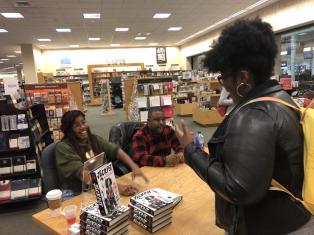
I waited for about an hour in line to get my books signed, making friends with some nice librarians and a high school English teacher (who was incidentally a W&M alumna) as the line inched forward. Finally, it was my turn. I walked up to the table, suddenly realizing I’d been standing there for an hour and I had come up with nothing to say to either Nic or Lamar. Fortunately, Nic noticed my Deathly Hallows t-shirt, which gave me the opening to tell her I was the girl from the Twitter poll she’d retweeted. One of my librarian friends, who I had handed my phone to for pictures, managed to capture the exact moment when Nic gleefully remembered the tweet and by extension me. She also captured the joy on my face when Nic hopped up to give me a very genuine hug.

FullSizeRender-6

A little stunned, I managed to tell her and Lamar a little about me while Nic signed my copy of Dear Martin and Jackpot: that I was a Ph.D. candidate by day and a YA writer/essayist by night; I researched Black women and girls in new media fantastic, digital and futuristic narratives; and that I looked up to folks like her and Lamar. Both of them were warm and engaged as I struggled to make coherent sentences. Finally, after she realized that I was a Ravenclaw, that you could make the “Ravynnclaw” pun and adjusted my personalized autographs in the books to reflect this discovery, I got my picture with both of them, packed up my books, and headed home.

Meeting Nic was amazing for so many reasons. How often do you get to meet a NYT Bestselling author? How often do you get to hug one? Or get a book signed? But beyond that, she met me with real sincerity and interest. It would have been so easy for her to shrug it off when I said I was a writer, but her immediate response was: “Are you working on something?” In a few short moments, we bonded over Harry Potter and tattoos, as well as the craft.

That night, when I got home, and she liked and responded to many of my fangirl tweets about the event, I thought about how lucky Nic’s friends are to have this genuine person in their lives that also happens to be a talented writer.

And then I remembered, as I excitedly sent Micah photo after photo, videos and voice memos as I sat in bed, that I am lucky to have a very genuine person in my life, that also happens to be a very talented writer.

Writers need writers. But we also need friends.

It’s awesome when they’re both.


If you’ve loved the last 150 Black Girl Does Grad School posts, consider supporting me on Ko-Fi!

Writing (and Defending) A Prospectus

In my Ph.D. program, after successfully completing your comprehensive exams, you then produce a prospectus. The prospectus is, in many ways, a speculative document. Think of it as a proposal for the dissertation: you are creating something that outlines the main research questions, the methodology, the existing literature, and your proposed intervention, while also giving your committee a sense of your timeline to completion. A prospectus is multi-faceted and multi-functional, thereby making it one of the most difficult genres of writing.

To start writing my prospectus, the first thing I did was check my handbook to see what the parameters and expectations were. These were the instructions given:

“The prospectus will give a full description of the inquiry to be undertaken. It will identify an issue or problem, explain how this bears upon or intervenes in a particular field of scholarship, relate the topic to previous and on-going works, detail the several parts of the project and show their interrelations, name the key primary sources, outline the principle methods, and suggest a timetable for completion. Such a prospectus should run between 3500 and 5000 words (approximately 14-20 pages) and should include as a supplement a bibliography of the principal primary and secondary sources.”


Next, I broke this up into sections that I knew I needed to answer:

  • Description of the inquiry
  • Identify an issue or problem
  • Explain how this intervenes in a field of scholarship
  • Relate the topic to previous or on-going works
  • Detail the parts of the project
  • Name the sources
  • Methodology
  • Timetable to completion

After I had the barebones structure, I reached out to a few trusted colleagues who were ahead of me in the same program, hoping to see their prospecti. I asked for and received about three prospecti to examine. Looking at their documents gave me a sense of how to structure my own.

Admittedly, I did something a little unconventional in terms of writing my first draft. The week after my oral comprehensive exam, I did a week long writing retreat sponsored by William & Mary Libraries, and spent five entire days just writing. I simply worked on drafting responses to each of the sections, and took advantage of being in the library to help build my bibliography and source material. By that Friday, I had a 20 page outline for what would eventually become my prospectus.

Following the retreat, with the exception of adding a section about the creative component I wanted to produce, I left it alone for almost the entire summer, coming back to it just before the start of the fall semester. Being able to leave it was a Godsend because I was able to reapproach my questions and methodology with fresh eyes and new ideas. I spent about two weeks stitching together my blocks of text, smoothing them out, connecting them more seamlessly until the document flowed as a cohesive unit.

Once I was happy with the way it read, I started to send it out to my chairs. Both offered substantive content and structural edits, which I took to heart and used to make my prospectus stronger.

After making the appropriate edits, I emailed the professors who would serve as my committee for my Prospectus Colloquium. In many programs, the defense of the prospectus is a much bigger deal than it is in mine. For some, one is not considered a candidate or “All But Dissertation” (ABD) until successful completion of the prospectus defense. In my program, we don’t even consider the colloquium “a defense;” it’s much more of a conversation about the project, a low key way to offer feedback that should propel you forward and help mold your path further.

Indeed, my colloquium was just that. Everyone was pleased with my proposed project, my methodology, my conversation with theorists, my proposed research and the creative component. They offered a few suggestions of note which would help me structure my chapters and overall narrative. Despite the project being “innovative” and “trail-blazing,” one of my chairs had very valid concerns about my work being legible in a way that would secure me a job.

I’m not sure I allayed her fears when I informed her that I’m not worried about being legible to older, white folks on search committees. My work is for Black girls that were and are like me. As long as I’m writing for them, I’m walking in my purpose and that is all I can ask for. Like I told my mother after the colloquium, I’m at a point where I’m no longer super concerned about landing a job in the Academy after I finish the Ph.D. I have so many skills and passions that something will turn up for me. That said, I have never been one who believed in simply waiting for things to fall in my lap. You must stay sharp and prepared so when opportunity comes knocking, you are ready. For me, that means getting my work out there in a variety of ways so that when the right opportunity comes, I can take it.

For the time being, I need to consider my next steps, which includes making an obnoxious, color-coded outline for my dissertation; pasting a timeline (also color-coded) to my bathroom mirror; creating a dissertation hashtag; and opening a new file in Scrivener. So that’s what I’m doing this weekend.

I’m ready to begin in earnest.


If you are a graduate student in American Studies or a related field, and need help formulating your prospectus, I am happy to send mine along. Just reach out via email or DM and say a little about who you are, what your project is and how you think seeing my prospectus could help you along.