Category Archives: Uncategorized

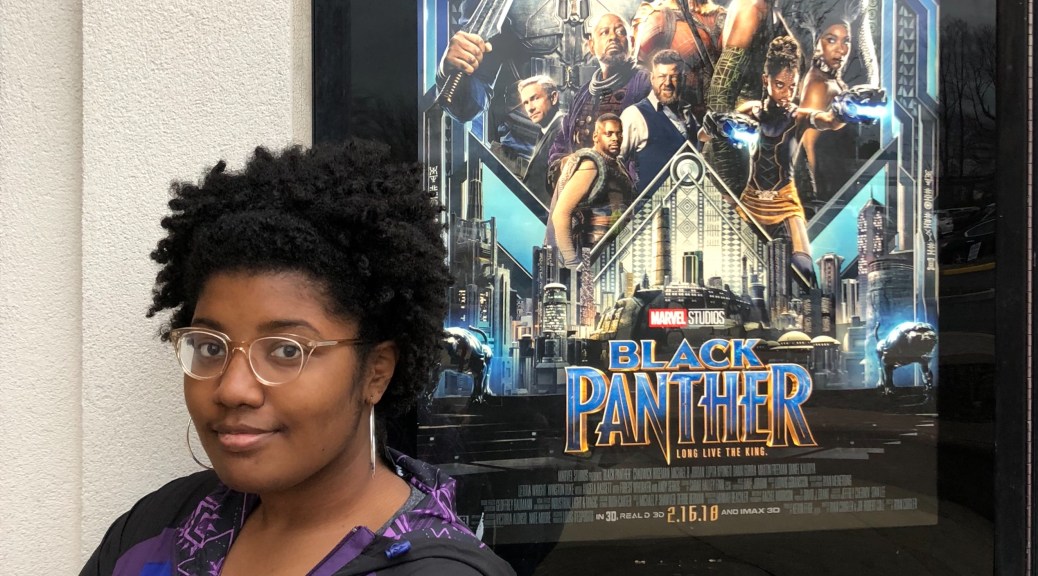
Week 5, or Confessions of Black Panther Scholar

WARNING: Black Panther spoilers ahead.

I was worried I wouldn’t love Black Panther.

I’m an aca-fan, a term that scholar Henry Jenkins uses to denote someone who is a fan of the things they study. I’m an aca-fan of Black Panther, in a very serious way. I have so much personal investment in the character, the narrative, and the authors that Black Panther turned into the focal point of my Master’s thesis.

I spent so much time wading waist deep in the comics from the late 1960s, critiquing, speculating, diving for meaning, that I worried I would not be able to simply enjoy the Black Panther film. Coupled with my anxieties about still enjoying the film were the expectations regarding my response. People laughed when I said I was not planning to write anything about Black Panther. I had inadvertently become– to some– an authority on Black Panther. I don’t believe that I am and to be frank, I don’t want to be. It doesn’t give you space to make mistakes, learn, grow. I am a Black Panther scholar with lots of questions I need to ask and still more to learn. I was worried that people would be expecting too much of me and I think that worry robbed me of a little of my joy in the weeks leading up to the film.

I tried my best to separate my academic self from my fan self so I could enjoy the film, but in the same way I cannot tear my womanhood from my Blackness, I was not able to do so. But I am so glad that I couldn’t– because it makes my love for Black Panther all the more rich.

So here are my top three favorite things about the Black Panther film:

  1. The diverse displays of Black womanhood. My favorite thing about Black Panther is all of the amazing Black women that surround him. Shuri represents a force in the STEM field, while managing to provide most of the laughs in the film, keeping her brother on his toes and also still managing to kick a little ass. Nakia gives T’Challa the Wakandan equivalent of a “Boy, bye” when he tells her if she weren’t so stubborn, she’d make a great queen. And Okoye– by far my favorite of all the fearless and strong women that make up the cast of characters in Black Panther. She gets to strike fear into the hearts of her enemies, deliver some of the funniest lines, and be in love with with her partner and her country. Needless to say, I’d drop out of grad school in a heartbeat if it meant I got to join the Dora Milaje.
  2. Killmonger as a character and the fact that he is driven by desire to liberate African Diasporic peoples. Michael B. Jordan as a person is a fan favorite for me but as Killmonger he was impeccable. Killmonger, in this rendition, is a Black liberationist. T’Challa and Killmonger are represent two strands of a potential strategy for liberation, and, to be honest, Killmonger’s arguments were compelling.
  3. The actual space of Wakanda. Walking into theaters filled with excited Black people made the on screen space of Wakanda even more real. My love letter to Wakanda would include a line about my pride for this powerful, culturally rich nation. It would praise the traditions and the King. It would give thanks for providing a space for me to be the fullest, most uncontained version of myself. My love letter to Wakanda would include how glad I am simply for Wakanda to exist, even if just in my imagination. Wakanda is real. It is my home. It is my heart. This is why representation matters.

Since Thursday, I’ve seen Black Panther three times. It gets better every time. I love it more every time. The characters become my friends. Wakanda becomes my home.

Maybe someday I’ll write that think piece that everyone is waiting for. But today, I just want to enjoy Black Panther.

Wakanda Forever.

Week 4, or Meeting Henry Jenkins

One of my favorite things about being in grad school is getting to meet people. Through conferences, public seminars and video calls, I’ve gotten to meet amazing people, including quite a few authors whose work I’ve come across in course work. Within just the last two weeks, I’ve been able to talk with Dr. Johnnetta Cole (a post about that experience can be found here) and, this past week, Dr. Henry Jenkins.

I first encountered Henry Jenkins’s work as an undergrad in a required critical theory course for my Comparative Literature major at the University of Virginia. After stuffing my head full of Althusser, Freud, and Barthes all semester, I distinctly remember finally being able to breathe– I could finally read an article once and get the gist of it. Not only did I understand, I was enthralled by his discussion of fan culture. As an avid Tumblr user at the time, I didn’t know that there were people who studied and talked about communities in which I belonged. Jenkins was my key to understanding that not everything academic had to be dense and difficult to engage.

My second encounter with Jenkins’s work was just last semester in my New Media, Old Media class, in which we read Convergence Culture. As we read through case studies of collective participation through Survivor spoilers and political activism through Harry Potter, I found myself again utterly inspired by the clarity of Jenkins’s prose and the innovativeness of his ideas. My ideas were no longer an island. Through Jenkins I found a way to ground my work and a model for moving forward.

Getting to meet Dr. Jenkins in person, therefore, was quite an experience. Liz Losh, my professor and mentor through the Equality Lab, arranged for a group of us to have a private lunch with Dr. Jenkins, during which we had an informal conversation. The conversation produced questions such as how do you stay true to yourself as you pursue work as a scholar? How do you withstand disappointment and critique? Do you have any writing tips? All questions to which Jenkins had generous and “therapeutic” answers. He told us all writing is rewriting, encouraged us to write with colleagues and develop an online presence. He told us about his personal experiences with being openly and somewhat hostilely critiqued and encouraged us to take a high road– engage, cautiously, and look for points of commonality and misunderstanding rather than investing yourself in a counter attack. And most importantly, I think, he encouraged us to think of doing interdisciplinary work as “undisciplined,” in the best way. This means that we should not limit ourselves based on discipline but follow our interests as far as they take us, borrowing from whatever toolkits we have available, using whomever we find inspiring, to come up with exciting new ideas. Strictly following the rules of any one discipline will only get us so far. We are the intellectual entrepreneurs. We are the undisciplined.

That night, after the excellent lunch, I attended Jenkins’s public lecture in which he discussed the civic imagination, its functions and results. It was a multifaceted presentation which drew from a broad range of sources: from Foucault to Stuart Hall, Superman to J. K. Rowling, Black Panther to Ms. Marvel. In essence, the talk encouraged us, the audience, to think of the civic imagination as something that can help better the world: it can help us imagine a process of change, imagine the self as a civic agent, and imagine the experiences and perspectives of others. This is what helps us go out into the world and create better futures based on what we have imagined.

Dr. Henry Jenkins is a self-proclaimed optimist. It was refreshing to encounter someone so celebratory after learning to do nothing but critique for a year and a half. He’s inspired me not to give up on my ambition to become a public intellectual, because public-facing academics are what we need. He reminded me to think of the real root of the word that will become my career: professor, or one who professes. Knowledge is not mine to hoard but something which I profess. Now that is something I can believe in.

Week 3, or Student Activism

One of the best things about my life as an American Studies graduate student this year is my role as an assistant to the Lemon Project: A Journey of Reconciliation. I’ve written about the Branch Out Alternative Break that I’ve done with the Lemon Project, yet never about the other responsibilities that I have. As a project committed to rectifying wrongs perpetrated against African Americans by the College of William & Mary, we bridge the gap between the College, community members and the greater Tidewater area through research, community outreach and student engagement. We are responsible for putting together an annual report on the Lemon Project’s findings and other engagements, putting on an annual Symposium, organizing a Alternative Break trip that is public history oriented, and orchestrating a couple of smaller gatherings (Porch Talks) every semester.

The idea behind the Porch Talks is that they would be informal gatherings where you learn from your elders. The topics would be pertinent to the Lemon Project’s mission or things that are relevant to the College or community. I was deeply excited for the first Porch Talk of this semester on Student Activism because it was my brain child. The Lemon Project team went to a symposium on slavery last fall at the University of Virginia, where my coworker, Sarah and I, attended a panel on the removal of Confederate monuments at Clemson University. One of the panelists, an undergraduate student named Khayla Williams, stood out to us. Passionate, quick-witted, and oh so smart, Khayla was the portrait of successful student activism. As we listened to her story about how a group of students at Clemson had staged a ten day sit-in (now referred to as the Sikes Sit-In) and how the administration had begun to listen afterwards, we knew her experiences and her story might be a valuable one for student activists at William & Mary to hear.

After the panel, I gave her my card and she e-mailed me, which began a steady stream of correspondence in which we arranged for her to visit the College to give a talk similar to the one she had given at UVA.

Before I knew it, February 1st was here and I was eagerly awaiting her arrival for her talk that evening. 5 o’clock came and I was astounded at the turn out. We had amassed a substantial crowd of around twenty or so people primarily composed of undergraduate students, an atypical make up for Lemon Project Porch Talks. After I introduced Khayla, I sat with my camera out, ready to take the occasional photograph, when suddenly, I found myself enthralled by her words, eagerly taking in every bit. She spoke about herself, how she came to activism, how the term activist was strange to use to describe herself, yet one that she accepted. She spoke about Clemson, about the culture, about the Sikes Sit-In. And she spoke about what they did after the Sit-In to keep the momentum going. Her suggestions were encouraging and manageable. Khayla suggested that first, we continue to talk about the event after it happens. Educate younger students about how and why protests have occurred so they can pick up where you left off. She suggested, second, to work in teams. You need a variety of people to make a movement happen. And finally, she reminded us to make it bigger than a one organization problem. An incident of racism shouldn’t just be a BSO problem– it should be a school wide problem. Make it so.

I was impressed with how she commanded space so easily and how conversational her talk was. It flowed neatly into a workshop, where she came prepared by looking into incidents which had happened at William & Mary and helped students work through how they could then organize to address these problems. Her suggestions were primarily based on things which had worked at Clemson: a sexual assault alert system, making demands of the administration, keeping a record– but that was the key, these things had worked. I hoped the students in attendance understood her point that her suggestions were “not a blueprint” but also understood that these were actionable things.

I’m glad William & Mary students got a chance to meet Khayla. Sometimes it’s nice to have a fresh pair of eyes on your situation to give you some perspective. I don’t think Khayla gave them any answers (though she never claimed to, and at any rate who could?) but I do think she gave them something to consider as they move forward onto whatever their next activist project may be and, hopefully, some perspective.

I dropped her off at the airport after passing an amicable hour alternatively chatting and humming to the radio. As she walked through the doors, I found myself thinking about how much I learn outside of the classroom and from people who aren’t my professors. I’m so grateful for my assistantship with the Lemon Project, which forces me think critically in a different way and has brought me so many teachable moments.