Category Archives: Dissertation

The Big Chop | Beneatha, 2019 Recap

In the penultimate episode of Black Enough’s first season, “Beneatha, 2019,” Amaya has finally worked up the courage to do what has been on her mind since she first concocted the idea of a Black Girl Magic Potion in episode 1: The Big Chop.

For those that are unfamiliar with the term, The Big Chop refers to the haircut one gets to go from relaxed hair to natural. The Big Chop comes in a variety of packages. Some folks transition for a few months (or a few years) before cutting off their relaxed ends; some make the decision and the hair is gone days, even hours later. Some people go into salons, and some do it themselves in the bathroom mirror.

The reactions to chopping one’s hair is equally varied. It stirs up feelings of joy, release, anxiety or shame– sometimes all of the above and more. As Watson has explored over the course of this season, there is a lot of value and significance tied up with Black hair. It was never just hair. And for some of us that eventually undergo the Big Chop, we do so because we realize that we have little or no memory of our hair in an unaltered state. Though it’s unclear from the narrative, one might assume that Amaya falls into this camp.

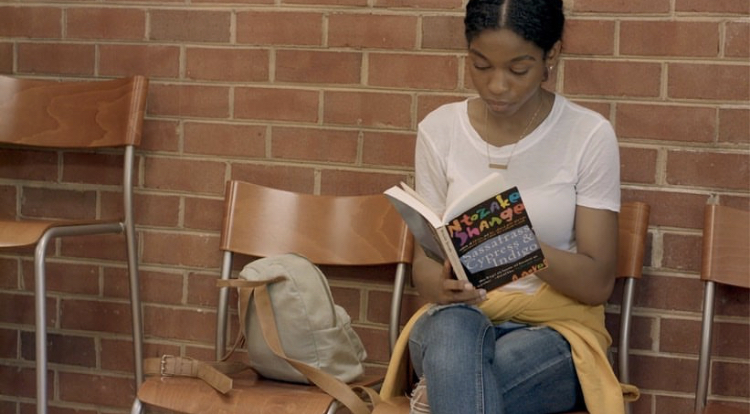
As she waits for her turn in the salon chair, Amaya pulls out Ntozake Shange’s Sassafrass, Cypress and Indigo to read while she waits. This choice is all too appropriate. Amaya is about to undergo one of the most important, most magical transformations of her life, and she holds in her hand a book about and made of magic. (Remember that first line: “Where there is a woman there is magic.”) Shange’s novel, like much of her writing, weaves together forms and stories to create Black women’s narratives so that we aren’t run into the ground under the weight of the narratives society tells about us. It pulls together pieces and bits to create something new, much like how Amaya has been quietly adding and crossing off ingredients to her Black Girl Magic Potion over the course of the season.

The salon becomes a cocoon, an incubator, for Amaya, as does the book. Both are spaces of retreat and refuge where one might turn inward, but also that of unbecoming in order to transform. When Amaya steps out of the salon, she is not, and cannot be, the same person she was before.

And that feeling of knowing that you can’t turn back is heavy. It’s mixed with things you didn’t even know you could feel. Amaya has to sit with the realization that she is different, the feeling of not immediately recognizing yourself when you look in the mirror– and dealing with why that is.

Anyone who has ever Big Chopped knows the struggle. It’s that awkwardness of trying to make your outward appearance match what’s going on in your head and in your heart. It’s that discomfort of stepping out what you knew and into the unknown. It’s the realization that you’re going to have to learn yourself all over again.

It’s all of that and more.

It was never just hair.

Further Reading

Sassafrass, Cypress and Indigo by Ntozake Shange

A Raisin in the Sun by Lorraine Hansberry

Looking for Lorraine: The Radiant and Radical Life of Lorraine Hansberry by Imani Perry

“My daughter is the reason I wear my hair curly,” Taylor Harris, Washington Post, Feb. 2017

Ravynn K. Stringfield is a Ph.D. candidate in American Studies at William & Mary. Her research focuses on Black women and girls as creators and protagonists of futuristic, fantastic and digital narratives in new media. She often likes to say she writes about Black girls flying. When she’s not researching, you can find her writing for her blog, Black Girl Does Grad School; learning new yoga poses; or bullet journaling.
Black Love Night | The Funk In Your Right Recap

Who was your first love? Episode 11 of Black Enough, “The Funk in Your Right,” takes up the question as Amaya and the crew attend BSU’s “Black Love Night.” The event features artistic expression around the theme of Black love. Judging by the expressions on several of the audience members faces, the first performer we’re introduced to (“Zora Assata Baraka X”– admit it, you giggled) is a little lackluster, so expectations are low.

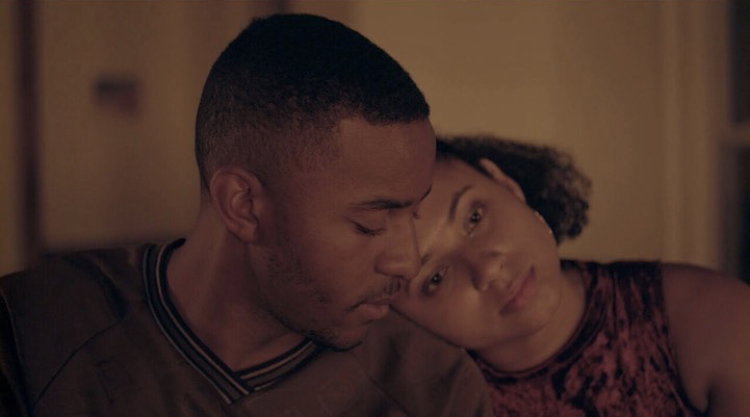
But when Nora Obi (played by guest star Hanna Watson) takes the stage to perform a spoken word called “Second Love,” a whole new world, full of new relations and wonder, unfurls before viewers’ eyes. While many in the audience are enraptured by Nora’s words, Amaya begins to curl into herself, literally and figuratively, seemingly attempting to distance herself from the rush of emotions Nora is awakening for her. Ember and Jaheem are appreciative of the performance, but Dre takes the opportunity to steal glances at his ex, Hadiyah– even though his current girlfriend is using his shoulder as a pillow. And before the performance even begins, Tryston responds to an inquiry about Amaya from Dre (“That you?”) with, “Somethin’ like that.” The map of relationships between characters has gotten messy in a matter of minutes, all thanks to Nora’s mastery of wordsmithing.

The episode is bookended with interviews from both Kemi Layeni and Freda Assuah. Kemi discusses how her expectations of college and love were shaped by the popular show A Different World. And in truth, what Black college student who watched A Different World before or during college didn’t have unrealistic expectations about what the undergraduate experience would hold for them? (While ADW had a profound impact on my expectations of love, my parents meeting at ages 5 and 6 was the relationship that really shaped my ideas about love.)

This episode also calls back to a moment from over four years ago for me, from the first Black Monologues at the University of Virginia. The script included three Love Letters, written by Black women in the cast and crew, to their loves, one night stands, and to Black men at UVA at large. Four years ago, I remember watching friends perform Love Letter Number 1, which was written by my now dear friend, about her Black Love, and this September, I had the privilege to watch those two embark on a lifetime of adventures together in marriage.

Watson’s long standing interest in depictions of Black love do not stop at romantic love. They also involve friendships (“Celie’s Rites” and Canaan [2018]), love of Jesus (a thematic arc through all of Watson’s work), and love of self, as we see in the final interview of the episode with Freda Assuah. Assuah reminds us that coming to self-love is a process, a practice that is often learned and cultivated.

Black Enough does a beautiful job grappling with all of these different layers to love over the course of the season, and in this particular episode. What is striking is that all of these components are equally important, no one overshadowing the other, working together in harmony. It points to the multi-faceted and complex nature of us as Black folks, as humans, and allows for us to be and feel everything all at once with no fear.


Beautiful Quotes from “Second Love”:

  • “But in dust he saw soil/where he could he plant himself and grow his whole world”
  • “See the earth is heavy when you don’t look to heaven”
  • “Love who sees all of me and stays anyway”
  • “Will you beatbox to my heartbeat when you think of me because you know my rhythms?”
  • “Beloved, be loved by Him”

Further Reading:

Hanna Watson, The Poet

Love Jones (1997)

A Different World (1987-1993)

Feminista Jones’ sex and love column at Zora Mag, XOXO”

Ravynn K. Stringfield is a Ph.D. candidate in American Studies at William & Mary. Her research focuses on Black women and girls as creators and protagonists of futuristic, fantastic and digital narratives in new media. She often likes to say she writes about Black girls flying. When she’s not researching, you can find her writing for her blog, Black Girl Does Grad School; learning new yoga poses; or bullet journaling.

“When we see water, we see death” | Wash Day, 1955 Recap

In lieu of a traditional blog post, this week’s episode of Black Enough, “Wash Day, 1955,” necessitated a break down. The spoken word poem, performed by Micah Ariel Watson herself, includes deep currents of history that bridge to the present and beyond. So in the spirit of weaving, I have annotated a piece of the spoken word, complete with links and as always, further reading:

When we see water, we see death.

400 years of life flashing before your eyes.

400 reasons to stay on the shore:

We are currently commemorating the 400 year anniversary of enslaved Africans being brought to America. As a graduate student living in Williamsburg, Virginia, I know the anniversary is heavy on everyone’s mind: from student work commemorating the occasion to the Association for the Study of Worldwide African Diasporas conference which was recently held in the city, we are actively looking for ways to pay proper tribute. One of the most compelling lectures I’ve heard about the difficulty acknowledging Black people in the Historical Triangle is Mark Summer’s, of Jamestown Rediscovery, talk, “The American Heartbreak.”

Reason number one too many bones dissolved into dust on the ocean floor

Reason number no one ever asked us to climb aboard–

They took is in droves too tragic to count into waters

In the “Further Reading” section of this post, I have listed several monographs, particularly those by Black women, whose histories of enslavement have been critical to my understanding of the Middle Passage and beyond. These readings include: Scenes of Subjection (Hartman), Saltwater Slavery (Smallwood), and The Price for Their Pound of Flesh (Berry).

Reason number $5.59 for a box of Dark and Lovely

I worked too hard for my respectability to get it wet

As Tanisha C. Ford discusses at length in the chapter, “Jheri Curl,” from her book Dressed in Dreams, hair has been used as a vehicle to communicate one’s politics, as well as communicate one’s identity.

Reason number twelve million stolen dreams

“What happens to a dream deferred?

Does it dry up

like a raisin in the sun?

Or fester like a sore—

And then run?

Does it stink like rotten meat?

Or crust and sugar over—

like a syrupy sweet?

Maybe it just sags

like a heavy load.

Or does it explode?”


Langston Hughes, “Harlem”

Reason number 1619, the beginning of being drowned by the land of the free

Reason number 1896 brings us to reason number 2 separate but equal fountains that said my water was inferior


Watson calls back to the Plessy v. Ferguson case of 1896, which established “separate but equal,” legalizing segregation. Despite the order to have equal facilities, Black facilities were poorer and lacked support from the government.

Plessy vs. 6 shots fired in Ferguson

Vs. “I don’t even let my son play with water guns.” for fear that it might kill him

This smart line references both the fatal shooting of Michael Brown in Ferguson, Missouri in August 2014 and the shooting of Tamir Rice, a 12 year old Black boy, whose crime was to be holding a water gun, later that very same year.

Reason number this ain’t old news

Reason number 1955

We found Emmett Till’s body in the Tallahatchie

Emmett Till was a 14 year old Chicagoan visiting family in Mississippi the summer of 1955 when he made the mistake of “offending” a white woman. Shortly thereafter, he was found horribly mutilated in the Tallahatchie River. His mother, Mamie Till, insisted on an open casket funeral so that the world could see what white men had done to her child.

So you can miss me with that Mississippi Wade In The Water

It’s already been troubled

The Negro spiritual, “Wade in the Water,” includes the line: “God’s gonna trouble the water.” I’ve included a link to an Alvin Ailey dance performance to the song because something about the movement and the song together pierces my soul, and I think it might be impactful for you.

So why on earth would we surround ourselves in something that we can’t even taste?

I mean if Flint was the only water you H2knew, wouldn’t you be afraid to drink, too?

Let alone immerse your whole body into a lead poisoned pool.


Flint, Michigan has been without clean water since April 2014 and has birthed the rise of young activists such as Mari Copeny, whose childhood was disrupted by water crisis.

When we see water, we see death.

*

Further Reading:

*The 1619 Project in the New York Times, August 2019

*American Heartbreak, Langston Hughes

*Saltwater Slavery: A Middle Passage from Africa to American Diaspora, Stephanie E. Smallwood

*The Price for Their Pound of Flesh: The Value of the Enslaved, from Womb to Grave, in Building a Nation, Daina Ramey Berry

*Scenes of Subjection: Terror, Slavery and Self-Making in Nineteenth-Century America, Saidiya Hartman